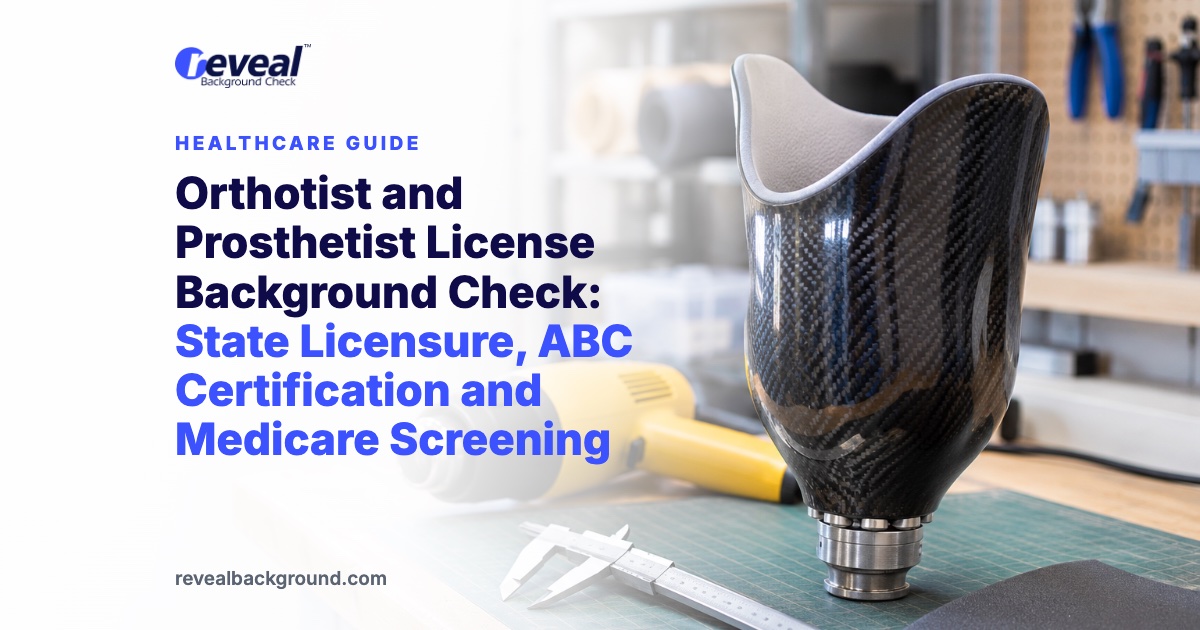
Orthotists and prosthetists design, fit and adjust braces, limbs and other custom devices for patients who are often recovering from surgery, injury or a progressive condition. Because the work touches direct patient care, involves custom medical devices, and frequently bills Medicare or Medicaid, hiring for these roles sits at the intersection of three separate screening systems: state professional licensure, voluntary certification through a national credentialing body, and federal program integrity screening tied to Medicare billing. Employers who only check one of the three can still end up with a practitioner who cannot legally bill for services or who should not have patient contact at all.
Does every state license orthotists and prosthetists?
No. State licensure for orthotics and prosthetics practitioners is not universal. A number of states, generally cited at around fifteen, have a dedicated licensure law for the profession, while many others have no state license at all and rely on national certification and Medicare supplier rules to set the practice standard. Where a state does not license the profession, say so plainly to an applicant rather than asking for a credential that does not exist there; the Medicare program itself recognizes this split, and its supplier rules explicitly account for personnel who practice in a state that does not offer licensure for orthotic and prosthetic practitioners (see the Medicare standard discussed below).
Georgia is a useful, verifiable example of a state that does license the profession. The Georgia Composite Medical Board licenses orthotists and prosthetists and requires applicants to submit references, verified work history, official transcripts, and proof of passing the certifying examination administered by the American Board for Certification in Orthotics, Prosthetics and Pedorthics as a condition of licensure. The Georgia Composite Medical Board’s orthotist and prosthetist licensing page lists these application requirements directly. The underlying administrative rule, filed with the Georgia Secretary of State, spells out two paths into the profession: a degree based path through an accredited education and residency program, or an experience based path for applicants with an associate degree and several years of supervised work in the field, with both paths converging on the same certifying examination requirement. That rule is published at Georgia Administrative Rules Chapter 360-31. Employers in any state should always confirm the current licensure rule for orthotics and prosthetics directly with that state’s own licensing board or health department rather than assuming another state’s requirements apply.
ABC and BOC certification versus state licensure
Separate from any state license, two national bodies issue the credential that most employers, insurers, and licensing boards treat as the practice standard: the American Board for Certification in Orthotics, Prosthetics and Pedorthics and the Board of Certification/Accreditation. Both credential orthotists, prosthetists, pedorthists and related technicians through examination, supervised residency, and continuing education. In states that license the profession, passing one of these examinations is typically built directly into the state licensing requirement, as Georgia’s rule illustrates. In states without a license, the national certification functions as the primary qualification check available to an employer, and verifying that the certification is current and in good standing with the issuing board is a reasonable step before an offer, separate from any criminal history check.
| Screening layer | What it confirms | Who runs it |
|---|---|---|
| State professional license (where one exists) | Legal authority to practice in that state, education or experience pathway, discipline history | State medical or health licensing board |
| National certification (ABC or BOC) | Examination, residency and continuing education standards for the profession | The certifying board itself, not a state agency |
| Medicare DMEPOS supplier standards | Whether the business and its personnel meet federal conditions to bill Medicare for orthotic and prosthetic devices | Centers for Medicare and Medicaid Services, through its enrollment contractors |
| OIG exclusion screening | Whether a person or entity is currently barred from federal health care program participation | HHS Office of Inspector General, searched by the employer |
| Criminal history and FCRA background check | Reportable criminal history consistent with the FCRA and applicable state law | Employer, through a consumer reporting agency, with disclosure and authorization |
Medicare DMEPOS supplier standards and state licensure
Orthotic and prosthetic devices are billed to Medicare as durable medical equipment, prosthetics, orthotics and supplies, commonly called DMEPOS. A business that wants to bill Medicare for these devices must enroll as a DMEPOS supplier and meet the supplier standards set out in federal regulation. Those standards tie directly back to state licensure: the regulation requires that orthotic and prosthetic personnel either hold a state license, where the state offers one, or practice in a state that does not offer licensure for the profession. The full standard, along with related conditions, is published at 42 CFR 424.57, DMEPOS supplier standards in the electronic Code of Federal Regulations.
The same regulation gives Medicare administrative contractors grounds to revoke a supplier’s billing privileges for a federal or state felony conviction within the preceding ten years, or for an exclusion or debarment from a federal or state health care program. That means a DMEPOS supplier’s Medicare billing status can turn on both the individual practitioner’s license status and the practitioner’s criminal and exclusion history, which is exactly why employers in this space generally need more than a single screening step before someone is placed with patients or allowed to bill under the practice’s Medicare number.
OIG exclusion screening
Separate from state licensure and from a criminal background check, federal law bars certain individuals and entities from participating in Medicare, Medicaid and other federal health care programs. The Department of Health and Human Services Office of Inspector General maintains the List of Excluded Individuals and Entities, a searchable database that health care employers use to confirm that an applicant or current employee is not currently excluded. Billing Medicare for services performed, ordered or supervised by an excluded individual can create liability for the employer, independent of whether that person otherwise holds a valid state license or national certification. The database and guidance on how to search it are published by the HHS Office of Inspector General’s Exclusions Program. Many health care employers, including orthotic and prosthetic practices that bill federal programs, check this list at hire and on a recurring basis afterward, since an exclusion can be added after the start date.
Criminal history disclosure and the FCRA
When an employer orders a background check report from a consumer reporting agency to evaluate an orthotist or prosthetist candidate, the Fair Credit Reporting Act and its implementing rule, Regulation V, set the procedural requirements regardless of whether the state licenses the profession. The employer generally must provide a clear, standalone disclosure, obtain the applicant’s written authorization, and, if the employer intends to take an adverse action based on the report, provide a pre-adverse action notice, a copy of the report, and a summary of the applicant’s rights, followed by an adverse action notice if the decision stands. The CFPB’s overview of Regulation V, which implements the FCRA’s consumer reporting and disclosure requirements, is published at Regulation V, Fair Credit Reporting. What a background check report actually surfaces about criminal history varies by state law and by how far back a reporting source goes, so employers should not assume a check will show every record in every state, and should rely on the FCRA process rather than any single database as the final word.
Practical screening checklist for employers
- Confirm whether the practice state licenses orthotists and prosthetists, and if so, verify the license directly with that state’s board rather than relying on the applicant’s documents alone.
- Verify that ABC or BOC certification, where claimed, is current and in good standing with the certifying body.
- If the practice bills Medicare as a DMEPOS supplier, confirm the practitioner meets the applicable supplier standard for state licensure or lack of a state licensing requirement under 42 CFR 424.57.
- Search the OIG exclusions database before hire and on a recurring schedule afterward.
- Run a criminal history background check through a consumer reporting agency with proper FCRA disclosure, authorization and adverse action procedure.
- Document each step, since a Medicare program integrity review or a state board complaint may ask for evidence of the screening that was performed.
Frequently asked questions
Do all orthotists and prosthetists need a state license?
No. Only a subset of states, roughly fifteen, currently license the profession directly. In states without licensure, national certification through a body such as ABC or BOC generally functions as the primary qualification standard.
Is ABC or BOC certification the same thing as a state license?
No. ABC and BOC are national certifying bodies, not state government agencies. In states that license the profession, passing the certifying examination is usually one of the state’s licensure requirements, but the certification itself is issued by the certifying board, not the state.
Why does Medicare care about state licensure for this profession?
Medicare’s DMEPOS supplier standards, found at 42 CFR 424.57, require that orthotic and prosthetic personnel be state licensed where the state offers a license, or that they practice in a state that does not offer one. A supplier that bills Medicare without meeting this standard risks losing billing privileges.
What is the OIG exclusions database and why would an employer check it?
It is a federal database maintained by the HHS Office of Inspector General listing individuals and entities currently barred from Medicare, Medicaid and other federal health programs. Employers who bill federal programs generally check it before hire and periodically afterward to avoid billing for services tied to an excluded person.
Will a background check always show a candidate’s full criminal history?
Not necessarily. What is reportable and how far back it goes varies by state law and by the sources a consumer reporting agency searches. The Fair Credit Reporting Act governs the disclosure, authorization and adverse action process, but it does not promise that every record will appear.
Can an employer refuse to hire someone solely because of a past conviction?
Employers may be able to consider a conviction as part of a broader hiring decision, generally subject to the FCRA’s adverse action process and any applicable state or local fair chance law. Decisions involving criminal history should be made with guidance from qualified counsel rather than a fixed rule.
Orthotic and prosthetic practices that want a single screening partner for criminal history, employment and education verification, and ongoing monitoring can learn more at Reveal Background. Related reading: Medical Device Sales Rep Background Check and Physical Therapist Background Check Requirements.
This article is general information, not legal advice. Employers should consult qualified counsel about licensure, Medicare enrollment and background check obligations specific to their state and practice.