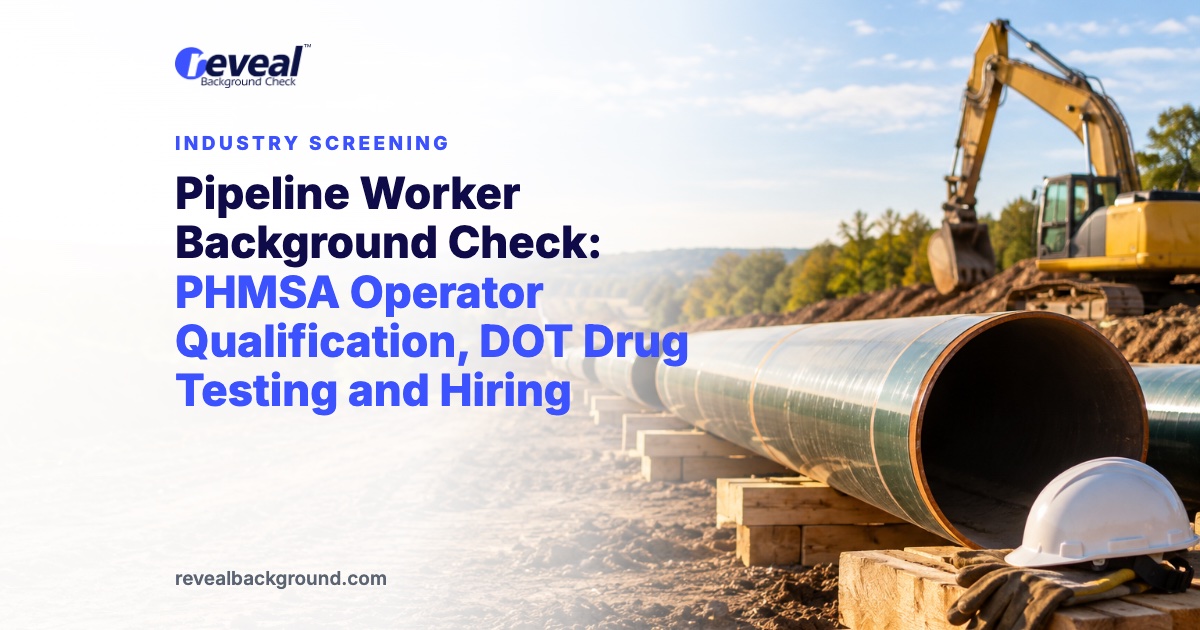
Hiring for pipeline construction, operations, or maintenance work means stacking several federal programs on top of whatever screening an employer already runs. Pipeline safety regulation does not work like a single licensing board with one fingerprint rule. Instead, a patchwork of requirements applies depending on what the worker actually does: whether the job touches a “covered function” under pipeline safety law, whether the worker drives a commercial vehicle, and whether the facility falls under federal security guidance. Employers and staffing contractors need to understand which pieces apply before they build a hiring checklist.
What counts as a “covered function” under pipeline safety rules
The Pipeline and Hazardous Materials Safety Administration (PHMSA) regulates the safety of gas and hazardous liquid pipelines under authority codified at 49 U.S.C. 60102. Within that framework, operators must identify which job tasks are “covered functions,” meaning operation or maintenance activities that could affect the safe operation of the pipeline. Someone performing a covered function, even as a contractor, is treated the same as an employee for purposes of the drug and alcohol testing and qualification rules described below. A person who never performs a covered function (an office administrator, for example) generally falls outside these specific federal requirements, even while working for a pipeline company.
PHMSA drug and alcohol testing for covered functions
Operators of gas and hazardous liquid pipelines must maintain a drug and alcohol testing program for employees and contractors who perform covered functions, under 49 CFR Part 199. The program follows the same general structure used across other DOT-regulated transportation modes: pre-employment drug testing before a person performs a covered function for the first time, random testing drawn from a pool throughout the year, reasonable suspicion testing, post-accident testing after qualifying events, and return-to-duty and follow-up testing for anyone who has violated the drug and alcohol rules. Part 199 also requires operators to query a previous DOT-regulated employer’s testing records for a new hire’s prior two years, similar to the process used in trucking and aviation.
This is a federal testing mandate, not a criminal history check. It confirms that a person performing safety-sensitive pipeline work is tested consistent with DOT procedures. It does not substitute for, and is not the same program as, any criminal background screening an employer chooses to run separately.
Operator Qualification: training and evaluation, not a background check
Separately, PHMSA’s Operator Qualification rule at 49 CFR Part 192, Subpart N requires pipeline operators to have a written qualification program covering individuals who perform covered tasks. The operator must identify covered tasks, use an evaluation method (written test, performance test, review of experience, or combination) to confirm a worker can perform the task safely, and reevaluate workers after certain events, including a worker’s involvement in an incident or a performance failure. Comparable qualification requirements for hazardous liquid pipelines appear elsewhere in the same subchapter. Operator Qualification is a competency and training record system. It is maintained by the operator and tracked per worker and per task, and contractors performing covered tasks must be qualified the same as direct employees. It does not involve a criminal record check, and PHMSA rules do not set a national criminal history standard for pipeline workers.
| Program | What it governs | Who it covers | Primary source |
|---|---|---|---|
| PHMSA drug and alcohol testing | Pre-employment, random, post-accident, reasonable suspicion, return-to-duty testing | Employees and contractors performing covered functions | 49 CFR Part 199 |
| Operator Qualification | Training, evaluation, and requalification for covered tasks | Individuals performing covered tasks for the operator | 49 CFR Part 192, Subpart N |
| FMCSA driver qualification and testing | Driver qualification files, MVR review, drug and alcohol testing, Clearinghouse queries | Workers who operate commercial motor vehicles, including many pipeline construction drivers | 49 CFR Parts 382 and 391 |
| TSA pipeline security guidance | Voluntary security practices, including personnel security measures for critical facility access | Operators of pipeline systems, particularly critical facilities | TSA Pipeline Security Guidelines |
CDL drivers on pipeline jobs fall under separate FMCSA rules
Pipeline construction and maintenance crews often include workers who drive commercial motor vehicles to move pipe, equipment, or hazardous materials between sites. Anyone operating a commercial motor vehicle that meets the federal weight or hazardous materials thresholds is subject to the Federal Motor Carrier Safety Administration’s separate driver qualification and testing rules, independent of the PHMSA programs above. Driver qualification files, motor vehicle record checks, and medical certification requirements are set out in 49 CFR Part 391, and drug and alcohol testing for these drivers, including required queries of the FMCSA Drug and Alcohol Clearinghouse, is governed by 49 CFR Part 382. These are the same rules that apply to over the road truck drivers, and a pipeline contractor who also drives commercial vehicles is treated as a regulated driver for that portion of the job. A fuller breakdown of how these driver rules work in practice is covered in our CDL truck driver background check requirements guide.
TSA security guidance encourages, but does not mandate, personnel screening
The Transportation Security Administration publishes voluntary Pipeline Security Guidelines that recommend operators, particularly those running critical facilities, adopt personnel security measures, which can include background screening as part of access control for sensitive sites. These guidelines are not a binding federal regulation in the way PHMSA’s testing and qualification rules are, and they leave the specific screening elements, including whether and how criminal history is checked, up to the operator. An operator with facilities identified as critical under TSA’s framework may have its own more detailed security plan requirements, but those plans are developed with TSA rather than published as a universal fingerprinting mandate.
Criminal history screening: no single federal rule, and that varies by employer and contract
Unlike the drug testing and qualification programs above, there is no single federal law requiring a criminal history check for pipeline workers generally. Some pipeline owners, particularly on projects involving critical infrastructure, government contracts, or access to secure facilities, require criminal background checks, fingerprinting, or site specific badging as a condition of site access, but that comes from the owner’s or general contractor’s own policy or contract terms rather than a PHMSA or TSA mandate applicable to every pipeline job. Employers building a screening program for pipeline hires should be explicit with candidates and contractors about which checks come from federal safety rules (drug testing, Operator Qualification, and driver qualification where applicable) and which come from the company’s or client’s own hiring policy. Where no specific government rule applies, it is more accurate to say the requirement is set by the operator or project owner, rather than implying a uniform federal standard exists.
FCRA duties when a third party background check is used
When a pipeline operator, general contractor, or staffing firm uses a consumer reporting agency to run a criminal history, employment, or driving record check, the Fair Credit Reporting Act’s procedural requirements apply regardless of the industry. The employer must provide a clear, standalone disclosure that a background check will be obtained, get the applicant’s written authorization, and, if the employer intends to take an adverse action such as not hiring or ending a contractor assignment based on the report, send a pre-adverse action notice with a copy of the report and the Summary of Rights, allow a reasonable period for the applicant to respond, and then send a final adverse action notice if the decision stands. These steps apply whether the hire is a direct employee or a contractor placed through a staffing agency, and they are separate from, and in addition to, any PHMSA or FMCSA program requirements. A background check does not uniformly surface every criminal record in every state, since reporting rules and lookback periods vary; state law and the specific scope of the check performed both affect what appears.
Building a hiring checklist for pipeline roles
A reasonable approach separates the pieces: confirm which jobs on the project involve covered functions or covered tasks, enroll those workers, including contractors, in the operator’s drug and alcohol testing program and Operator Qualification tracking before they begin covered work, confirm commercial driver qualification files and Clearinghouse queries for anyone operating qualifying vehicles, apply whatever criminal history or badging screening the project owner or operator requires for site access, and run any third party background check through a proper FCRA process with disclosure, authorization, and adverse action notices. Workers who also hold a hazardous materials endorsement on their commercial license face an additional federal security threat assessment, which is covered separately in our hazmat endorsement background check guide.
Frequently asked questions
Does PHMSA require a criminal background check for pipeline workers?
No. PHMSA’s federal rules require drug and alcohol testing for covered functions and an Operator Qualification program for covered tasks, but they do not set a national criminal history screening requirement. Any criminal background check comes from the operator’s or project owner’s own policy.
What is a covered function under pipeline safety rules?
A covered function is an operation or maintenance activity that could affect the safe operation of a gas or hazardous liquid pipeline. Operators identify these functions, and anyone performing them, including contractors, is subject to the drug and alcohol testing program under 49 CFR Part 199.
Is Operator Qualification the same as a background check?
No. Operator Qualification under 49 CFR Part 192, Subpart N, is a training and evaluation program that confirms a worker can safely perform a specific covered task. It tracks competency, not criminal history or identity verification.
Do pipeline workers who drive commercial vehicles need separate screening?
Yes, generally. Anyone operating a commercial motor vehicle that meets federal thresholds is subject to FMCSA’s driver qualification file, motor vehicle record review, and drug and alcohol testing rules, including Clearinghouse queries, under 49 CFR Parts 382 and 391, in addition to any PHMSA requirements tied to the pipeline work itself.
Are TSA’s pipeline security guidelines mandatory?
The published Pipeline Security Guidelines are voluntary recommendations encouraging security practices, including personnel screening at critical facilities. Operators identified as critical may work with TSA on more specific security plan requirements.
What must an employer do before rejecting a pipeline candidate based on a background check?
Under the Fair Credit Reporting Act, the employer must have provided a standalone disclosure, obtained written authorization, and, before finalizing a negative decision, sent a pre-adverse action notice with a copy of the report and the Summary of Rights, followed by a final adverse action notice if the decision stands.
Reveal Background helps employers and staffing contractors build compliant screening programs for pipeline and other skilled trade hiring, from FCRA-compliant criminal history checks to motor vehicle record reviews. Learn more at Reveal Background.
This article is general information, not legal advice. Employers should consult qualified counsel and the applicable PHMSA, FMCSA, and TSA guidance for their specific operations.