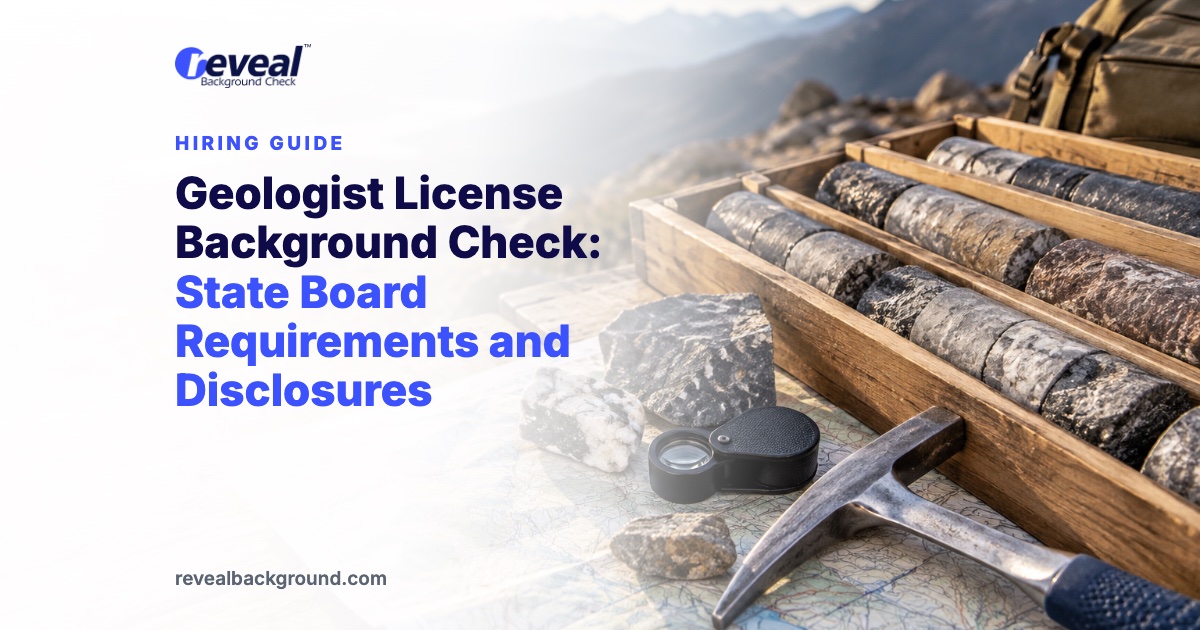
A professional geologist license, often shortened to PG, is issued and regulated at the state level rather than by any single federal agency. That means the application process, including whatever character or criminal history review a board applies, can look different from one state to the next. Some boards ask applicants to submit fingerprints as part of the review. Many others describe only education, work experience, and examination requirements on their public applicant pages, with no fingerprint or criminal history step mentioned at all. Employers hiring geologists for environmental consulting, mining, or site assessment work layer their own background check on top of whatever the licensing board already requires, and that employer level check runs under a separate federal law with its own disclosure rules.
This guide walks through how state geology boards typically structure licensure, where criminal history review does and does not appear, how reciprocity works between states, and what employers in environmental and mining roles need to do correctly when they run their own background check on a geologist candidate.
How state boards evaluate a geologist applicant
Most state boards that license geologists built their process around three things: an approved geology curriculum completed at an accredited school, a documented period of qualifying work experience, and a passing score on a national licensing exam. The exam most boards rely on is split into two sections, commonly called the Fundamentals of Geology section and the Practice of Geology section, and a board may allow a candidate to sit for the fundamentals section while still completing the experience needed for the practice section. Oregon’s State Board of Geologist Examiners describes this exact two part structure on its own exam qualification page, including the minimum geology coursework and upper level credit hours an applicant needs before sitting for either section.
South Carolina’s Board of Registration for Geologists lays out a similar framework on its registration and licensure page, requiring graduation from an approved geologic curriculum, a set number of years of documented work experience, and passing both portions of the national exam for applicants registering by examination. The same page describes separate paths for registration by reciprocity and registration by endorsement, each with its own education and experience documentation, which illustrates how much of the licensure process is about verifying academic and professional history rather than running a single standardized background check.
Criminal history and fingerprinting: it depends on the board
This is where state boards diverge the most, and it is worth being precise rather than assuming every board handles it the same way. California’s Board for Professional Engineers, Land Surveyors, and Geologists states directly on its applicant information page that most applicants, including those applying for licensure as a professional geologist, must submit fingerprints through the state’s Live Scan program, or by mail for applicants located outside California, as part of the application. That page also gives a separate contact address for fingerprint related questions, which suggests the board treats this step as a routine and expected part of the file, not an exception.
By contrast, the South Carolina and Oregon board pages reviewed for this article do not describe a fingerprint submission or a criminal history check anywhere in their applicant facing instructions. That does not necessarily mean no such review happens behind the scenes, since boards can apply general good character or fitness standards under their state’s licensing statutes without spelling out the mechanics on a public web page. What it does mean is that a geologist applicant should not assume every state handles criminal history the same way California does, and should check the specific board’s own application materials rather than relying on what another state requires. Where a board’s public materials are silent on the question, the accurate answer is that the requirement is not stated, not that one does or does not exist.
Reciprocity and licensure across state lines
Geologists who move between states, or who take on multistate environmental and mining projects, often look for reciprocity rather than starting the full application process over. South Carolina’s board grants registration by reciprocity to applicants already registered in North Carolina, Georgia, or Virginia, with the exam requirement waived but education and experience documentation still required, and it offers a separate registration by endorsement path for applicants licensed in other states whose original requirements were judged equivalent to South Carolina’s own. Other states structure comity differently, and some do not offer it at all for certain geology credentials, so a geologist planning to work across state lines should confirm the receiving state’s specific comity rules rather than assuming any license transfers automatically.
Employer background checks for environmental and mining roles
Licensure review by a state board is a separate process from the background check an employer runs before hiring a geologist for a specific job. When an employer, or a consumer reporting agency acting on the employer’s behalf, pulls a criminal history report, employment verification, or similar consumer report to help decide whether to hire, promote, or retain someone, the Fair Credit Reporting Act’s employment screening rules apply regardless of whether the role also requires a state license. The joint guidance from the EEOC and the FTC on employment background checks walks through the required sequence: a clear standalone disclosure that a report will be obtained, the applicant’s written authorization, a pre adverse action notice with a copy of the report and a summary of rights if the employer is leaning toward not hiring based on the results, and a final adverse action notice if that decision stands. The same guidance also covers the nondiscrimination side, since applying screening criteria inconsistently across candidates, or in a way that is not job related, can create liability on its own.
Environmental and mining employers often layer additional, role specific requirements on top of the standard background check. A geologist working on an active mine site, for example, generally needs site specific safety training before working underground or on surface mining operations, separate from the person’s state geology license. The Mine Safety and Health Administration’s training and education program describes the new miner and site specific training that federal mine safety rules require, which is a compliance obligation distinct from, and in addition to, both the state geology license and the employer’s own hiring background check.
Example state board requirements
| State | Licensing authority | National exam required | Criminal history or fingerprint step described on applicant pages | Reciprocity or endorsement |
|---|---|---|---|---|
| California | Board for Professional Engineers, Land Surveyors, and Geologists | Yes, for most professional geologist applicants | Yes, fingerprinting through Live Scan or by mail for out of state applicants | Not described as automatic; each application reviewed individually |
| Oregon | State Board of Geologist Examiners | Yes, two part exam (Fundamentals of Geology and Practice of Geology) | Not described on the exam qualification page reviewed | Separate application and registration process; not addressed on the page reviewed |
| South Carolina | Board of Registration for Geologists | Yes, except for applicants registering by reciprocity | Not described on the licensure page reviewed | Yes, with North Carolina, Georgia, and Virginia; endorsement available from other states with equivalent requirements |
These three boards illustrate the range, not an exhaustive list. A geologist or an employer trying to confirm the rule in a specific state should go directly to that state’s own licensing board page rather than extrapolating from a neighboring state.
What this means for employers and candidates
Employers hiring for environmental consulting, geotechnical, or mining roles should keep license verification and background screening as two separate, documented steps. Confirming that a candidate’s professional geologist license is active and in good standing with the issuing state board is a licensure question. Running a criminal history check, employment verification, or similar consumer report as part of the hiring decision is a background screening question governed by the Fair Credit Reporting Act. Treating them as the same step risks skipping a required disclosure or authorization, since a license lookup is not a substitute for proper FCRA documentation when a consumer report is also being used.
Candidates applying for a geology license should expect to document education and work experience closely, since that is the part of the process every board reviewed here treats as central. Whether fingerprinting or a criminal history step is also required depends entirely on the specific state, and candidates should ask the board directly rather than assume a process used in one state applies everywhere.
Reveal Background’s guide to the professional engineer license background check process covers a closely related technical licensing track that many environmental and mining employers also encounter, and the guide to the land surveyor license background check walks through another state regulated technical credential that frequently appears alongside geology work on the same project.
Frequently asked questions
Do all states require a professional geologist license?
No. Licensure requirements for geologists vary significantly by state, and not every state regulates the title in the same way. Anyone working across state lines should confirm the specific requirement in each state where the work will take place rather than assuming a license requirement exists or does not exist everywhere.
Does every state geology board run a fingerprint or criminal history check on applicants?
Not based on what the boards themselves publish. California’s board describes a fingerprint submission through Live Scan as part of its application process. South Carolina and Oregon’s applicant facing pages do not describe a comparable step. Applicants should check the specific board’s current application instructions rather than assuming one state’s process applies to another.
What is the national exam most geology boards require?
Most boards that require an exam use a two part national licensing exam, commonly referred to by its fundamentals and practice sections, which tests geology knowledge and applied professional practice. Oregon’s and South Carolina’s boards both describe this two part structure as part of their own licensure requirements.
Can a geologist licensed in one state use that license to get licensed in another state?
Sometimes, through reciprocity or endorsement, but it is not automatic everywhere. South Carolina, for example, grants reciprocity to applicants already registered in North Carolina, Georgia, or Virginia, and offers endorsement for applicants from other states whose requirements were judged equivalent. Other states set their own comity rules, so a geologist should confirm the specific requirement in the state where a license is needed.
Does an employer still need to follow FCRA rules if a geologist is already state licensed?
Yes. A state license verification is separate from an employer’s own background check. If the employer or a consumer reporting agency pulls a criminal history report or similar consumer report as part of the hiring decision, the Fair Credit Reporting Act’s disclosure, authorization, and adverse action requirements still apply regardless of the candidate’s licensure status.
Does a geologist working on a mine site need anything beyond the state license and a background check?
Generally yes. Federal mine safety rules require site specific and new miner safety training before someone works at an active mine, which is a separate compliance obligation from both the state geology license and the employer’s hiring background check.
Employers building a screening program for environmental, geotechnical, or mining hires can review Reveal Background’s background check services for technical and licensed professional roles.
This article is general information, not legal advice. Employers and license applicants should consult the specific state board or qualified counsel about how licensing and background check requirements apply to their situation.