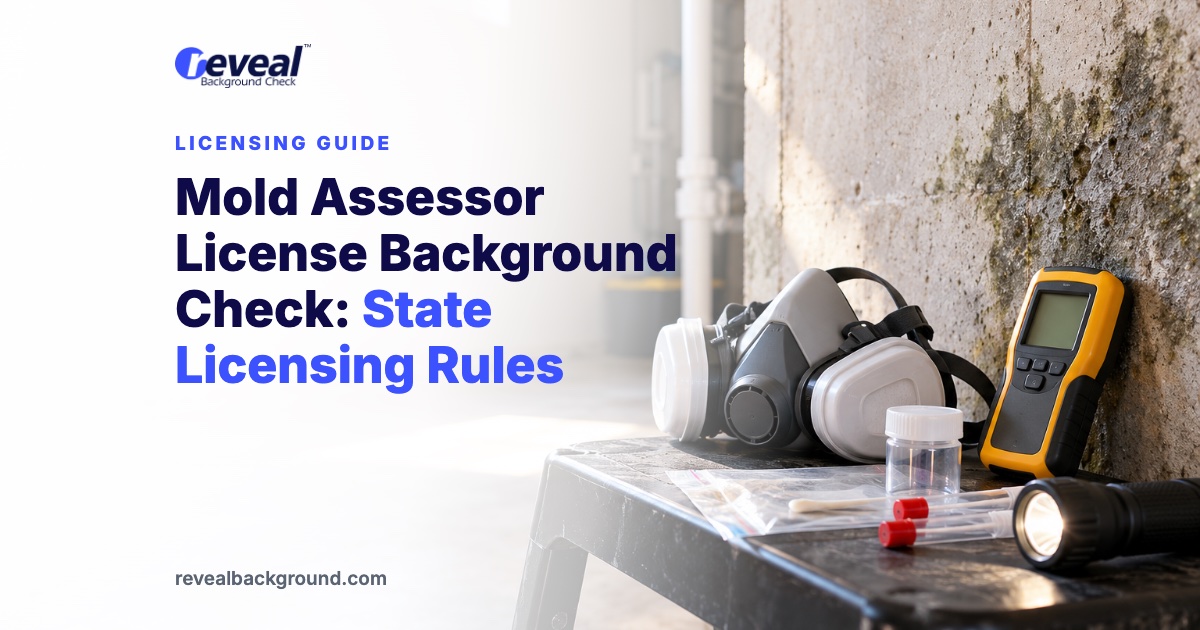
Mold inspection and remediation sit in an unusual spot in the trades. The work looks like general contracting or environmental cleanup, but a handful of states treat it as its own licensed profession, with a separate exam, separate insurance minimums, and in some cases a separate criminal history review. Employers who hire mold assessors or remediation contractors, and companies that screen those hires, need to know which rule belongs to the state license and which belongs to their own background check process. The two are not the same thing, and a clean state license is not a substitute for an employer’s own screening.
This post looks at how three states with active mold licensing programs, Florida, Texas, and New York, structure their requirements, including where each one does or does not touch criminal history. Other states vary widely. Some license mold work under an environmental or home improvement contractor category, and many have no mold specific license at all. Where a state has no published rule on criminal history or fingerprinting for mold work, the honest answer is that there is no rule, not that one must exist.
Why mold work is licensed separately from general contracting
States that regulate mold assessment and remediation usually do so because the two tasks create a conflict of interest if done by the same business on the same job. An assessor who also profits from the remediation has an incentive to find more damage than exists. Florida, for example, generally bars the same licensee from both assessing and remediating the same property, and Texas limits who can perform both roles on one project. Licensing lets a state set minimum training, require liability insurance, and give the public a way to verify that a person doing invasive work in a home or school has met a baseline standard.
Florida: an exam and insurance standard, not a universal fingerprint rule
Florida licenses mold assessors and mold remediators through the Department of Business and Professional Regulation under Florida Statutes section 468.8413. To sit for the exam, an applicant generally needs either a two year degree with specified science credit hours plus a year of documented field experience, or a high school diploma with at least four years of documented field experience in mold work. Section 468.8414 requires passing the licensing exam and documented training in water, mold, and respiratory protection. A separate endorsement path exists for people who already hold an equivalent out of state license or a recognized national certification, and that path requires the applicant to be of good moral character and to carry the insurance required under section 468.8421, which sets minimum coverage of one million dollars for both assessors and remediators.
The statute text covering standard exam based licensure does not spell out a fingerprint submission or a criminal history background check specific to mold assessors. That differs from some other Florida licensed trades, where fingerprinting is written directly into the chapter. Anyone relying on this post for a specific Florida application should confirm current requirements directly with the department, since administrative rules can add detail that statute text alone does not capture.
Texas: a background check built into the application itself
Texas regulates mold work through the Texas Department of Licensing and Regulation, which issues separate licenses for mold assessment technicians, assessment consultants, remediation workers, and remediation contractors, along with company level registrations. Unlike Florida’s statute text, the TDLR mold remediation contractor application states plainly that the department will run a criminal history background check and that an applicant must pass it to be eligible for the license. Applicants who are unsure whether a past conviction will be a problem can request a Criminal History Evaluation Letter before they apply, so they are not guessing. Beyond the background check, Texas requires proof of an approved training course certificate, a minimum amount of hands on field experience, and passage of a licensing exam before the department issues the credential. Contractor level licenses also require proof of commercial general liability insurance. Program details, forms, and current law citations are maintained on the TDLR mold licensing program page.
New York: training and insurance, with no published criminal history screen
New York licenses mold work through the state Department of Labor, which issues separate credentials for mold assessors, mold remediation contractors, and mold abatement workers under its mold program. According to the Department of Labor mold program page, applicants complete an approved training course and apply through the department’s online licensing portal. The department’s mold program FAQ sets liability insurance minimums for the contractor level licenses but does not describe a criminal history check, fingerprinting step, or moral character review as part of mold licensure. That is a real difference from Texas, not an oversight in this summary. Employers who need a criminal history check on a New York based mold hire have to run their own, because the state license process does not appear to perform one.
How the three programs compare
| State | Licensing agency | Published criminal history check | Fingerprinting described | Minimum liability insurance | Exam required |
|---|---|---|---|---|---|
| Florida | Department of Business and Professional Regulation | Not described for standard exam route; good moral character required only for endorsement | Not described in statute | $1,000,000 | Yes |
| Texas | Texas Department of Licensing and Regulation | Yes, required to pass before licensure | Not described as a separate step; background check is name and record based | Contractor level insurance required, amount set by rule | Yes |
| New York | Department of Labor | Not described in current program materials | Not described | $50,000 for contractor level licenses | Training course completion required; department confirms eligibility |
The pattern to take from this table is that there is no single national rule. Some states screen criminal history as part of mold licensure, some do not, and the details change as legislatures and agencies update their programs. An employer should never assume a state mold license includes a background check equivalent to what the employer would run itself.
What this means for an employer’s own screening
A state mold license answers a narrow question: did this person meet the state’s training, exam, and insurance requirements. It does not answer the questions an employer typically cares about for hiring purposes, such as whether the person has a recent conviction relevant to working alone inside homes and occupied buildings. When an employer orders its own consumer report for that purpose, the Fair Credit Reporting Act and its implementing rule, Regulation V, require a standalone disclosure, written authorization from the applicant, and, if the employer intends to act on the report, a pre adverse action notice followed by an adverse action notice with a copy of the report and a summary of rights. A background check does not show the same information in every state, and how far back a report can look varies by state law, so employers should not assume a report “will show” every past record.
Employers should also be careful about blanket policies. Guidance from the Equal Employment Opportunity Commission cautions against an automatic, across the board exclusion of anyone with a criminal record, and recommends that employers instead consider the nature of the offense, how much time has passed, and the actual duties of the mold assessment or remediation role before making a decision. Employers with questions about how a specific record interacts with hiring for licensed trade work should talk to counsel rather than rely on a blanket rule.
Frequently asked questions
Do all states license mold assessors and remediators?
No. Only a subset of states run a dedicated mold assessor or mold remediator license. Many states regulate mold work only indirectly, through general contractor licensing or not at all. Confirm the current rule with the specific state licensing agency before assuming a program exists.
Does a mold assessor license always include a criminal history check?
No. It varies by state. Texas requires applicants to pass a criminal history background check as part of licensure. Florida’s standard exam route and New York’s current program materials do not describe a comparable check for mold specific licenses.
Is fingerprinting required for a mold assessor license?
Fingerprinting is not described as a required step in the Florida, Texas, or New York mold licensing materials reviewed for this post. Some other state licensed trades do require fingerprints, so this should be confirmed directly with the relevant state agency rather than assumed either way.
Can a past conviction disqualify someone from a state mold license?
It can, depending on the state and the nature of the offense. Texas explicitly reviews criminal history and may deny a license, though applicants can request an evaluation letter in advance. Florida’s endorsement path requires good moral character. State rules vary, so a specific record should be checked against the specific state’s current criteria.
What should an employer verify before hiring a mold assessor or remediation contractor?
Verify the state license is active and matches the role performed, confirm the required insurance is in place, and run the employer’s own background check under the Fair Credit Reporting Act with proper disclosure and authorization, since the state license process may not include the same screening the employer needs.
Does a state mold license replace an employer’s own background check?
No. A state license confirms training, exam, and insurance requirements were met. It is not a substitute for an employer’s own FCRA compliant background check, and employers should not assume the state process already covers what they need to know about an applicant’s history.
Mold work shares a lot in common with other environmental trades that mix state licensing with employer screening. See how this plays out for lead abatement crews and for asbestos abatement workers, two other trades where a state credential and an employer’s own background check cover different ground.
Employers that need a compliant background check program for licensed trade hires can learn more at Reveal Background.
This article is general information, not legal advice. Licensing and background check requirements change and vary by state, so confirm current rules with the applicable state agency or with legal counsel before making a hiring decision.