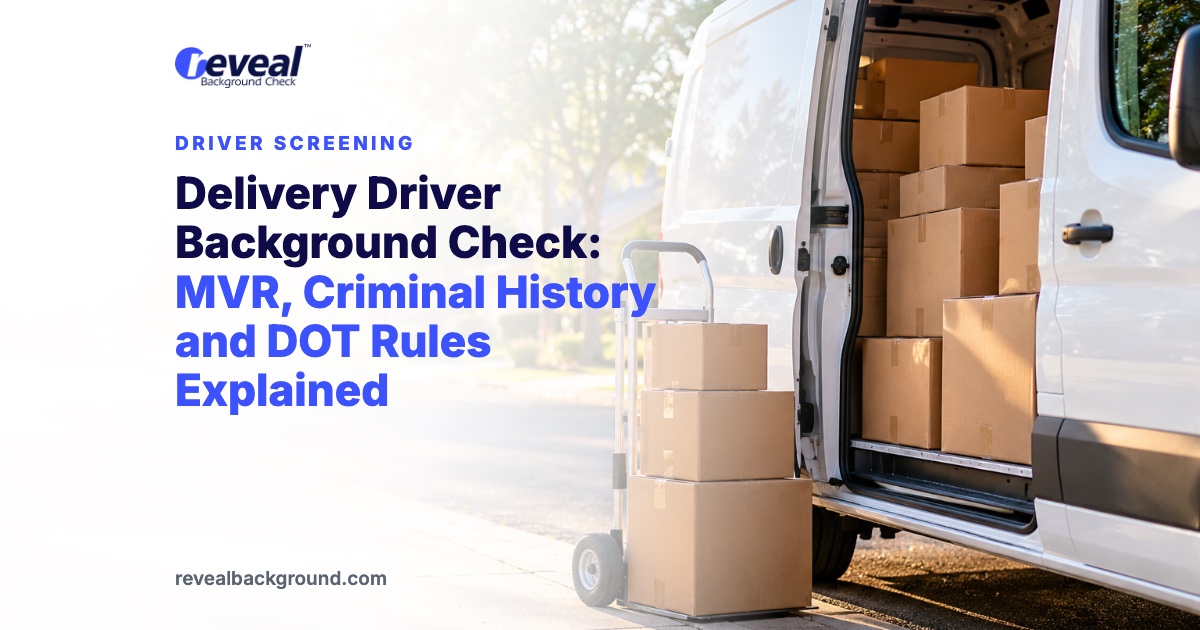
Delivery driving covers a wide range of jobs: a courier running documents across town, a food delivery driver on a scooter, a parcel driver in a company van, or a route driver moving freight in a box truck. Each role carries a different mix of screening needs, and the vehicle a driver operates, not just the job title, usually decides which federal rules apply. This guide walks through what a thorough delivery driver background check typically includes, when federal trucking rules apply and when they do not, and what employers owe applicants under the Fair Credit Reporting Act.
What a delivery driver background check usually covers
Most employers build a delivery driver screen around four pieces: identity verification, a criminal history search, a motor vehicle record (MVR) check, and, where the vehicle or role requires it, drug testing. Because delivery drivers often work alone, carry packages or cash equivalents, and enter homes, loading docks, or office buildings unsupervised, employers tend to weigh criminal history and theft related records more heavily than they would for a desk role.
| Screening element | What it typically shows | Why it matters for delivery work |
|---|---|---|
| Criminal history search | County, state, and federal court records, subject to state rules on lookback periods | Unattended access to homes, vehicles, and packages raises theft and safety concerns for employers |
| Motor vehicle record (MVR) | License status, class, endorsements, violations, and suspensions from the state DMV | Confirms the applicant can legally and safely operate the vehicle the job requires |
| Drug testing | Controlled substance results, mandatory under DOT rules for certain commercial vehicles | Required by federal rule for drivers of qualifying commercial motor vehicles; otherwise employer policy |
| Employment and reference checks | Prior work history, sometimes prior driving incidents | Helps verify experience operating similar vehicles or routes |
When DOT and FMCSA rules apply, and when they do not
Many delivery roles never trigger federal commercial vehicle rules at all. The Federal Motor Carrier Safety Administration (FMCSA) regulations generally apply to drivers operating a commercial motor vehicle, which federal rule defines by weight, passenger count, or hazardous materials load rather than by job title. A vehicle with a gross vehicle weight rating, gross combination weight rating, or actual weight of 10,001 pounds or more used in interstate commerce can bring a driver under these rules, and commercial driver’s license (CDL) thresholds apply at higher weight and passenger limits. The exact definitions are set out in 49 CFR 390.5, which employers should check against the specific vehicle in use rather than assuming based on the delivery service’s brand or size.
A driver delivering food on a bike or in a compact car, or a courier using a personal sedan, typically falls outside FMCSA’s commercial vehicle rules entirely. A driver operating a box truck or step van near or above the weight threshold may fall inside them. Employers running mixed fleets should check vehicle specifications, not assumptions, before deciding which rules apply to which drivers.
DOT drug and alcohol testing thresholds
For drivers who do operate a commercial motor vehicle as defined by FMCSA, federal drug and alcohol testing rules apply, covering pre-employment, random, post-accident, and reasonable suspicion testing. These requirements are set out in 49 CFR Part 382. Employers of qualifying drivers also have duties under the FMCSA Drug and Alcohol Clearinghouse, a database that tracks driver drug and alcohol program violations; employers must query the Clearinghouse before hiring a CDL driver and annually for current drivers, as described on the FMCSA Clearinghouse site. Delivery drivers who do not meet the commercial motor vehicle definition are not subject to this federal testing structure, though an employer may still require drug testing as a matter of company policy, subject to state law.
Separately, drivers who are required to hold a CDL are also subject to driver qualification file rules, including a review of the applicant’s driving record for the preceding three years, under 49 CFR 391.23.
Motor vehicle records and state DMV access
An MVR check pulls a driver’s licensing and violation history directly from the state agency that issued the license. Because every state runs its own system, the fastest and most reliable path for employers is the state DMV’s own records request process. California, for example, allows employers to request a driver record through the California DMV’s online driver record request service. Other states run similar but separately administered systems, and an MVR pulled for a driver licensed in one state will not automatically reflect violations recorded in another unless the states participate in record sharing for that purpose, so employers should confirm the process for the specific state where the driver is licensed.
Driving records are personal information protected under the federal Driver Privacy Protection Act, which limits who can obtain a driver’s motor vehicle record and for what purpose. The statute, codified at 18 U.S.C. 2721, permits disclosure for use by an employer to obtain or verify information relating to a driver, but employers should still follow their state DMV’s specific authorization and request procedures rather than assuming blanket access.
Criminal history and theft concerns for unattended deliveries
Delivery work often means entering homes, offices, or secure facilities without direct supervision, and many delivery roles involve handling cash, high value packages, or sensitive documents. Employers weighing criminal history for these reasons should still apply it consistently and job-relatedly rather than through a blanket disqualification policy, since state and local laws on criminal history consideration, including lookback periods and ban-the-box timing, vary and continue to change. A background check does not show the same record in every state, since what qualifies as reportable and how far back it can be reported depends on state law; employers should confirm current limits for the state where the screening occurs rather than assume a fixed national rule.
Independent contractor platforms
Many delivery drivers work as independent contractors for platforms rather than as employees, including food delivery and parcel delivery apps. Classification as a contractor does not exempt a platform from consumer reporting law when it uses a third party consumer reporting agency to run a background check as a condition of giving someone access to deliver on the platform; the Fair Credit Reporting Act’s disclosure, authorization, and adverse action duties generally apply in that situation, whether the worker is ultimately classified as an employee or a contractor. Platforms should not represent any particular screening company as an endorsed or exclusive partner, and should independently confirm which rules apply to their specific worker classification and vehicle types.
FCRA duties for any employer using a background check company
Whenever an employer uses a third party consumer reporting agency rather than running checks entirely in house, the Fair Credit Reporting Act sets out a specific sequence of steps. The statute’s definitions and employer obligations are set out at 16 CFR Part 600, with the underlying statutory text at 15 U.S.C. Chapter 41, Subchapter III. In general, employers must:
- Provide a clear, standalone written disclosure that a background check will be obtained, separate from the job application
- Get the applicant’s written authorization before requesting the report
- Send a pre-adverse action notice, along with a copy of the report and a copy of the Summary of Rights, before taking any adverse action based on the report
- Allow a reasonable period for the applicant to respond or dispute information before finalizing a decision
- Send an adverse action notice if the employer proceeds with the adverse decision
These steps apply regardless of whether the driver role is full time, part time, or gig based, as long as a consumer reporting agency is involved. Employers should consult counsel on how these federal duties interact with state specific notice and timing requirements, which vary and are not covered here.
Frequently asked questions
Does every delivery driver need a DOT drug test?
No. DOT drug and alcohol testing under 49 CFR Part 382 generally applies only to drivers operating a commercial motor vehicle as defined by weight, passenger count, or hazardous materials load under 49 CFR 390.5. Many food and parcel delivery drivers using smaller vehicles fall outside that definition, though an employer may still require drug testing as a matter of its own policy.
Can an employer pull an MVR from another state?
Each state DMV manages its own driving records, and the process for requesting one varies by state. Employers should use the issuing state’s own request process, such as the California DMV’s driver record request service, and confirm what, if anything, is shared across states for a given driver.
Is a criminal history check required for delivery drivers?
There is no single federal rule requiring a criminal history check for all delivery driving roles. Employers choose to run one based on job relevance, such as unattended access to homes or high value goods, and must apply any resulting decision consistently, subject to state and local laws on criminal history consideration.
Do independent contractor delivery drivers get the same FCRA protections as employees?
When a platform uses a third party consumer reporting agency to screen a worker, FCRA’s disclosure, authorization, and adverse action duties generally apply regardless of whether the worker is ultimately classified as an employee or an independent contractor.
What is the FMCSA Clearinghouse and does it apply to all delivery drivers?
The Clearinghouse is a database of drug and alcohol program violations for drivers who hold a commercial driver’s license. It applies to employers of CDL holders, who must query it before hiring and annually afterward, as described on the FMCSA Clearinghouse site. It does not apply to delivery drivers who are not required to hold a CDL.
What is the Driver Privacy Protection Act and why does it matter for MVR checks?
The Driver Privacy Protection Act, at 18 U.S.C. 2721, restricts who can access personal information in motor vehicle records and for what purposes, including employer verification use. It is the reason MVR requests go through a state DMV’s defined process rather than open public access.
For employers building or refining a delivery driver screening program, see our related guides on gig worker background check requirements and driver license checks for employers. Learn more about compliant screening programs at Reveal Background.
This article is general information, not legal advice. Screening programs should be reviewed with qualified counsel familiar with applicable federal and state law.