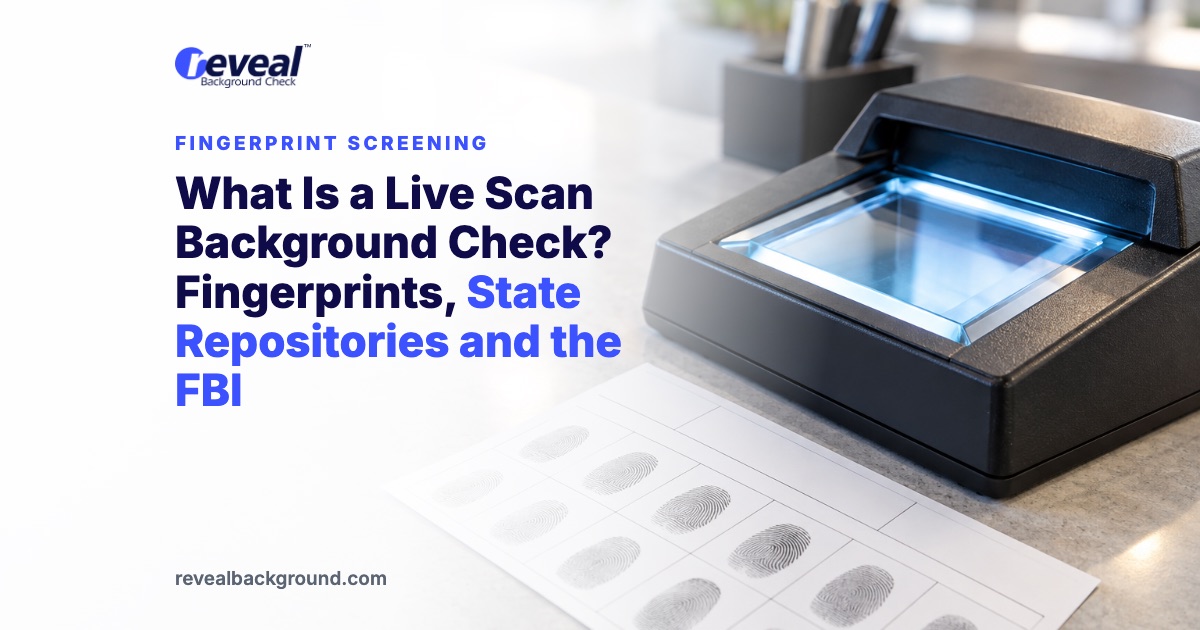
Live Scan is the term most people use for electronic fingerprinting. Instead of rolling ink onto paper cards, an operator captures an applicant’s fingerprints on a digital scanner and transmits them to a state identification bureau, and in many cases onward to the Federal Bureau of Investigation, for a criminal history search. The name comes from California, where the state Department of Justice built one of the first large scale electronic fingerprint networks for licensing and employment, but the same basic process now runs under different program names in most states.
Because Live Scan is built around a fingerprint rather than a name, it answers a different question than the background check most job applicants are used to. This post explains how the process works, who is typically required to complete one, what the resulting report actually contains, and how it compares to a standard name based consumer report.
How the Live Scan Process Works
Capturing the fingerprints
An applicant visits a fingerprinting location, either a dedicated Live Scan site, a police or sheriff’s department, or a vendor contracted by the state. The operator scans all ten fingerprints along with basic identifying information and a code that tells the system which agency requested the check and why. That routing code matters because it determines which statute authorizes the search and what the requesting agency is legally allowed to see back.
Where the data goes
The fingerprint image and applicant data are sent electronically to the state’s central repository, typically run by the state department of justice or public safety agency, which searches its own criminal history database. California’s Department of Justice describes this as an automated search against its statewide fingerprint database, with the images forwarded to the FBI for a federal check when the requesting agency is authorized to receive one. Texas runs a comparable system, where fingerprints collected through the state’s electronic fingerprinting services program are searched against both the Texas Department of Public Safety’s records and the FBI’s files for authorized applicant types such as child care providers, teachers, and security personnel.
The legal basis for sharing an FBI identification record with a non law enforcement agency, such as a licensing board or an employer, comes from federal regulation governing the exchange of criminal history information for noncriminal justice purposes. Under 28 CFR Part 20, the FBI may only release fingerprint based criminal history results to an agency when a federal or state statute, or a state law approved by the Attorney General, specifically authorizes that use. This is why a Live Scan request always has to identify the exact statute or licensing rule behind it.
Who Is Typically Required to Complete a Live Scan
Requirements vary by state and by role, but Live Scan or its equivalent shows up most often in these situations.
State occupational licensing
Many professional and occupational licensing boards, from real estate to childcare administration to certain healthcare licenses, require applicants to submit fingerprints as part of the license application. The board sets the routing code, and results generally go straight to the board rather than to an employer.
Schools and childcare
Teachers, school employees, and childcare workers are commonly fingerprinted under state education or child care licensing statutes, since these roles involve regular contact with children.
Healthcare settings
Certain healthcare licenses and facility employment categories require fingerprint based checks, generally tied to state health and safety statutes that govern who may work with patients or in a licensed facility.
Firearms dealers and related licenses
Some states route firearms related licensing through the same fingerprint infrastructure. California’s Department of Justice, for example, references a dedicated Request for Live Scan form tied to its firearms related record requests, distinct from the point of sale background check run at the time of a purchase.
Foster care and adoption
Prospective foster and adoptive parents, and other adults in the household, are generally required to complete state and federal criminal history checks as part of the approval process. The Child Welfare Information Gateway summarizes how states set these background check requirements for caregivers, noting that most states require both state and FBI fingerprint based checks alongside a review of child abuse and neglect registries.
What Comes Back: Reading the Result
A Live Scan search that finds a match returns what is commonly called a rap sheet, a record built from the arrests, charges, and dispositions on file under that fingerprint. Unlike a commercial background report, it is organized around booking and case events rather than a narrative summary, and it can include arrests that never led to a conviction unless state law restricts what may be disclosed for that purpose. Because the search is based on the fingerprint image itself rather than a name, a rap sheet generally captures records filed under aliases or misspelled names that a name based search could miss, as long as that person was fingerprinted at the time of the earlier arrest.
When no fingerprint match is found, the requesting agency generally receives a clearance result rather than a blank report. A possible match can trigger a manual review by an examiner before results are released, which can extend how long the process takes for that individual.
Live Scan Versus a Name Based Background Check
Employers and consumer reporting agencies, including screening companies operating under the Fair Credit Reporting Act, generally run a different kind of search built on the applicant’s name, date of birth, and other identifiers rather than a fingerprint. The table below outlines the main differences.
| Feature | Live Scan fingerprint check | Name based background check |
|---|---|---|
| Identifier used | Fingerprint image | Name, date of birth, Social Security number trace |
| Who runs the search | State identification bureau, sometimes forwarded to the FBI | Court record custodians, often compiled through a consumer reporting agency |
| Governing framework | State fingerprint statutes and federal rules on FBI record dissemination | Fair Credit Reporting Act and state consumer reporting laws |
| Common use case | Licensing, school and childcare employment, foster and adoptive placement | General pre-employment and tenant screening |
| Risk of missed records | Lower risk of missed identity, but limited to jurisdictions that share fingerprint data | Possible mismatches from common names or aliases, generally addressed by searching multiple identifiers |
The two are not interchangeable, and an employer that only runs a name based check is not necessarily seeing everything a Live Scan check would surface, and vice versa. Some employers use both, particularly in regulated industries where a license, a fingerprint clearance, and a separate FCRA governed background report are all required for the same position. When a background report is used for employment or tenant decisions, employers still owe applicants the standard disclosure, authorization, and adverse action process regardless of whether a fingerprint check was also completed for licensing purposes.
Cost and Turnaround
Live Scan fees generally include two parts: a rolling or capture fee charged by the fingerprinting location, and a processing fee set by the state and, when applicable, the FBI. These fees vary by state and by the statute behind the request, and applicants should confirm current pricing with the requesting agency or the fingerprinting location rather than relying on a fixed number, since fee schedules change. Processing time also varies. Many electronic submissions clear quickly when there is no fingerprint match on file, while a possible match that requires manual examiner review can take considerably longer. Applicants applying for a license or a job that requires Live Scan should ask the requesting agency what their expected process looks like rather than assuming a standard turnaround.
Where to Get Live Scan Fingerprinting Done
Most states publish a directory of approved fingerprinting locations, which can include police departments, sheriff’s offices, and private vendors under contract with the state. The requesting agency, whether it is a licensing board, a school district, or a state child welfare office, typically supplies the applicant with the correct routing code before the appointment. Bringing that code and a valid photo identification to the appointment helps avoid a rejected or misrouted submission. A background screening provider such as Reveal Background can help an employer understand which parts of its hiring process require a fingerprint based check through the state and which parts are covered by a standard consumer report.
Frequently asked questions
Is a Live Scan background check the same as a regular background check?
No. Live Scan is a fingerprint based search run through a state identification bureau and, when authorized, the FBI. A regular pre-employment or tenant background check is generally a name based search compiled by a consumer reporting agency under the Fair Credit Reporting Act. They can cover overlapping records, but they are searched, governed, and delivered differently.
Who pays for a Live Scan fingerprint check?
It varies by state, by employer, and by the statute requiring the check. Some agencies charge the applicant directly, some employers cover the fee, and some licensing boards build the fee into the license application cost.
Can Live Scan fingerprinting be done from home?
Generally no. Live Scan requires an in person visit to an approved fingerprinting location that has the scanning equipment and the correct routing setup for the requesting agency.
How long does a Live Scan background check take?
It varies. A clean electronic search with no fingerprint match on file can clear relatively quickly, while a possible match that needs manual review by an examiner can take considerably longer. The requesting agency is the best source for a current estimate.
Does a Live Scan check show arrests that did not lead to a conviction?
It can, depending on the state and the statute authorizing the search, since a rap sheet is built from booking and case events on file rather than a filtered summary. Some states restrict what may be disclosed to noncriminal justice requesters, so the same fingerprint search can return different amounts of detail depending on who requested it and why.
What happens if my Live Scan fingerprints come back with a possible match?
An examiner generally reviews the potential match before the state releases a result to the requesting agency. That review confirms whether the fingerprint truly belongs to the applicant before any record is disclosed, which is part of why a possible match can take longer to resolve than a clean search.
Related Reading
For more on how fingerprint based searches compare to identity based searches, see Fingerprint vs. Name-Based Background Checks: What Each One Misses. Florida’s own fingerprint based standard for certain caregiving and licensed roles is covered in What Is a Level 2 Background Check? Florida’s Fingerprint Standard Explained.
This article is general information, not legal advice. Background check and fingerprinting requirements vary by state and by role, and employers and applicants should confirm current requirements with the relevant licensing agency or legal counsel.