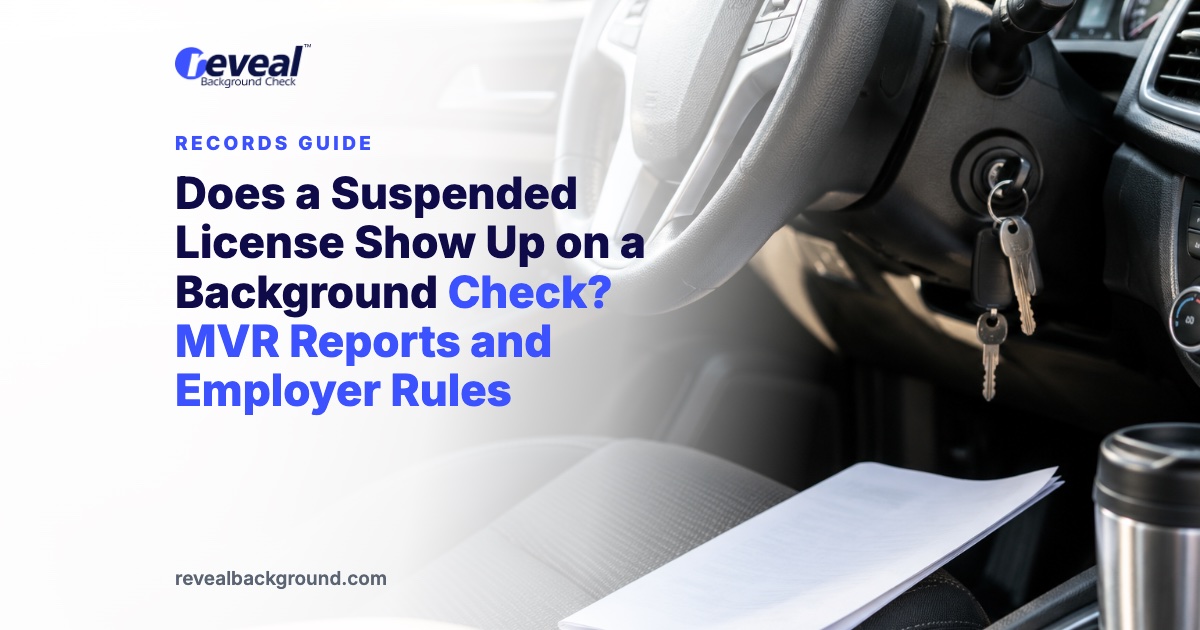
A suspended license is one of the most common surprises employers and applicants run into during hiring for driving roles. Whether it shows up on a background check depends almost entirely on which kind of check gets run. A standard criminal history search and a motor vehicle record are two different products pulled from two different systems, and they do not report the same information.
This guide explains where a suspension actually appears, what a motor vehicle record shows, how the Fair Credit Reporting Act applies when a report affects a hiring decision, and what changes for commercial driver license holders under federal rules.
Motor Vehicle Record vs Criminal Background Check
A motor vehicle record, often called an MVR, is maintained by the state agency that issues driver licenses, not by a court or a police department. It lists the license status, class, restrictions, violations, accidents, and any suspension or revocation along with the agency’s reason for it. Because the MVR is the state’s own driving file, a current or past suspension will generally appear there, including suspensions that never involved a criminal charge, such as a suspension for unpaid tickets, failure to appear, or accumulated points.
A criminal background check pulls from a different universe of records, built from court dockets and law enforcement data at the county, state, or national level. A license suspension by itself is an administrative action, not a crime, so it typically will not surface on a criminal history unless the underlying conduct was itself charged as an offense, such as driving while license suspended or revoked, or a DUI that triggered both a criminal case and an administrative suspension. Reporting practices and record availability vary by state and by court, so a criminal check should never be treated as a reliable way to detect license status.
| Situation | Shows on MVR | Shows on criminal background check |
|---|---|---|
| Suspension for accumulated points or moving violations | Yes, with the agency’s status and reason code | Usually no, unless a separate criminal charge was filed |
| Suspension for failure to appear or failure to pay a fine | Yes | Usually no |
| Suspension tied to a DUI or DWI conviction | Yes | Often yes, since the underlying offense is criminal |
| Suspension for driving without required insurance | Yes | Usually no |
| Conviction for driving on a suspended license | Yes | Yes, this is itself a separate criminal or traffic offense in most states |
Why Employers Pull an MVR Instead of Guessing
For any role that involves operating a vehicle, employers generally request an MVR directly rather than relying on a criminal search to catch license problems, because the two reports answer different questions. Some states run programs built specifically for this purpose. California’s Department of Motor Vehicles, for example, operates an Employer Pull Notice program that lets enrolled employers receive an automatic notice when an enrolled driver’s record changes, including a new suspension, revocation, or conviction, so a problem is flagged without the employer having to repeatedly repull the record. Other states offer a similar driving record request service without the ongoing monitoring feature; Washington’s Department of Licensing, for instance, publishes details on license suspensions and how a driver can check status or request reinstatement.
Because an MVR is considered a consumer report when it is obtained through a third party for employment purposes, it falls under the same Fair Credit Reporting Act framework as a criminal background check. A careful comparison of license class, validity, and history is covered in more depth in our guide on driver license checks for employers.
FCRA Rules When a Suspension Appears on a Report
When an employer uses a third party consumer reporting agency to pull an MVR or a criminal background check, the Fair Credit Reporting Act and its implementing rule, Regulation V, set the procedure the employer has to follow. The employer must give the applicant a clear standalone disclosure that a report will be obtained, get the applicant’s written authorization, and if the result may lead to an adverse decision, provide a pre-adverse action notice along with a copy of the report and a summary of rights before anything final happens, followed by an adverse action notice if the employer proceeds. The Consumer Financial Protection Bureau’s Regulation V lays out these consumer reporting duties in detail. A background check will not necessarily show every suspension in every state, since reporting windows, lookback periods, and what counts as reportable vary by state law, so employers should rely on the actual MVR content and never assume a particular outcome in advance.
CDL Drivers and the FMCSA Clearinghouse
Commercial driver license holders face an additional federal layer. Under 49 CFR 391.23, a motor carrier must investigate a driver’s driving record with each state where the driver held a license during the prior years before using that person to operate a commercial vehicle, which means a suspension on the state MVR is squarely part of the required review for CDL roles. Separately, the FMCSA Drug and Alcohol Clearinghouse is a federal database that tracks drug and alcohol program violations for CDL and commercial learner’s permit holders. The Clearinghouse is not a license status system and does not replace the state MVR check, but a carrier that skips either one is not meeting its full driver qualification obligations. A deeper walkthrough of how carriers query this database appears in our post on FMCSA Clearinghouse queries.
State Rules Vary
How long a suspension stays visible, whether it is purged after reinstatement, and what reason codes an employer actually sees on the printed record differ by state motor vehicle agency. Some administrative suspensions clear from a routine MVR once the license is reinstated and a waiting period passes, while a suspension tied to a serious offense may stay visible much longer. Because this varies, an employer reviewing a candidate’s MVR should read the actual document the state agency issued rather than assuming a rule that applies in a different state. State law also controls who can request another person’s MVR and for what purpose, so an employer screening program should be consistent with the specific state’s access rules in addition to federal FCRA requirements.
What a Suspension on the Record Means for a Candidate
A visible suspension does not automatically disqualify a candidate, and an employer generally may not apply a blanket rule without considering the nature of the role, the reason for the suspension, and how long ago it happened. Employers evaluating driving positions may want to weigh whether the suspension was tied to unsafe driving versus an administrative lapse such as a missed payment, and should apply the same standard to every candidate rather than treating similar records differently. Candidates with a past suspension can help their own case by confirming the license has been reinstated and by being ready to explain the circumstances if asked. Employers making these calls should consult legal counsel on how local and state law applies to their specific hiring decision, since this is general information and not legal advice.
Frequently asked questions
Does a suspended license always show up on a background check?
It shows up on a motor vehicle record pulled from the state licensing agency. It generally will not show up on a standard criminal background check unless the suspension stemmed from, or led to, a criminal charge such as driving on a suspended license or a DUI.
Can an employer see why a license was suspended?
Most state motor vehicle records include a status and a reason for a suspension or revocation, though the exact wording and detail vary by state agency.
Is a suspended license the same as a criminal record?
No. A license suspension is an administrative action taken by a state licensing agency. It only becomes part of a criminal record if the driver was separately charged with a criminal or traffic offense connected to it.
Do CDL drivers face extra screening for a suspension?
Yes. Federal rules require motor carriers to review a commercial driver’s state driving record as part of the driver qualification process, and the FMCSA Drug and Alcohol Clearinghouse adds a separate check for drug and alcohol program violations.
Can a candidate be rejected just for a past suspension?
Employers generally should not apply an automatic rule without considering the role, how the suspension happened, and how long ago it occurred, and should apply any policy consistently to every applicant.
What should an employer do before using a motor vehicle record in a hiring decision?
Follow the Fair Credit Reporting Act steps: provide a clear disclosure, obtain written authorization, and if the record may lead to a negative decision, send a pre-adverse action notice with a copy of the report and a summary of rights before taking final action.
For a compliant way to screen driving candidates, see how Reveal Background builds MVR and criminal history screening into a single hiring workflow.
This article is general information for employers and job seekers, not legal advice. State and federal rules on driving records and background checks change, and an employer should consult qualified counsel before making a hiring decision based on a motor vehicle record or a background check.