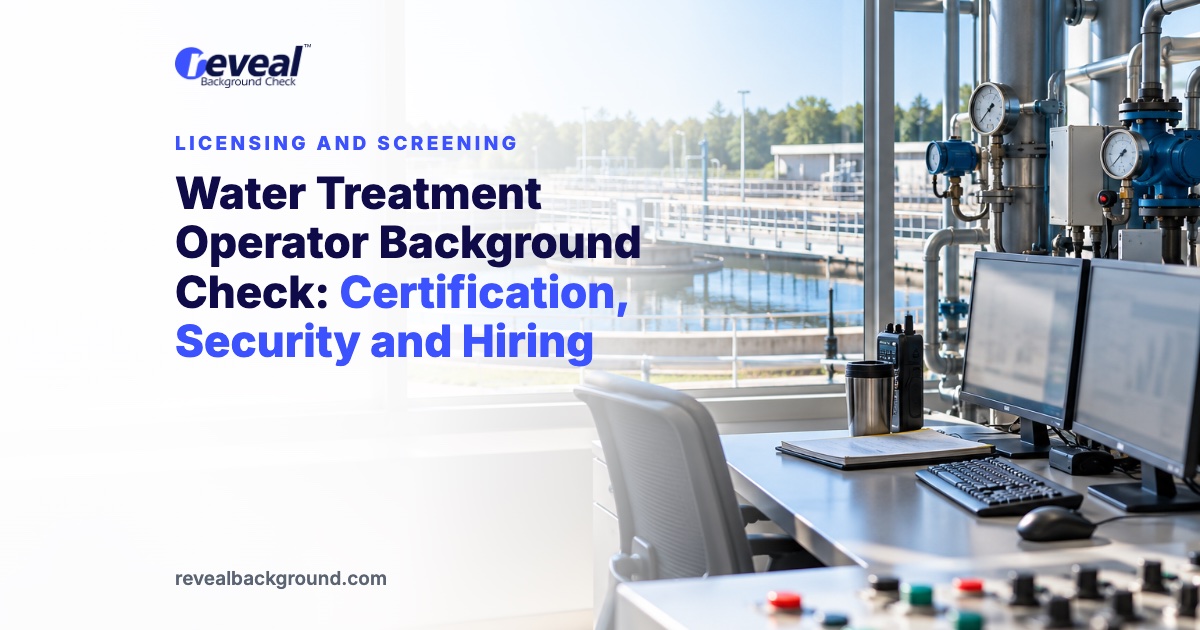
Water and wastewater treatment operators run the systems that keep drinking water safe and keep sewage from backing up into communities. The job comes with two separate layers of screening that employers and candidates often confuse: the certification a state agency issues to run a plant, and the background check a utility or contractor runs before and during employment. This guide walks through both, plus the federal rules that treat water systems as critical infrastructure and the FCRA duties that apply whenever a third party pulls a report.
Operator certification is a state function, not a federal one
There is no single national water operator license. Each state certifies operators through its own environmental or health agency, and the certification requirements, exam content, and renewal rules vary by state and by the class or grade of the facility. Two examples illustrate the pattern rather than a national norm:
- In Texas, the Texas Commission on Environmental Quality (TCEQ) occupational licensing program issues water and wastewater operator licenses, sets training provider standards, and publishes criminal history requirements that applicants must meet to hold a license.
- In California, the State Water Resources Control Board’s Division of Drinking Water operator certification program certifies treatment and distribution operators by grade level, based on experience, education, and a state exam.
Operators should confirm the current rule with their own state board rather than assume another state’s requirements apply. Where a state does not require a criminal history check as part of certification, that should not be read as a gap. It simply means the screening responsibility sits with the hiring utility or contractor instead of the certifying agency.
Water systems are treated as critical infrastructure
Separate from individual operator certification, federal law treats drinking water and wastewater systems as critical infrastructure because of the public health and safety consequences of disruption. The Cybersecurity and Infrastructure Security Agency (CISA) designates water and wastewater systems as a critical infrastructure sector, describing it as a national critical function whose disruption, through physical attack, cyberattack, or contamination, could have a debilitating effect on public health and economic stability.
On the regulatory side, the America’s Water Infrastructure Act (AWIA) of 2018 requires community water systems serving larger populations to complete risk and resilience assessments and emergency response plans, covering physical security, cybersecurity, and operational resilience. The EPA’s water resilience program page is the primary source for current AWIA assessment requirements and deadlines by system size. Utilities that fall under AWIA generally build physical and operational security, including facility access control, into the same resilience planning that covers staffing decisions, which is one reason many systems run criminal history checks on operators and anyone with unsupervised plant or system access even where state certification itself does not require one.
Certification levels and operator-in-training paths
Most state programs certify operators in graded levels, with the grade tied to the size, complexity, or treatment process of the plant a person is allowed to operate independently. A candidate typically starts as an operator-in-training or at the lowest grade, logs supervised hours at a facility, and sits for a state exam before advancing to a higher grade that allows independent operation of larger or more complex systems. Renewal usually requires continuing education hours tracked by the state board, and lapses or disciplinary actions against a license are handled by that same board, not by a federal agency. Because the structure differs state to state, a multi-state utility or contractor should verify the grade and renewal status directly with each state board where it operates rather than rely on a candidate’s self-report.
What a utility’s background check typically covers
Because operator roles combine physical plant access, control system access, and sometimes driving duties, utility and contractor background checks tend to be broader than a single database search. Typical components include:
| Screening element | Why it applies to this role |
|---|---|
| Criminal history check | Operators have unsupervised access to treatment facilities, chemical storage, and in many systems, the control infrastructure identified as critical infrastructure. |
| State certification verification | Confirms the candidate holds a valid, current operator certificate or license at the required grade for the facility, directly with the state board. |
| Motor vehicle record (MVR) | Applies when the role involves driving a utility or service vehicle between sites, sample collection runs, or commercial vehicle operation. |
| CDL drug and alcohol query | If the position requires a commercial driver’s license, federal rules require employers to query the FMCSA Drug and Alcohol Clearinghouse before allowing a person to drive a commercial motor vehicle. |
| Employment and certification verification | Confirms prior utility or contractor experience and that any required apprenticeship or operator-in-training hours were actually completed. |
| Drug testing | Common at utilities given the safety sensitivity of plant operations, and required separately for CDL positions under DOT rules. |
A background check does not show the same things in every state, and the seven year reporting limit on many types of records varies by state law and by the type of record. Employers should confirm what their consumer reporting agency can lawfully report in their state rather than assume uniform results nationwide.
FCRA duties when a third party runs the check
When a utility, municipality, or contractor uses a consumer reporting agency to run a background check on an operator candidate or employee, the Fair Credit Reporting Act and its implementing Regulation V apply. The Consumer Financial Protection Bureau’s Regulation V and the underlying Fair Credit Reporting Act, 15 U.S.C. 1681, require the employer to:
- Provide a clear, standalone written disclosure that a background check will be obtained, separate from the job application.
- Get the candidate’s written authorization before requesting the report.
- Send a pre-adverse action notice, a copy of the report, and the consumer’s Summary of Rights before deciding not to hire or to take an adverse action based on the report.
- Give the candidate a reasonable opportunity to respond, then send an adverse action notice if the employer proceeds with the decision.
Public employers, such as a municipal water authority, should also confirm whether their state or local fair chance hiring law adds timing or disclosure requirements beyond the federal floor. Employers evaluating a criminal record should generally apply the framework in the EEOC’s enforcement guidance on arrest and conviction records, which recommends considering the nature of the offense, the time elapsed, and the nature of the job rather than applying a blanket exclusion. An employer generally may consider a relevant conviction in making a hiring decision, but should consult counsel on how to apply that consideration consistently and lawfully.
Physical access, cybersecurity, and the case for ongoing screening
Because water and wastewater facilities are designated critical infrastructure, many utilities extend screening beyond the initial hire. An operator with credentials to a supervisory control and data acquisition (SCADA) system or chemical storage area represents a different risk profile than most roles, which is why some utilities build periodic rescreening, badge access reviews, or re-verification of certification status into their broader resilience planning rather than treating the background check as a one-time event. The scope and frequency of any ongoing screening is a utility policy decision, and should be applied consistently and in a way that still respects FCRA notice and authorization requirements each time a new report is pulled. A utility that wants to rescreen current employees generally needs a new disclosure and authorization for that later report, the same as it would for a new candidate.
Contractors and vendors who send personnel onto utility property for maintenance, construction, or IT work raise a related question: who runs the background check on a subcontractor’s employee. Utilities should set this expectation in the contract itself, specifying what level of screening the contractor must complete and how certification or access badge issuance is verified, rather than assuming the general contractor’s own hiring process automatically meets the utility’s security requirements.
Frequently asked questions
Does every state require a criminal history check to get a water operator certification?
No. Certification requirements vary by state. Some state boards, such as Texas’s TCEQ, publish criminal history requirements as part of occupational licensing. Where a state’s certifying agency does not impose one, the hiring utility or contractor may still run its own criminal history check as a condition of employment.
Is a background check required before someone can work as a water treatment operator?
There is no single federal law requiring a background check for every water operator role. Many utilities and contractors choose to run one because of the plant access, public health stakes, and critical infrastructure designation involved, and some state or local employers may have their own policies.
Do CDL requirements apply to water utility drivers?
If the role requires operating a commercial motor vehicle above the federal weight or passenger thresholds, the employer must comply with DOT and FMCSA rules, including a query of the FMCSA Drug and Alcohol Clearinghouse before permitting the person to drive.
What happens if a background check turns up a criminal record?
The employer must follow FCRA’s pre-adverse action process: provide a copy of the report and the Summary of Rights, give the candidate a chance to respond, and only then proceed to a final adverse action notice if the decision stands. Employers generally should weigh the nature and age of the offense against the specific duties of the role rather than apply an automatic exclusion.
Can an operator’s certification be affected by a criminal conviction after they are already licensed?
This depends on the state board’s specific rules, which vary. Operators should check directly with their certifying agency rather than assume a rule from another state or industry applies.
Are water systems actually considered critical infrastructure?
Yes. CISA designates water and wastewater systems as a critical infrastructure sector, and larger community water systems have separate federal risk and resilience assessment obligations under the America’s Water Infrastructure Act.
Related reading
- Utility Worker Background Checks: Access, Safety, and Compliance
- CDL Truck Driver Background Check Requirements: FMCSA Rules, Clearinghouse and MVR Checks
Utilities and contractors building a screening program for certified operators can see how Reveal Background structures criminal history, MVR, and verification packages around FCRA requirements.
This article is general information, not legal advice. Employers should consult qualified counsel to confirm requirements for their state and workforce.