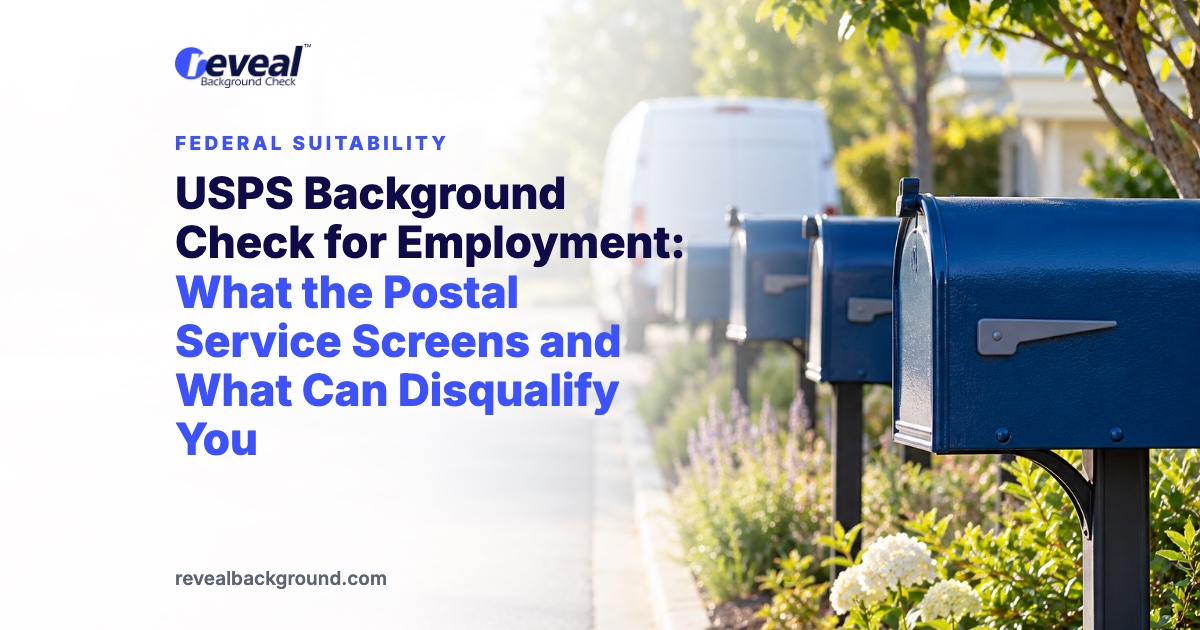
The United States Postal Service hires several hundred thousand career and non career employees, and every one of them goes through a pre employment screening process before they carry mail, work a window, or drive a delivery route. That process looks different from a typical private sector background check. USPS is a federal entity, so hiring decisions are governed by federal suitability rules rather than a simple pass or fail report. This post walks through what the Postal Service actually reviews, how a disqualifying record is decided, and how the federal process compares to the background check most private employers run under the Fair Credit Reporting Act.
The basic steps in the USPS hiring process
Applicants apply through the USPS careers site, which lists open positions and the application requirements for each craft. Once a conditional job offer is extended, the applicant typically moves through several screening steps before a final start date is confirmed:
- A criminal history and background questionnaire covering roughly the last five years of employment and residence history, along with any criminal record disclosures.
- A fingerprint based criminal history check submitted through the FBI’s criminal records system.
- A pre employment drug screen.
- For positions that require operating a postal vehicle, a review of the applicant’s motor vehicle record and driving history.
- Verification of Selective Service registration for male applicants born after 1959, since federal employment generally requires proof of registration or a valid exemption.
- A suitability review that weighs the information gathered against the specific duties of the position.
Selective Service registration is a separate federal requirement from the background check itself. Most men living in the United States between ages eighteen and twenty five must register, and federal agencies are directed to confirm registration status as a condition of employment. Applicants who are unsure whether they are registered can check directly through the Selective Service System.
The five year history questionnaire
Before the fingerprint check comes back, applicants complete a written history covering the places they lived and worked over roughly the preceding five years, along with questions about prior convictions, military discharge characterization, and whether they were ever fired or asked to resign. Postal hiring staff use this questionnaire to confirm identity, check references, and flag anything that needs a closer look once the fingerprint results arrive. Giving false or incomplete answers on this questionnaire is treated separately from the underlying conduct. An applicant who lies on a federal employment form can be found unsuitable for that reason alone, even if the conduct itself would not have been disqualifying.
The fingerprint based criminal history check
USPS submits each applicant’s fingerprints for a national criminal history check rather than relying only on self reported information or a database search. A fingerprint based check pulls directly from criminal history records held at the state and federal level, which is more complete than a name based search and catches records that a name search can miss, including cases filed under a different name or in a jurisdiction the applicant did not list. The Office of Personnel Management, which sets suitability policy for most of the federal workforce, describes investigative standards for positions across agencies, including USPS, on its suitability and background investigations page.
Drug screening and the medical review officer
Most USPS positions require a negative pre employment drug test as a condition of the job offer. A specimen is collected and sent to a certified laboratory, and any result reported as non negative is reviewed by a medical review officer before it is reported to the hiring office. The medical review officer’s role is to determine whether a legitimate medical explanation, such as a current prescription, accounts for the result. This post does not discuss avoiding a drug screen; the detection and verification process exists specifically to rule out evasion and confirm legitimate medical use.
How suitability decisions actually get made
This is the part that surprises a lot of applicants: a criminal record does not automatically disqualify someone from a USPS job. Suitability determinations for federal employment are governed by 5 CFR Part 731, which lays out the specific factors a hiring agency must weigh before finding someone unsuitable. Those factors, detailed in 5 CFR 731.202, include the nature and seriousness of the conduct, how long ago it happened, the applicant’s age at the time, evidence of rehabilitation, and how directly the conduct relates to the duties of the specific position being filled. In practice, this means two applicants with similar records can get different outcomes depending on the job, how much time has passed, and what else is in the file.
Certain categories of conduct carry more weight in a suitability review regardless of the specific position: recent violent offenses, recent drug trafficking offenses, and any finding of dishonesty, especially dishonesty connected to the application itself or to prior government service. A dismissal for cause from a prior federal job, a falsified employment application, or a pattern of recent serious offenses are the kinds of findings that make an unsuitable determination far more likely. A single older, non violent conviction with a demonstrated period of stability afterward is treated very differently under the same regulation.
Oversight of the Postal Service’s hiring and conduct standards
The USPS Office of Inspector General is the independent oversight body that audits Postal Service operations, including personnel and hiring related controls, and investigates misconduct inside the organization. Its reports are a useful public window into how consistently the agency’s own screening and conduct standards are actually applied in practice.
Federal suitability versus a private employer background check
Private employers screening job applicants operate under a completely different legal framework than federal suitability review. A private employer background check is governed by the Fair Credit Reporting Act, which the Consumer Financial Protection Bureau implements through Regulation V. Under that framework, an employer must get the applicant’s written authorization before pulling a report, and if the employer decides not to hire based in whole or in part on the report, it must send a pre adverse action notice, give the applicant a chance to respond, and then send a final adverse action notice if the decision stands. A federal suitability review does not run through that same notice and dispute structure, because the employer is the federal government and the process is governed by civil service law rather than the FCRA.
| Feature | USPS federal suitability review | Private employer FCRA background check |
|---|---|---|
| Governing framework | 5 CFR Part 731 and related civil service suitability rules | Fair Credit Reporting Act and Regulation V |
| Criminal record source | Fingerprint based criminal history check | Varies by vendor; often name based with record level verification |
| Decision standard | Case by case weighing of listed suitability factors | Employer’s own policy, subject to EEOC guidance and state and local fair chance laws |
| Required notices | Agency specific suitability procedures | Pre adverse action notice, copy of report, Summary of Rights, final adverse action notice |
| Dispute path | Internal suitability appeal processes | Direct dispute with the consumer reporting agency and the furnisher |
Dispute rights depend on which process applies
If a private employer background check contains an error, the applicant has a federal right to dispute it directly with the consumer reporting agency that produced the report, and that agency must reinvestigate within a defined timeframe. That dispute right comes from the FCRA, not from federal suitability law, so it applies to the private sector report, not to a federal background investigation conducted directly by a federal agency. Our related post on how applicants dispute a background check walks through that process step by step. Readers weighing a federal suitability review against the separate world of security clearance investigations may also find our post comparing security clearance reviews and employment background checks useful, since the two are often confused but run on different legal tracks entirely.
What this means for applicants
A record in an applicant’s past is not an automatic bar to a Postal Service job in most cases. What tends to matter most is how recent and how serious the conduct was, whether it involved violence or drug trafficking, and whether the applicant was honest about it on the application and questionnaire. Dishonesty on the forms themselves is treated as its own problem, separate from whatever the underlying record shows. Applicants with questions about a specific record are generally better served asking the hiring office how the suitability factors apply to their situation than guessing at the outcome in advance.
Frequently asked questions
Does a felony conviction automatically disqualify someone from a USPS job?
No single type of record results in an automatic bar for most positions. Suitability determinations under 5 CFR Part 731 are made case by case, weighing the nature of the conduct, how long ago it occurred, and its relevance to the specific job. Certain conduct, such as recent violent offenses or dishonesty on the application, carries more weight.
Does USPS use a fingerprint based check or a name based database search?
USPS submits applicant fingerprints for a criminal history check rather than relying solely on a name based search, which generally produces a more complete record than name based searches alone.
Do all USPS applicants need to register with Selective Service?
Most male applicants born after 1959 generally must be registered with the Selective Service System or qualify for an exemption to be eligible for federal employment, including USPS positions. Applicants can verify their own registration status directly with the Selective Service System.
Can an applicant dispute an error found during a USPS background check?
The dispute path depends on which part of the process is involved. Errors in a fingerprint based criminal history record generally go through FBI record correction procedures, while federal suitability decisions have their own internal review channels, separate from the FCRA dispute rights that apply to private sector consumer reports.
Is a USPS suitability review the same as a security clearance investigation?
No. Most USPS positions involve a suitability determination, not a security clearance. A smaller number of postal positions that involve national security access may require a higher level investigation, but that is a separate process from the standard pre employment suitability review most applicants go through.
What disqualifies someone from driving positions specifically?
Positions that require operating a postal vehicle include a review of the applicant’s motor vehicle record in addition to the standard screening steps, and a poor driving history or a disqualifying license status can affect eligibility for those specific roles even when it would not affect a non driving position.
This article is general information about the USPS hiring and federal suitability process, not legal advice. Employers and applicants with specific questions should consult the applicable federal regulations or qualified counsel. Learn more about compliant background screening at Reveal Background.