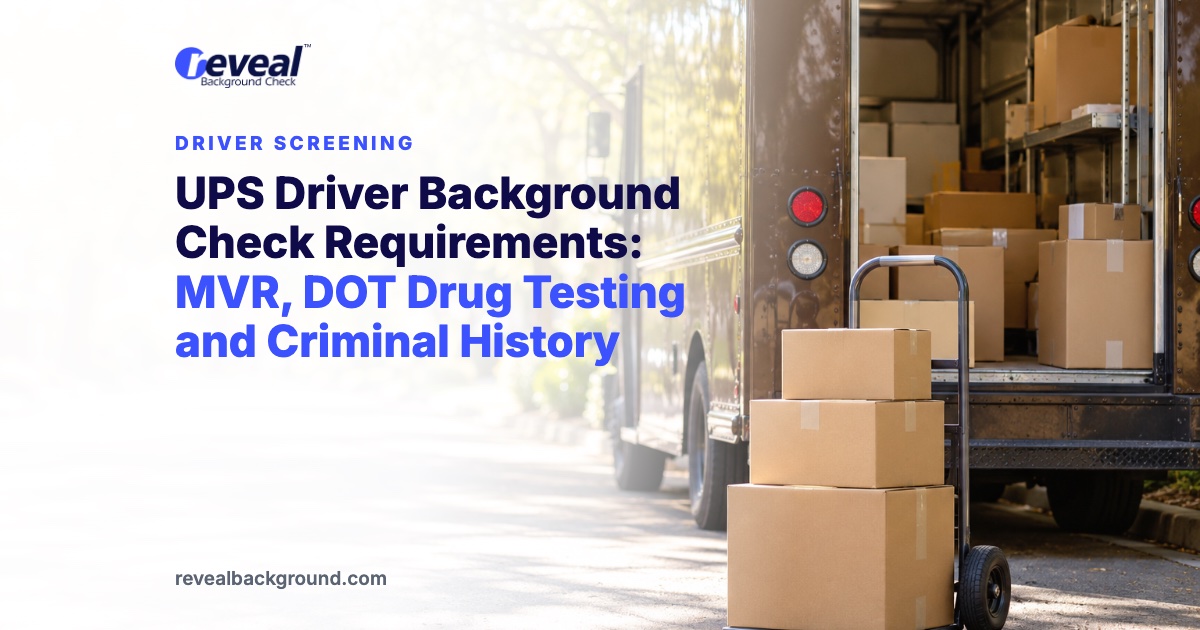
UPS drivers are employees of United Parcel Service, not independent contractors, and they go through an employer background check like any other hire. What gets checked, and which federal rules apply, depends heavily on the vehicle the driver operates. A package car driver in a van under 26,001 pounds is screened differently than a feeder (tractor trailer) driver who needs a commercial driver’s license. This post walks through the general screening employers in this role run, where federal Department of Transportation rules kick in, and what job seekers and hiring teams should expect.
Two very different driving jobs under one employer
UPS hires for several driver roles, and the vehicle class is what determines whether federal commercial driver rules apply.
- Package car drivers drive the familiar brown delivery vans and box trucks. Most of these vehicles fall under 26,001 pounds gross vehicle weight rating, so the driver typically does not need a commercial driver’s license (CDL) and is not automatically subject to the full set of federal “driver qualification” rules written for commercial motor vehicles.
- Feeder drivers operate tractor trailers between hubs and need a Class A CDL. Any employee who drives a commercial motor vehicle that meets the federal definition, generally a combination vehicle over 26,001 pounds or one that requires a CDL, is a “driver” under the Federal Motor Carrier Safety Administration’s (FMCSA) safety regulations and is covered by the federal rules described below.
Seasonal helpers and temporary peak season drivers are hired through the same employer process, though hiring volume and timelines shift around peak shipping periods. The underlying screening obligations do not change because a role is seasonal or union represented; what changes is scheduling and training logistics.
Federal DOT rules that apply to CDL and commercial drivers
For drivers who operate a commercial motor vehicle covered by the Federal Motor Carrier Safety Regulations, several background and health checks are not optional. These rules come from Title 49 of the Code of Federal Regulations and apply regardless of which company employs the driver.
Driving record and safety performance history
Before letting someone drive a covered commercial vehicle, a motor carrier must investigate the applicant’s driving record for the preceding three years and request safety performance history from the applicant’s previous DOT regulated employers going back three years, as set out in the driver qualification regulations at 49 CFR Part 391. The carrier reviews state motor vehicle record (MVR) history, prior accidents, and any record of safety violations before a conditional offer becomes final, and again on an annual basis once the person is driving.
Commercial driver’s license requirements
Feeder and other CDL positions are governed by the Commercial Driver’s License standards at 49 CFR Part 383, which set the testing, endorsement, and disqualification rules a CDL holder must meet, including disqualifying offenses such as certain traffic and substance related convictions. A carrier must also confirm the license is valid and not currently disqualified, suspended, or revoked.
DOT drug and alcohol testing
Drivers subject to the commercial driver qualification rules must pass a pre employment controlled substances test before they first drive, and are subject to random, reasonable suspicion, post accident, return to duty, and follow up testing under the DOT drug and alcohol testing rules at 49 CFR Part 382. A medical review officer reviews any non negative lab result and confirms whether a legitimate prescription explains it before any result is reported to the employer.
The Drug and Alcohol Clearinghouse
Employers of CDL drivers are also required to query the FMCSA Drug and Alcohol Clearinghouse before hiring a CDL holder and at least annually for current drivers. The Clearinghouse is a database of drug and alcohol program violations reported by employers, medical review officers, and testing labs across the industry, so a violation at one carrier follows the driver rather than disappearing when they change jobs.
None of these federal rules apply to a role that does not require operating a covered commercial motor vehicle, such as most package car routes in a smaller van. For those roles, screening is governed by ordinary employer policy and state law rather than the DOT driver qualification framework.
Criminal history and state rules
There is no single nationwide fingerprinting or state licensing requirement that applies to delivery drivers the way there is for, say, a nurse or a notary. Whether a criminal history check includes fingerprint based state or FBI records, or is limited to a name based county and multistate records search, depends on the employer’s process and on state law where the job is located. Several states and cities also restrict when and how an employer can ask about or act on criminal history, commonly through “fair chance” or ban the box laws; those rules vary by jurisdiction and are not uniform, so a hiring team should check the specific state and local law that applies to the location, rather than assume one rule applies everywhere.
Employers that use criminal history in hiring decisions should also be mindful of federal guidance on individualized assessment, including considering the nature of the offense, how much time has passed, and the job’s duties, which the Equal Employment Opportunity Commission’s enforcement guidance on arrest and conviction records addresses. This is general background, not legal advice, and employers should consult counsel on how it applies to a specific hiring decision.
| Screening element | Package car driver (non CDL) | Feeder / CDL driver |
|---|---|---|
| Criminal history check | Per employer policy and state/local law | Per employer policy and state/local law |
| Motor vehicle record (MVR) | Commonly checked by employer | Required, 3 year review under 49 CFR 391 |
| DOT drug and alcohol testing | Not required by DOT rule | Required under 49 CFR 382 |
| Clearinghouse query | Not applicable | Required before hire and annually |
| License verification | Standard driver’s license | CDL status and endorsements under 49 CFR 383 |
What employers must handle under the FCRA
When an employer uses a third party consumer reporting agency to run these checks, the Fair Credit Reporting Act sets procedural duties that apply regardless of the driving role. The employer generally must provide a standalone disclosure and get written authorization before ordering the report, and if the employer plans to take an adverse action based on the report, it must send a pre adverse action notice with a copy of the report and a summary of rights, allow the applicant a reasonable opportunity to respond, and then send an adverse action notice if it proceeds. The Federal Trade Commission’s guidance on using consumer reports for employment lays out these employer duties in plain terms. A background check does not automatically disqualify every applicant with a record; what it reports and how it is used varies by employer policy, by the role, and by state law, and no report can be said to show every record in every case.
Frequently asked questions
Does UPS require a CDL for all driver jobs?
No. Package car drivers generally operate vehicles under 26,001 pounds and typically do not need a CDL. Feeder drivers who operate tractor trailers between hubs do need a commercial driver’s license with the appropriate class and endorsements.
Is DOT drug testing required for every UPS driver?
DOT drug and alcohol testing under 49 CFR Part 382 applies to drivers who operate a commercial motor vehicle covered by the federal driver qualification rules, which generally means CDL required vehicles. Non CDL delivery roles are not automatically subject to the DOT testing program.
Does a criminal record automatically disqualify a driver applicant?
There is no universal rule that says a given conviction automatically disqualifies every driving applicant everywhere. Employer policy, the nature and age of the offense, and state and local law on criminal history in hiring all factor in, and these vary by jurisdiction.
What is the FMCSA Drug and Alcohol Clearinghouse?
It is a federal database that records drug and alcohol program violations for CDL holders. Employers of CDL drivers must query it before hiring and at least annually, so a violation reported by one employer is visible to the next.
Do seasonal UPS drivers go through the same screening?
The screening obligations are based on the role and the vehicle, not on whether the position is seasonal. A seasonal feeder driver is still subject to the federal CDL driver rules; a seasonal package car driver is screened under the same non CDL process as a permanent hire in that role.
Can an employer see a driver’s full driving history from every state?
Motor vehicle record checks pull from the state or states that issued and recorded the driver’s history. Coverage and detail vary by state, which is part of why the federal rules require carriers to request safety performance history directly from a CDL driver’s previous DOT regulated employers as well.
For employers building or auditing a driver screening program, related reading: DOT Background Check Requirements for Drivers: What FMCSA Actually Requires and The FMCSA PSP Report: What Driver Hiring Teams See and How to Use It. To see how Reveal Background supports FCRA compliant screening programs, visit revealbackground.com.
This article is general information, not legal advice. Employers should consult qualified counsel about how federal, state, and local screening and employment law apply to a specific hiring decision.