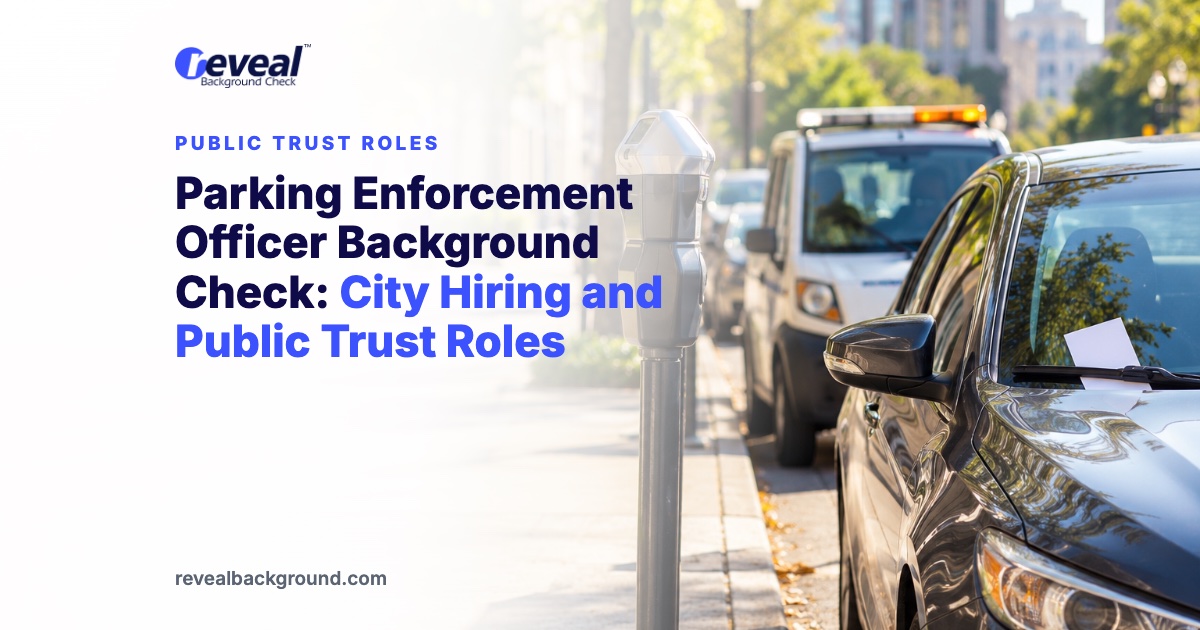
Parking enforcement officers, sometimes called parking control officers or traffic enforcement agents depending on the city, are civilian municipal employees. They are not sworn police officers, but they carry limited authority to issue citations, interact with the public daily, drive a city vehicle on patrol, and sometimes handle payment disputes or towing decisions. Because the job combines public contact, driving, and a position of public trust, most cities and counties put applicants through a civilian background screening process before hire, even though there is no single federal license that governs the role.
Who actually sets the hiring rules
There is no federal statute or national licensing board for parking enforcement officers. The job is created and regulated entirely at the city, county, or transit authority level, through each employer’s own civil service rules, human resources policy, and municipal code. That means requirements vary by jurisdiction, and a candidate should always confirm the specific posting and civil service rules for the city or agency they are applying to rather than assume a nationwide standard. What is consistent nationally is the federal law that governs how any employer, public or private, must run a background check once it decides to use one, and the federal guidance that shapes how criminal history can be weighed in the hiring decision.
Criminal history and fingerprinting
Most municipal employers require a criminal history check as part of hiring any civilian employee who will be in a public facing, public trust, or vehicle operating role, and many require that the check be based on fingerprints rather than a name only search. Fingerprint based checks are run against a state criminal record repository and, when authorized, against the FBI’s national database, so they catch out of state and federal history that a county court search alone might miss. California’s Department of Justice describes the process plainly: an applicant is fingerprinted through a Live Scan operator, the prints are submitted electronically, and the state repository returns a report to the hiring or licensing agency based on dissemination rules set by statute for that category of employment, as explained by the California Department of Justice. Not every city requires fingerprint based screening for parking enforcement specifically, and some run a standard name and date of birth criminal history check instead, so applicants should ask the hiring department which method applies to the position rather than assume one way or the other.
Driving record review
Because the job involves patrolling in a city owned or marked vehicle, most parking enforcement postings require a valid driver’s license and an acceptable motor vehicle record, and a clean driving history is often reviewed alongside the criminal background check. Agencies that regularly need to see an employee’s current driving record, not just a one time snapshot at hire, commonly enroll the position in an ongoing driver monitoring arrangement with their state’s motor vehicle department so that a new violation or license suspension is flagged without waiting for the next renewal cycle. The exact MVR standard, including how many points or what kind of violation disqualifies a candidate, is set by the hiring jurisdiction and should be confirmed in the job posting or civil service rule for that specific agency.
Drug testing and medical screening
Parking enforcement officers who drive a city vehicle on public streets are not automatically subject to the federal Department of Transportation testing rules that apply to commercial truck and bus drivers, because the position typically does not require a commercial driver’s license. Some cities nonetheless require a pre employment drug screen as a matter of local personnel policy, particularly where the position is classified alongside other public safety adjacent civilian roles. Whether a drug test applies, and under what policy, again depends entirely on the hiring city or county, so applicants should check the specific job announcement.
How criminal history is supposed to be weighed
Federal civil rights law does not say that any employer, including a city government, may automatically reject an applicant because of an arrest or conviction. Under Title VII of the Civil Rights Act, the U.S. Equal Employment Opportunity Commission’s guidance explains that an employer should look at the nature and gravity of the offense, the time that has passed, and the nature of the job before excluding someone based on a criminal record, because a blanket exclusion policy can have a disproportionate effect on some groups of applicants and is not automatically lawful just because it is applied evenly, according to the EEOC’s enforcement guidance. Many states and cities also have their own fair chance or ban the box rules that go further than federal law, for example by delaying when a public employer can ask about criminal history in the hiring process. Those rules differ by location, so a candidate should not assume the federal floor is the only rule in play.
When a city uses an outside background check company
Some municipal human resources departments run background checks in house, often through direct access to a state fingerprint repository. Others contract with a third party consumer reporting agency to pull and compile the report. When a city or county uses an outside company for this purpose, the hiring process is covered by the federal Fair Credit Reporting Act, and the employer has specific duties regardless of how routine the job seems. The employer must give the applicant a clear, standalone disclosure that a background check will be obtained, get the applicant’s written authorization, and if the city decides not to move forward based on something in the report, it must first send a pre adverse action notice with a copy of the report and a summary of the applicant’s rights, give the applicant a reasonable chance to respond, and only then send a final adverse action notice if it proceeds with the decision. These procedures are set out in the Consumer Financial Protection Bureau’s implementing regulation for the Fair Credit Reporting Act, codified at 12 CFR part 1022, subpart H, and the Bureau’s own summary of the rule confirms that these disclosure and adverse action requirements apply whenever a consumer report is used for an employment decision. A background check will not necessarily surface a record in every state, and what counts as reportable and for how long varies by state law, so no applicant should be told a report is certain to show, or certain to hide, any particular history.
What a typical screening package looks like
| Screening element | Why it applies to this role | Set by |
|---|---|---|
| Criminal history check, sometimes fingerprint based | Public trust position with daily public contact and citation authority | City, county, or transit agency civil service rules |
| Motor vehicle record review | Officer patrols and drives a marked city vehicle | Hiring agency and state DMV standards |
| Pre employment drug screen (where required) | Local personnel policy for the classification | City or county human resources policy |
| FCRA disclosure, authorization, pre adverse and adverse action notices | Applies whenever a third party consumer reporting agency runs the check | Federal law, 12 CFR part 1022 subpart H |
| Ban the box or fair chance timing rules | May restrict when criminal history can be asked about in public hiring | State or local fair chance law, where one exists |
Frequently asked questions
Is a parking enforcement officer a licensed profession?
No. There is no federal or statewide professional license for the role. Hiring requirements, including background screening, are set by the individual city, county, or agency that employs the officer.
Do parking enforcement officers need fingerprint based background checks?
Many public employers require fingerprint based criminal history checks for civilian positions that involve public contact, and some run them through a state repository such as California’s Department of Justice. Whether this specific role requires fingerprinting depends on the hiring jurisdiction, so applicants should confirm with the agency.
Will a past arrest automatically disqualify an applicant?
Not automatically. Federal guidance from the EEOC says employers should weigh the nature of the offense, how much time has passed, and the nature of the job rather than apply a blanket exclusion. State and local fair chance laws may add further protections.
Does the job require a drug test?
It depends on the city. Parking enforcement officers generally do not need a commercial driver’s license, so they are not automatically covered by federal commercial driver drug testing rules, but some local governments still require a pre employment screen under their own personnel policy.
What happens if a city uses an outside company to run the background check?
The Fair Credit Reporting Act applies. The applicant must get a standalone disclosure and give written authorization before the check runs, and if the city plans to reject the applicant based on the report, it must send a pre adverse action notice with a copy of the report and a summary of rights before making a final decision.
Is a driving record check part of this background check?
Typically yes, because the role involves driving a city vehicle. The specific standard for what driving history is acceptable is set by the hiring agency and state motor vehicle department, not by a single national rule.
Related reading
For another civilian municipal role with similar public trust screening, see our guide to school crossing guard background check requirements. For how fair chance timing rules can affect any public sector hiring process, see ban the box and fair chance hiring laws. Employers who need to build a compliant screening program for civilian public roles can learn more at Reveal Background.
This article is general information, not legal advice. Hiring requirements for public employees vary by city, county, and state, and employers should confirm current rules with their own counsel and the applicable civil service authority.