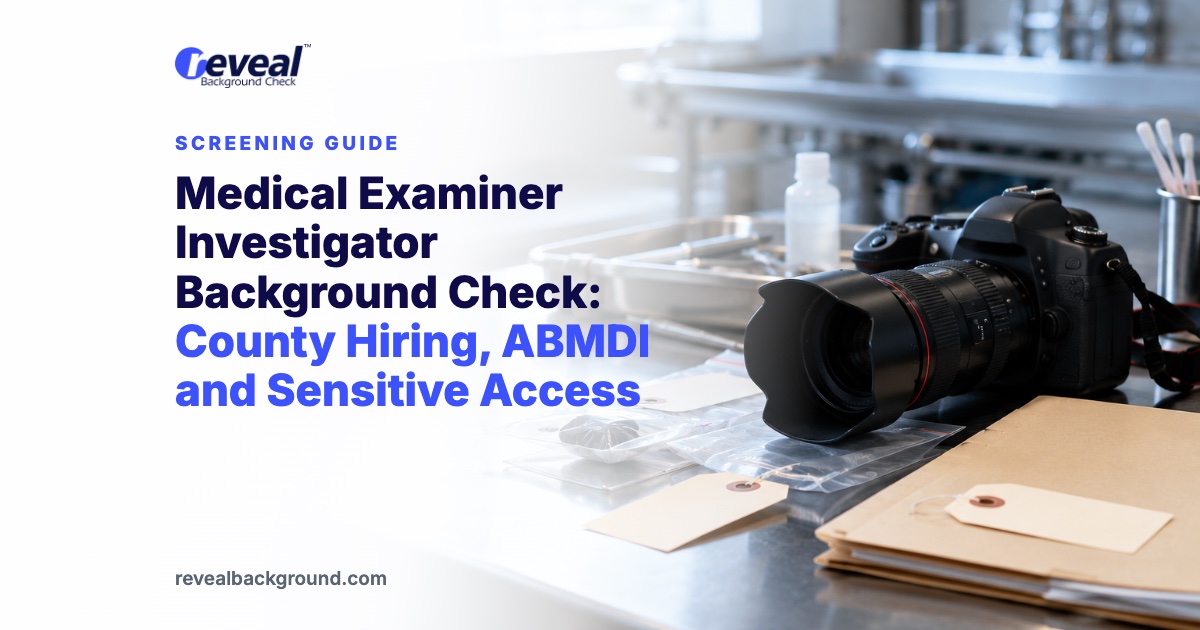
A medical examiner investigator, sometimes called a medicolegal death investigator, works for a county or state government to determine the circumstances, manner and cause of unexpected, violent or unattended deaths. The job sits next to law enforcement but is a civilian, public health and public safety role at the same time. Investigators enter homes, workplaces and crime scenes, collect evidence, handle personal property, and read sensitive medical, financial and criminal history records about the people they investigate. Because of that access, the hiring background check for this role is typically more extensive than a standard government employment screen.
What the job actually involves
Medicolegal death investigators respond to death scenes, document the scene and the body, interview witnesses and family members, collect evidence for toxicology and autopsy, and coordinate with law enforcement, funeral homes and next of kin. The scope and depth of this work, including scene documentation and chain of custody for evidence, is described in detail in the Department of Justice guide for scene investigators, which lays out the core tasks that most offices expect a trained investigator to perform. You can read that guide directly at the National Institute of Justice death investigation guide.
Because investigators are frequently the first government representative inside a home after a death, and because they handle evidence that may later matter in a criminal case, offices treat the position as sensitive even when the investigator has no arrest power.
Why the background check is strict
Medical examiner and coroner offices are almost always county or state government employers, which means the hiring process generally follows the same civil service and personnel rules used for other public safety and health department staff. A real, currently posted state medicolegal death investigator opening makes the scope of that screening clear: employment is contingent on a satisfactory state and federal criminal history background check, a check against the state child abuse and neglect central registry, a federal health and human services exclusion list check, reference checks and E-Verify, with financial, credit or driving checks added for some positions. You can read that posted requirement language at Virginia’s own state employment listing for a medicolegal death investigator position.
That is one jurisdiction’s posting, not a national standard, and the exact list of checks varies by county and by state personnel rules. What is consistent across most offices is the theme: criminal history, any history involving vulnerable people such as children or patients, and financial integrity checks for a role that may handle valuables recovered from a scene.
| Screening element | Why it is used | How common |
|---|---|---|
| State and federal criminal history check | Role enters homes and scenes alone, handles evidence and property | Standard in most offices |
| Driving record review | Investigators drive county vehicles to scenes, often on call | Common where field response is required |
| Drug testing | Same safety sensitive standard used for other scene responders | Common, policy varies by employer |
| Polygraph examination | Some offices housed inside a sheriff or police department apply the same pre employment step used for sworn hires | Not universal, varies by agency |
| Credit or financial history check | Access to recovered cash, jewelry and personal property from scenes | Used by some, not all, employers |
| Abuse and neglect registry checks | Investigators may handle cases involving minors or dependent adults | Required where state registries exist |
Scene access, evidence and records are the real sensitivity
The part of this job that drives the background standard is not the title, it is the access. A medical examiner investigator may be present at a scene that is still an active criminal investigation, may handle evidence before it reaches a crime lab, and may need to query criminal history or law enforcement records systems to identify a decedent or next of kin. Access to criminal justice information systems and the dissemination of criminal history record information are governed at the federal level under the rules that control how that data can be shared and with whom, which is one reason agencies vet investigators closely before granting system access. The underlying federal framework is published at 28 CFR Part 20, Criminal Justice Information Systems.
Investigators also routinely see protected health information, prescription records and financial records belonging to decedents and their families. Offices generally require confidentiality agreements in addition to the background check itself, and a disqualifying item does not have to be a conviction, an unresolved pattern of financial trouble or dishonesty on the application can also end a candidacy.
ABMDI certification is a professional standard, not a licensing law
Many medical examiner investigators pursue certification through the American Board of Medicolegal Investigators, a voluntary professional credentialing body for the field. Certification generally requires a combination of education, supervised case experience and a written examination, and many offices prefer or require it for permanent investigator positions or for advancement past an entry level title. Certification is a professional standard set by the field itself, not a state occupational license, so whether it is required, preferred or optional depends entirely on the hiring office’s own job description and civil service classification. Applicants should treat a job posting’s stated requirements, not general assumptions about the field, as the actual rule for that opening.
Hiring models vary a great deal by state
There is no single national model for who performs this work. Some states run a centralized state medical examiner system with civilian investigator staff employed directly by the state. Others use a county coroner system where an elected coroner’s office hires its own investigators. A few states still rely substantially on local physicians who serve as county medical examiners, which changes who is actually hired and screened at the county level. North Carolina’s statewide system, for example, is organized around a network of county medical examiners working with the state Office of the Chief Medical Examiner, a structure that looks different from a large metro office that employs full time civilian investigators. You can see how that state describes its own structure at the North Carolina Office of the Chief Medical Examiner.
Because the organizational model differs so much by state, a candidate should not assume that the hiring process, the civil service rules, or even the job title used in one state will match another. Checking the specific county or state office’s own posting is the only reliable way to know what will be screened.
What applicants and hiring offices should keep straight on FCRA
When a government employer runs its own background check using its own personnel office and public records access, the Fair Credit Reporting Act generally does not apply in the same way it does to a private employer using a third party consumer reporting agency. If a county or state office instead contracts with an outside consumer reporting agency to run all or part of the background check, standard FCRA duties apply: a clear standalone disclosure, the applicant’s written authorization, a pre adverse action notice with a copy of the report and the Summary of Rights if the office is considering disqualifying the applicant based on that report, and a final adverse action notice if it proceeds. A background check does not automatically disqualify a candidate everywhere, state law and agency policy on how far back a record counts vary, and no report should be described as guaranteeing a hiring outcome either way.
Frequently asked questions
Is a medical examiner investigator a police officer?
Generally no. Most medical examiner investigators are civilian government employees without arrest authority, working alongside law enforcement rather than as sworn officers. Some offices are organizationally housed inside a sheriff’s department, which can affect training and screening expectations, but the title itself is not a law enforcement certification.
Do all medical examiner investigators need ABMDI certification?
Not by law. ABMDI certification is a voluntary professional credential, and whether an employer requires, prefers or does not require it depends on that specific office’s job classification. Applicants should check the actual job posting rather than assume a universal rule.
What typically shows up on the background check for this role?
Most offices run a state and federal criminal history check at minimum, and many add driving record review, drug testing, abuse and neglect registry checks, and sometimes a credit or financial history check. The exact mix varies by county and state personnel policy, so the hiring office’s own posting is the best source.
Will a past criminal record automatically disqualify an applicant?
Not automatically in every jurisdiction. Disqualification rules vary by state and by the nature and age of the record. Applicants with questions about a specific record should ask the hiring office directly rather than assume the outcome.
Why do some offices require a polygraph exam for this civilian role?
Some medical examiner or coroner offices are organized inside a sheriff’s or police department and apply the same pre employment screening steps, including a polygraph, that the agency uses for sworn hires. This is not universal and depends entirely on the individual agency’s policy.
Who actually runs the background check, the county or a private company?
It depends on the employer. Many government offices run checks in house through their own personnel department and direct access to criminal history systems. Others contract with an outside consumer reporting agency for part of the process, which brings standard federal disclosure and adverse action requirements into play.
For related county government hiring standards, see how courts handle similar criminal justice records access in our guide to court clerk background check requirements, and how another sensitive county role approaches criminal history and integrity screening in probation officer background check requirements. Employers building or reviewing a screening program for sensitive government roles can learn more at Reveal Background.
This article is general information for employers and applicants, not legal advice. Hiring and background check rules for medical examiner and coroner offices vary by state and county, and employers should confirm current requirements with their own counsel and personnel office.