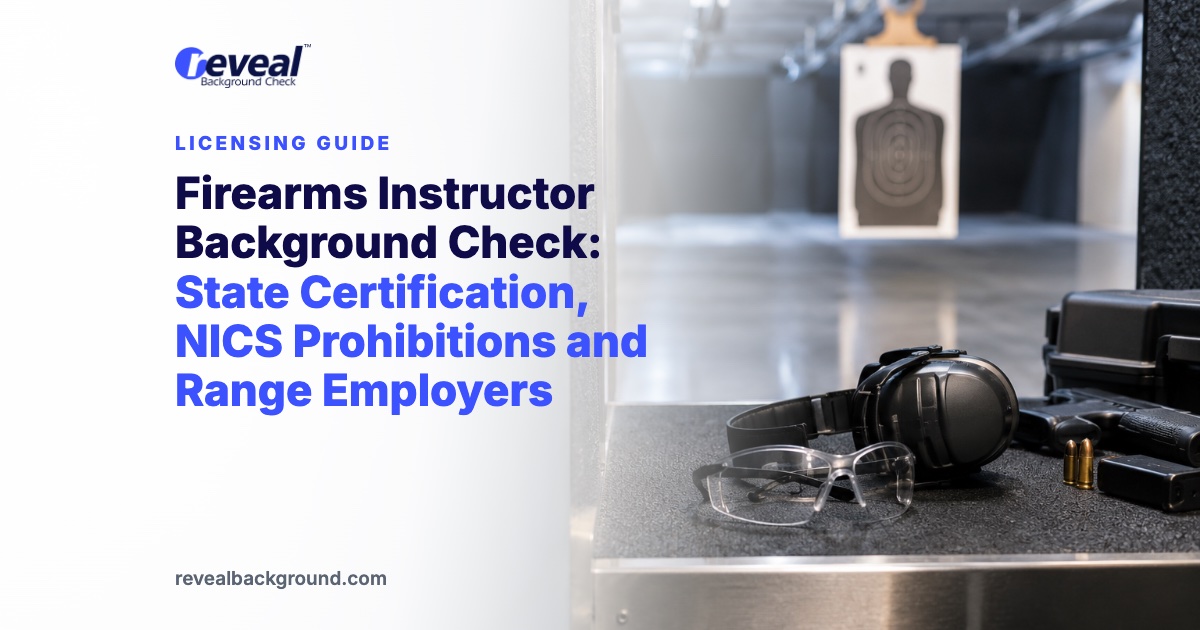
Concealed carry instructors, range safety officers who also teach, and private security firearms trainers all sit in an unusual spot. They are certified by a state agency, they handle live firearms and ammunition as part of their job, and in most states they are screened before that certification is issued and again at renewal. Employers that hire instructors, whether a gun range, a training academy, or a private security firm, generally rely on that state certification as a floor and then add their own screening on top of it.
Who actually certifies firearms instructors
There is no single federal license for firearms instructors. Certification is handled state by state, usually by the state police, a department of public safety, or a licensing board, and the rules differ depending on what the instructor is teaching. An instructor who signs off on concealed carry or license to carry training is regulated differently than a private security firearms trainer, and a hunter education instructor is regulated differently still.
Texas is a clear example. The Texas Department of Public Safety certifies License to Carry handgun instructors directly, and its instructor resources page lays out the application and renewal materials an applicant has to submit to become a DPS certified License to Carry handgun instructor. Florida takes a different approach. The Florida Department of Agriculture and Consumer Services, which administers the state’s concealed weapon license program, sets out who qualifies to teach the required training course on its concealed weapon or firearm license instructor qualification page. Virginia regulates firearms trainers who work under its private security licensing framework through the Department of Criminal Justice Services, which requires firearms instructors to keep their certification current through in-service training tracked on its firearms instructor in-service course page.
Where a state has not published a specific firearms instructor certification, the rule simply does not exist yet in that state, and an employer should not assume one does. The right move is to check that state’s police agency or professional licensing board directly rather than guess.
The federal floor: who may not lawfully possess a firearm
Regardless of what a state certification requires, federal law sets a baseline that applies to every instructor, employer, and student. Under 18 U.S.C. 922(g), a person may not ship, transport, receive, or possess a firearm or ammunition if they fall into certain categories, including a conviction for a crime punishable by more than a year in prison, being a fugitive from justice, unlawful use of a controlled substance, being subject to a qualifying domestic violence protective order, a conviction for misdemeanor domestic violence, or a dishonorable discharge from the armed forces, among other categories. The full text of these federal firearm disabilities is published by the Government Publishing Office at 18 U.S.C. 922. An instructor who cannot lawfully possess a firearm cannot lawfully teach with one, so this statute functions as the floor underneath every state certification rule.
It is worth separating this federal possession rule from the point of sale background check most people associate with buying a gun. That point of sale check runs through the National Instant Criminal Background Check System when a person buys a firearm from a licensed dealer. Becoming a certified firearms instructor is a separate process handled by the state, and it generally relies on a fingerprint based state and FBI criminal history check rather than a single NICS query, though the disqualifying categories largely overlap with the federal list above.
What the certification background check usually covers
Across the states that publish a specific firearms instructor certification, a few elements tend to repeat even though the details vary:
- A fingerprint based state and FBI criminal history record check submitted through the certifying agency, not a private vendor.
- Proof that the applicant can lawfully possess a firearm, which ties back to the federal categories under 18 U.S.C. 922.
- An underlying firearms instructor credential, such as a recognized training organization certificate, or prior law enforcement or military firearms instructor experience, that the state agency accepts or builds on top of.
- A renewal cycle with continuing or in service training, rather than a one time credential that never expires.
How certification approaches compare
| State example | Certifying agency | Background check element | Renewal pattern |
|---|---|---|---|
| Texas | Department of Public Safety | Application through DPS for License to Carry handgun instructors | Periodic renewal through DPS instructor materials |
| Florida | Department of Agriculture and Consumer Services | Instructor must meet a qualifying credential recognized by the state program | Ongoing compliance with program qualification rules |
| Virginia | Department of Criminal Justice Services | Certification tied to the state’s private security licensing framework | In service training required to keep certification current |
| Any other state | Varies, generally the state police or a licensing board | Varies, confirm directly with that state’s agency | Varies by state program |
What range and training facility employers typically add
A state instructor certification tells an employer that a person met that state’s minimum bar on the day it was issued. It does not replace an employer’s own hiring screening, and most ranges, academies, and security firms run a separate background check before putting an instructor on the payroll, for the same reasons any employer screens: liability exposure, access to firearms and ammunition inventory, and contact with the public, including minors in youth shooting programs.
When an employer orders that check from a consumer reporting agency, the Fair Credit Reporting Act sets out what has to happen. The employer must give the applicant a clear, standalone disclosure that a background check will be obtained, get the applicant’s written authorization, and if the results might lead to turning the applicant down, send a pre adverse action notice with a copy of the report and the Summary of Rights before any final decision, followed by an adverse action notice if the employer proceeds with the negative decision. A background check does not automatically surface every past record in every state, since reporting rules and lookback periods vary by state and by the type of record, so employers should not assume a report will show everything or that any particular record is hidden from it.
Disqualifiers are not automatic in every direction
A felony conviction or an active domestic violence protective order will generally block someone from lawfully possessing a firearm under federal law, which in turn generally blocks state instructor certification. Older or lower level records are a different story. Whether a particular misdemeanor, an expunged case, or a medical marijuana card under state law affects eligibility can depend on the specific state program and on federal firearm eligibility rules that do not always track state marijuana law. Employers and applicants dealing with a gray area case should talk to the certifying agency or an attorney rather than assume either outcome, since this is exactly the kind of fact specific question that a general guide cannot answer.
Related reading on Reveal Background
For a look at how background screening works on the retail side of the firearms industry, see our guide to the firearms dealer license background check. If you are comparing firearms instructor screening to other armed roles, our guide to the bodyguard license background check covers state rules for executive protection work. For employer screening across any licensed role, visit Reveal Background.
Frequently asked questions
Do firearms instructors need a background check to get certified?
In states that publish a specific firearms instructor certification, yes. The certifying agency, generally the state police or a licensing board, typically requires a fingerprint based state and FBI criminal history check as part of the application. States without a published instructor certification program do not have this requirement, so the answer depends on the state.
Does a felony conviction disqualify someone from becoming a certified firearms instructor?
A felony conviction generally prevents a person from lawfully possessing a firearm under 18 U.S.C. 922, which in turn generally prevents state certification as a firearms instructor, since the instructor has to be able to lawfully handle the firearms used in training. Outcomes can vary with expungement or restoration of rights, so this is a question for the certifying agency or an attorney in a specific case.
Is a firearms instructor run through the same background check as a gun buyer at a store?
Not exactly. A retail firearm purchase is checked through the National Instant Criminal Background Check System at the point of sale. Instructor certification is a separate state process that generally uses a fingerprint based criminal history check rather than a point of sale query, although the same federal disqualifying categories apply to both.
How often do certified firearms instructors have to renew?
This varies by state. Some agencies require periodic renewal with updated paperwork, and some, like Virginia’s framework for private security firearms trainers, require ongoing in service training to keep the certification active. Check the specific state agency’s current renewal cycle rather than assuming a fixed timeframe.
Can a range or training facility run its own background check on an instructor in addition to state certification?
Yes, and many do. State certification confirms the instructor met that state’s minimum requirement on the date of issuance. An employer that orders its own consumer report must still follow the Fair Credit Reporting Act, including proper disclosure, written authorization, and pre adverse and adverse action notices if the results affect the hiring decision.
Does holding a national training organization’s instructor certificate replace a state license?
Generally no by itself. Several states use a recognized training organization certificate as one qualifying credential toward state certification, but the state agency still issues its own certification and may still require its own background check. Confirm the specific requirement with the state agency rather than assuming a national certificate is sufficient on its own.
This article is general information, not legal advice. Background screening and firearms licensing rules vary by state and change over time, so confirm current requirements with the relevant state agency or an attorney before making a hiring or certification decision.