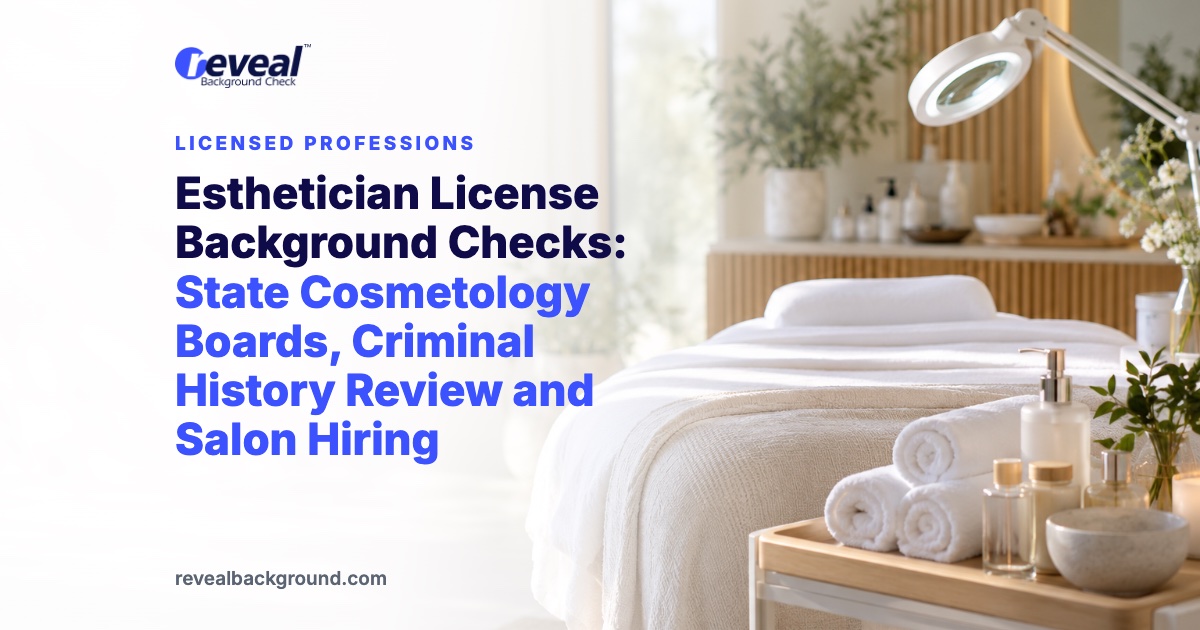
Estheticians work close to clients, often with chemical peels, extractions, waxing, microdermabrasion and sometimes needles or lasers depending on the state’s scope of practice rules. Because the work involves skin contact, licensed tools and sometimes access to a client’s home or a medical spa’s back office, salon and spa owners frequently ask two separate questions: what does the state licensing board already check before it issues an esthetician license, and what should the employer check on top of that. Those are not the same review, and treating them as one step often leaves a hiring gap.
Who licenses estheticians, and what the license actually confirms
Estheticians are licensed at the state level, almost always through the same board that regulates cosmetology and barbering, sometimes a standalone board and sometimes a division of a larger consumer affairs or occupational licensing agency. The license confirms that a person completed the required hours of training at an approved school, passed a written and practical exam, and met the board’s standards of conduct. It does not tell a salon owner whether that person has a pending charge, a conviction from a prior job, or a driving record if the role includes mobile or in home services.
Licensing structures vary by state. California regulates estheticians through the Board of Barbering and Cosmetology, which publishes applicant rules and requires disclosure of criminal pleas and convictions as part of the licensing file. Texas regulates the same occupation through the Texas Department of Licensing and Regulation, which oversees barbering and cosmetology licenses including esthetician specialty licenses. New York licenses estheticians under its appearance enhancement business framework through the Department of State, alongside natural hair styling and waxing licenses. A salon owner hiring across more than one state should confirm the current rule with the specific board rather than assume one state’s process matches another’s.
| State board example | What the board reviews at licensing | What it does not cover |
|---|---|---|
| California Board of Barbering and Cosmetology | Education hours, exam, disclosure of criminal pleas or convictions on the application | Ongoing employer checks after the license is issued, driving record, drug screening |
| Texas Department of Licensing and Regulation | Education hours, exam, licensing eligibility review for the barbering and cosmetology program, which includes esthetician specialty licenses | Salon level hiring decisions, client facing background checks, vehicle use |
| New York Department of State | Education hours, exam, licensing under the appearance enhancement category that includes esthetics | Employer specific screening, scope beyond licensing eligibility |
Fingerprinting and criminal history at the board level
Whether a state requires fingerprinting or a criminal history disclosure for an esthetician applicant depends on the board. Some boards ask applicants to disclose criminal pleas or convictions directly on the license application rather than running a separate fingerprint based criminal history search, which is the approach California’s barbering and cosmetology board uses for its applicant disclosure forms. Other states route cosmetology and esthetics licensing through a general occupational licensing framework that may or may not include a fingerprint based check, and the rule can change by statute. Where a specific board does not publish a fingerprinting requirement for estheticians, the accurate statement is that no such requirement currently exists for that license, not that one exists but is simply unpublished.
There is also a broader legal trend limiting how much weight a licensing board can give to a conviction that has no direct relationship to the occupation. California’s AB 2138 amended state law so that boards generally cannot deny, suspend or revoke a license solely because of a conviction that is substantially unrelated to the qualifications, functions or duties of the licensed profession, and it narrowed how far back certain convictions can be considered. Other states have adopted similar fair chance licensing reforms, so the specific statute and effective rule should be confirmed with the state’s current law rather than assumed to be uniform nationwide.
What the salon or spa should still check as the employer
A license confirms training and exam results. It does not replace an employer’s own screening, and the esthetician role has a few features that make screening worth doing carefully.
- Criminal history. A county, state or national criminal history search, consistent with the role and any state specific restrictions on how far back an employer may consider a record.
- License verification. Confirming the esthetician license is active, in good standing and not subject to board discipline, directly through the issuing board’s verification tool.
- Driving record. Relevant only if the role includes mobile esthetics, home visits or driving a company vehicle between locations.
- Drug screening. Many spas and medical spas screen for roles that involve needles, chemical peels or client facing services, consistent with state law on pre employment testing.
- Registry checks. Some employers, particularly medical spas affiliated with a healthcare practice, check exclusion or sanction registries relevant to the clinical setting.
Running the employer background check under the FCRA
When a salon, spa or medical spa employer orders a background check through a third party consumer reporting agency rather than doing the search itself, the Fair Credit Reporting Act governs the process. The Federal Trade Commission’s guidance for employers lays out the core steps: provide the applicant a clear, standalone disclosure that a background check will be obtained, get the applicant’s written authorization, and if the employer is considering not hiring based on the report, send a pre adverse action notice with a copy of the report and a copy of the Summary of Rights before taking final action, followed by an adverse action notice if the decision stands. These steps apply regardless of what the report contains, and they apply the same way whether the candidate is a seasoned esthetician or a recent graduate.
Employers who consider criminal history as part of the hiring decision should also be aware of the Equal Employment Opportunity Commission’s guidance on how arrest and conviction records interact with federal nondisclosure discrimination law, which encourages an individualized assessment that looks at the nature of the offense, the time that has passed and its relevance to the job rather than a blanket exclusion. State law may add its own limits on top of that federal guidance, and those limits vary, so a salon group hiring in multiple states should check each state’s rule rather than apply one state’s standard everywhere.
Frequently asked questions
Do all states fingerprint esthetician license applicants?
No. Fingerprinting and criminal history disclosure requirements for esthetician licensing vary by state board. Some boards collect a criminal history disclosure on the application itself rather than a separate fingerprint based search. Where a board does not publish a fingerprinting requirement, the accurate answer is that the state does not currently require one for that license, and the specific board should be checked for its current process.
Does an active esthetician license mean the person has no criminal record?
No. A license confirms the applicant completed the required training and passed the state exam, and in states that ask for disclosure, that any disclosed criminal history was reviewed against licensing standards at the time of application. It is not the same as a current employer background check and does not reflect anything that happened after the license was issued.
Can a salon refuse to hire an esthetician because of a past conviction?
Employers generally may consider criminal history as part of a hiring decision, but should do so through an individualized review rather than an automatic exclusion, consistent with Equal Employment Opportunity Commission guidance, and should also follow any state specific limits on how far back a record may be considered. Employers should consult counsel on how these rules apply to a specific situation.
Is a driving record check necessary for an esthetician?
Only if the role involves driving, such as mobile esthetics, in home services or moving between multiple salon or spa locations in a company vehicle. For a standard in salon role with no driving duties, a motor vehicle record check is usually not relevant.
What steps does the FCRA require before a salon can reject a candidate based on a background check?
The employer must provide a standalone disclosure, obtain written authorization, and if considering an adverse decision based on the report, send a pre adverse action notice with a copy of the report and the Summary of Rights, then wait a reasonable period before sending a final adverse action notice if the decision stands.
Does licensing cover medical spa roles that involve lasers or injectables?
Scope of practice for lasers, chemical peel strength and any injectable adjacent services varies significantly by state and is often governed separately from the basic esthetician license, sometimes requiring additional certification or physician supervision. Employers should confirm the applicable scope of practice rule with the state board rather than assume the esthetician license alone covers advanced procedures.
Internal resources
For background on how a related personal care license is reviewed, see our massage therapist background check guide. For a broader look at confirming any professional credential before hire, see professional license verification for employers. To set up compliant screening for your salon or spa, visit Reveal Background.
This article is general information, not legal advice. Licensing and background check rules vary by state and change over time, so employers should verify current requirements with the applicable state board and consult legal counsel for specific hiring decisions.