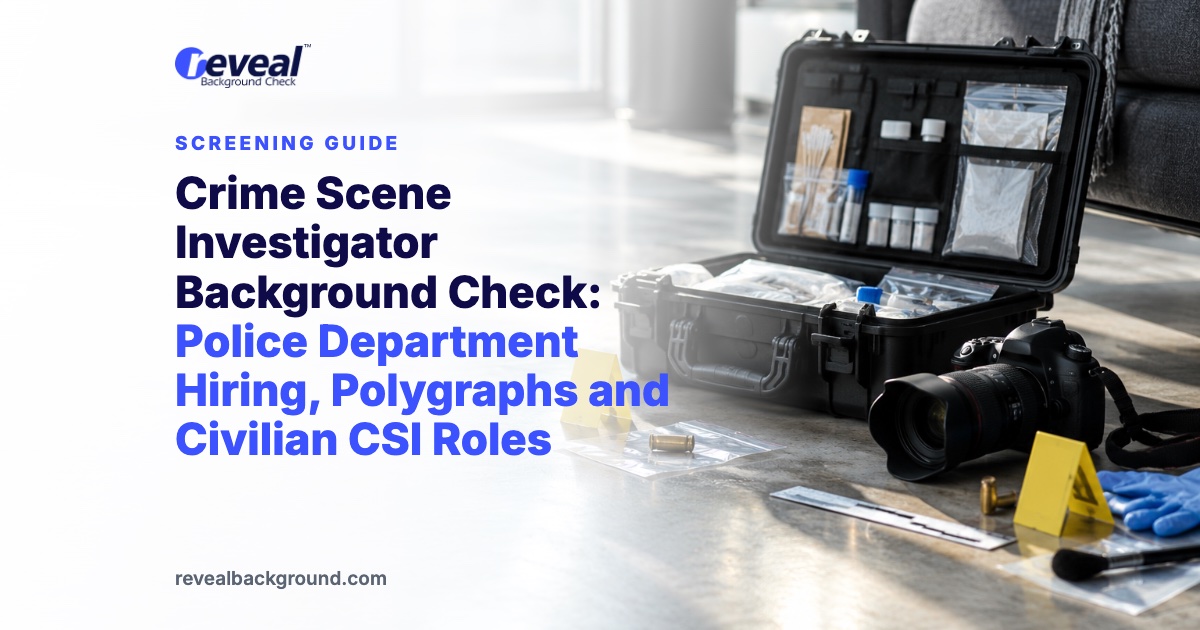
Crime scene investigators collect, photograph and preserve the physical evidence that later shows up in a courtroom. Because that evidence has to hold up under cross examination, the person who touched it has to hold up too. Police departments and sheriff’s offices treat a crime scene investigator opening, whether it is filled by a sworn officer or a civilian technician, as a position of unusual trust, and the background investigation reflects that.
This guide explains how the screening works, what typically disqualifies a candidate, how sworn and civilian paths differ, and where federal evidence response work adds another layer.
Sworn CSI versus civilian crime scene technician
Agencies fill these roles two different ways. A sworn crime scene investigator is a certified peace officer who was trained at a police academy and meets a state’s minimum standards for law enforcement employment before being assigned to the crime scene or forensic services unit. A civilian crime scene technician is a non sworn employee, often with a science or criminal justice background, hired directly into the forensics role without academy training or arrest powers.
The distinction matters for background screening because sworn officers go through the same statewide peace officer hiring standards as every other officer in that state, while civilian technicians are screened under the hiring agency’s own policy, which can be lighter in some areas and just as strict in others, particularly around evidence handling and courtroom credibility.
| Screening element | Sworn CSI (peace officer) | Civilian crime scene technician |
|---|---|---|
| Governed by state peace officer standards | Yes, through the state’s POST style commission | Usually no, governed by agency policy instead |
| Full background investigation | Yes, standard for all sworn hires | Common but scope varies by agency |
| Polygraph examination | Used by many agencies, not universal | Less common, depends on the agency |
| Psychological evaluation | Typically required before academy or field training | Sometimes required, varies by employer |
| Fingerprint based criminal history check | Required | Required |
| Credit history review | Common where state law allows | Less consistent, depends on the role |
| Prior employer background verification | Required, often through a formal interagency process | Typically a standard reference check |
What the investigation actually checks
A pre-employment background investigation for a crime scene role generally covers several areas at once rather than a single database pull:
- Criminal history. A fingerprint based state and federal criminal history check, run through the hiring agency rather than a commercial report.
- Employment history. Investigators contact prior law enforcement or forensic employers directly, not just by phone reference, to review personnel files for misconduct, untruthfulness findings or performance problems.
- Drug use history. Candidates are asked about past drug use, and agencies set their own lookback rules and disqualifying thresholds, which differ by department.
- Financial history. A credit check is used by many agencies as a stability and fraud risk indicator, within the limits of state law.
- References and neighborhood checks. Investigators may interview personal references, neighbors, or former coworkers, a step that goes well beyond what a typical employer background check covers.
- Driving record. Relevant because CSI staff drive to active scenes, sometimes transporting evidence.
For sworn positions, this process sits inside the state’s minimum selection standards for peace officers. California’s Commission on Peace Officer Standards and Training, for example, publishes hiring requirements and resources that agencies use to screen peace officer candidates, including background investigation guidance, as part of statewide minimum standards for law enforcement employment. (California POST, Hiring)
Why the agency contacts your previous department directly
One difference between a CSI background check and an ordinary employer screen is that agencies do not rely only on what a candidate’s old employer is willing to say in a short phone call. Several states require law enforcement agencies to exchange a departing employee’s personnel and background file with the new hiring agency as a condition of the appointment process. Texas, for instance, requires agencies hiring a licensed peace officer to request and review background records from every prior appointing agency through a formal statewide system, with documentation timelines set by rule. (Texas Commission on Law Enforcement) That kind of file sharing is designed to catch problems, such as a documented untruthfulness finding, that a candidate might otherwise be able to leave behind by simply moving to a new jurisdiction.
Polygraph exams
Polygraph screening is common in law enforcement hiring but is not required everywhere and is not applied the same way in every agency. Where it is used, the exam usually focuses on integrity questions, such as undisclosed criminal conduct, drug use beyond what was admitted on the application, or serious untruthfulness, rather than general life history. Candidates should expect the agency’s own written policy to state whether a polygraph is part of the process, and should rely on that policy rather than assume a single national rule applies.
Why the standard is higher for evidence roles
A crime scene investigator’s credibility is part of the evidence. If a defense attorney can show that the person who collected or logged physical evidence has an undisclosed history of dishonesty, drug use, or a broken chain of custody in a prior job, that can affect how a jury weighs the evidence itself, independent of whether the evidence is scientifically sound. Forensic science guidance on evidence handling emphasizes documented procedures and accurate recordkeeping from the moment evidence is collected at a scene, which is one reason agencies look closely at an applicant’s honesty record rather than only criminal history. (NIST, Crime Scene Investigation Guide) The National Institute of Justice similarly supports research and standards work aimed at making forensic evidence handling more reliable and better documented across the field. (National Institute of Justice, Forensic and Investigative Sciences)
Common disqualifiers
Exact disqualifying standards are set by each state and agency, not by a single federal rule, so candidates should check the hiring agency’s own job posting or applicant guide for specifics. That said, several categories appear across most sworn and many civilian CSI postings:
- A felony conviction, which generally bars sworn peace officer certification in most states.
- Recent or ongoing illegal drug use, with the exact lookback period set by the agency.
- A documented finding of dishonesty or falsification in a prior job, which agencies may weigh heavily because it goes directly to courtroom credibility.
- A pattern of financial instability flagged in a credit check, depending on state law and agency policy.
- Certain domestic violence convictions, which can also affect firearm eligibility for sworn roles.
A single past arrest without conviction, a decades old minor offense, or an isolated issue disclosed upfront does not automatically end a candidacy. Agencies generally review the whole file, and outcomes vary by jurisdiction, so a candidate with a record should talk to the specific agency rather than assume the worst case applies everywhere.
Federal evidence response work
Some crime scene processing happens at the federal level, including on evidence response teams that assist with major incidents. Federal civilian employees working in forensic, laboratory or evidence support roles go through the government’s standard suitability and background investigation process for federal employment, which is set by the Office of Personnel Management and applied across agencies rather than created case by case. (U.S. Office of Personnel Management, Suitability) That process looks at many of the same categories described above (criminal history, honesty, financial responsibility) but follows federal adjudicative guidelines rather than a state POST standard.
What candidates can expect from the timeline
The CSI hiring process, sworn or civilian, usually runs longer than a typical office job application because of the number of steps involved: application review, written or skills testing, an oral interview, a conditional offer, then the background investigation itself, plus a polygraph and psychological evaluation where the agency requires them. Candidates should expect multiple rounds of paperwork, including signed releases allowing the agency to pull criminal history, driving records, and sometimes credit history, and should expect investigators to follow up directly with former employers rather than accept a resume at face value.
Frequently asked questions
Do all crime scene investigators have to be sworn police officers?
No. Many agencies hire civilian crime scene technicians who are not certified peace officers and do not carry arrest powers, alongside or instead of sworn crime scene investigators. Which model an agency uses depends on local policy.
What shows up on a crime scene investigator background check?
Typically a fingerprint based criminal history check, verification of prior employment including direct contact with past law enforcement or forensic employers, drug use history, driving record, and in many agencies a credit check. Sworn positions add the state’s peace officer background investigation standards on top of the agency’s own screening.
Is a polygraph exam required for crime scene investigator jobs?
It depends on the agency. Polygraph screening is common in law enforcement hiring, including for some crime scene roles, but it is not used by every department and is not required by a single uniform national rule. Candidates should check the specific agency’s hiring process.
Can a past conviction disqualify a crime scene investigator applicant?
A felony conviction generally bars sworn peace officer certification in most states, and documented dishonesty in a prior job is treated seriously because it affects courtroom credibility. Minor or old offenses do not automatically disqualify a candidate, and agencies generally review the full file rather than apply one rule to every record.
How is a federal evidence response role screened differently?
Civilian employees in federal forensic or evidence support roles go through the government’s standard suitability and background investigation process administered under Office of Personnel Management guidelines, rather than a state peace officer standards process.
Why do crime scene investigator jobs have stricter background checks than other civilian roles?
Because the investigator’s own credibility and documented procedures can be challenged in court along with the physical evidence, agencies screen for honesty, integrity and reliability as closely as they screen for criminal history.
Internal resources
For related hiring background checks in law enforcement, see our guides on the state trooper background check process and the FBI special agent background check. Employers building a compliant screening program for forensic, law enforcement or evidence handling roles can learn more at Reveal Background.
This article is general information, not legal advice. Background check rules vary by state and by agency, and employers should confirm current requirements with the relevant licensing commission or legal counsel before making hiring decisions.