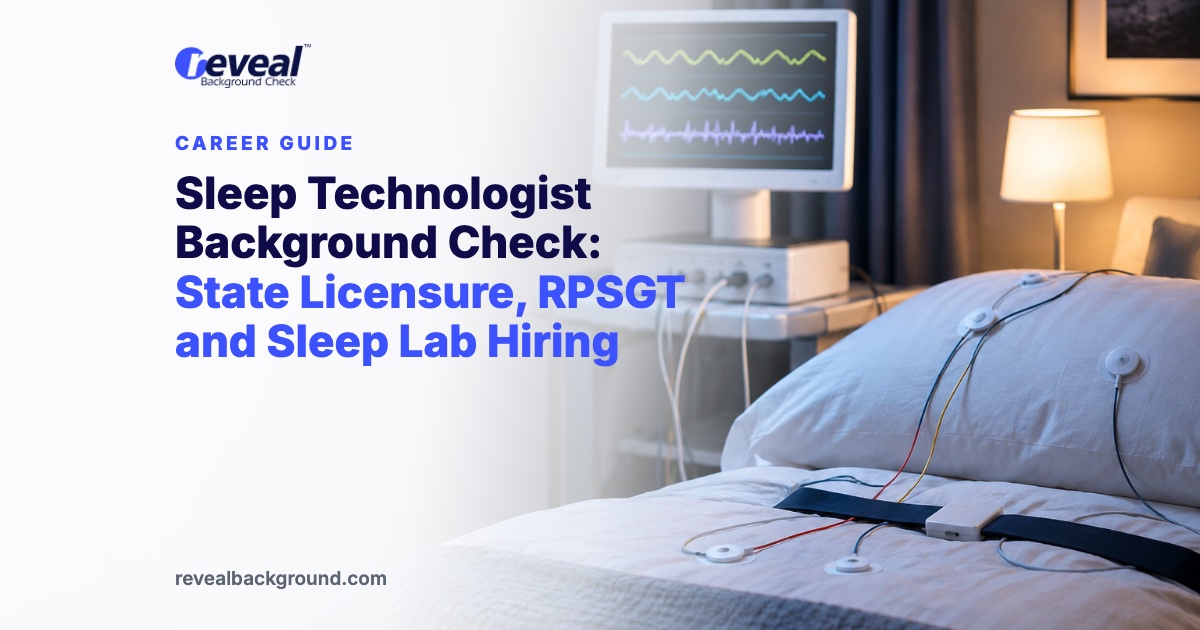
A sleep technologist, also called a polysomnographic technologist, hooks a patient up to sensors, monitors brain waves, breathing and heart rhythm through the night, and reports what the recording shows to a physician. The work happens overnight, often with one technologist alone in a lab with a patient who may be a child, an older adult, or someone with a cognitive or physical impairment. That combination of overnight solo contact and a dependent patient population is why hospitals and sleep centers tend to screen this role more closely than a typical technical job, even in the states that do not license it at all.
This guide covers where polysomnographic technology is an actual licensed profession, what a background check for the role generally includes, and how the national RPSGT credential and lab accreditation standards fit into hiring even where state law is silent.
Is a sleep technologist a licensed profession?
It depends entirely on the state. Most states have no polysomnographic technologist license at all. In those states, anyone the employer deems qualified, usually meaning a graduate of an accredited polysomnography program or a credentialed respiratory therapist with sleep training, can perform the work, and the job is regulated the way any other hospital or clinic staff position is regulated, through the employer’s own hiring and credentialing policy rather than a state board.
A smaller group of states has written polysomnographic technologists into their health professions licensing law, usually under the state medical board or a respiratory care board. Virginia and New York are two states with codified, verifiable licensing schemes for the role, described below. Other states have considered or previously enacted similar laws; where a program is not confirmed active on that state’s own regulatory site, this guide does not list it, because licensing rules change and a secondhand list can go stale. Anyone hiring or applying across state lines should check that state’s own medical or health licensing board directly rather than assume a rule carries over from a neighboring state.
| State approach | Who issues the credential | What is required |
|---|---|---|
| Virginia (licensed) | Virginia Board of Medicine | License required to practice or use the title; verified professional credential, application, and disclosure of any discipline in another jurisdiction |
| New York (authorized title) | New York State Education Department, Office of the Professions | Authorization required to use the title “Authorized Polysomnographic Technologist”; associate degree or equivalent in polysomnographic technology, good moral character, age 18 or older, examination |
| Most other states | No dedicated state license | Employer sets hiring criteria; national certification (RPSGT, CPSGT) and accredited sleep center staffing standards fill the gap |
Virginia’s licensing requirements
Under Virginia Code Section 54.1-2957.15, it is unlawful to practice as a polysomnographic technologist, or use that title, without a current license from the Board of Medicine. The statute defines the practice as the monitoring, testing and treatment of people with sleep disorders, including applying electrodes and sensors, carrying out physician-ordered therapeutic interventions such as airway management, and educating patients about their sleep disorder treatment. Students and trainees in a polysomnographic technology program can work without a license, but only under the direct supervision of a licensed polysomnographic technologist or a licensed physician, and they must become licensed within 18 months of starting the program or six months of finishing it, whichever comes first.
The licensing procedure itself is spelled out in the Board of Medicine’s regulations at 18VAC85-140. An applicant submits a completed application and fee, verification of a qualifying professional credential in polysomnographic technology, verification of practice, and, if licensed or certified anywhere else, documentation of any pending or past disciplinary action in that jurisdiction. In practice, that disciplinary disclosure requirement functions as the state’s background check: it surfaces license actions in other states even before a criminal history check runs.
New York’s authorization requirements
New York regulates the title rather than the act in some respects, but the effect is the same for hiring purposes. Under New York’s licensure requirements for polysomnographic technology, anyone using the title “Authorized Polysomnographic Technologist” must be authorized by the Office of the Professions under Education Law Section 8505 and Part 79-4 of the Commissioner’s Regulations. The applicant must be of good moral character, at least 18 years old, and have completed an approved associate degree or higher program in polysomnographic technology, or an equivalent program accepted by the department, along with the required examination. A limited permit is available at a lower fee for people working toward full authorization.
New York’s moral character review sits alongside, not instead of, whatever criminal history check the hiring hospital or sleep center runs separately under its own policy and under the Fair Credit Reporting Act.
The RPSGT credential and lab accreditation standards
Outside Virginia and New York, the credential that actually drives hiring in most sleep labs is the Registered Polysomnographic Technologist designation, a national certification issued by a private credentialing board rather than a government agency. It is voluntary in the sense that no state requires it in order to work, but it functions as the de facto qualification bar because accredited sleep centers build it into their staffing policy. Sleep centers that seek accreditation from the field’s national accrediting body are expected to staff with technologists who hold the national credential or an equivalent entry level certification, with a defined ratio of credentialed staff on each overnight shift. An employer that wants to keep its lab’s accreditation current will therefore verify the credential as part of hiring, the same way a hospital verifies a nursing license, even in a state where no government license exists for the job.
Because that credential comes from a private board rather than a state agency, it is not part of the government background check process described below. Verifying it is a separate credentialing step the employer typically runs through the issuing board’s own verification system.
What a sleep lab background check typically covers
Background screening for a sleep technologist position generally mirrors screening for other direct patient care roles rather than following any sleep specific federal rule. A typical pre-employment check includes a criminal history search, verification of education and any state license or national certification claimed on the application, employment history verification, and, where the employer is a hospital or health system, a check against federal exclusion lists for healthcare fraud and abuse. Drug screening is common given the overnight, low supervision nature of the shift, but is set by employer policy rather than by a sleep specific law.
When a consumer reporting agency runs that check, the employer has to follow the Fair Credit Reporting Act regardless of what state the job is in. That means a standalone disclosure, written authorization from the applicant, a pre-adverse action notice with a copy of the report and a summary of rights if the employer is thinking about not hiring based on the report, and an adverse action notice if that decision becomes final. The Equal Employment Opportunity Commission’s guidance on background checks adds that whatever standard an employer applies to a background report has to be applied the same way to every applicant regardless of race, national origin, sex, disability, age, or other protected characteristics, and that an automatic exclusion based on a criminal record can raise a discrimination concern if it is not tied to the actual duties of the job.
Overnight contact and vulnerable patients
Sleep studies on children, people with dementia, or patients with significant mobility or cognitive limitations raise the same concerns that apply to any overnight, low supervision caregiving role. Some employers and some state hospital licensing rules require an additional check against a state’s abuse or neglect registry for staff who work alone with these populations, separate from a general criminal history search. Whether that applies to a given sleep lab job depends on the state’s hospital licensing rules and the specific patient population the lab serves, so an employer should confirm the requirement with its own state health department rather than assume one rule covers every lab.
Frequently asked questions
Do all states require a license to work as a sleep technologist?
No. Most states have no dedicated license for polysomnographic technologists. Virginia and New York have codified licensing or authorization requirements for the title; other states leave hiring qualifications to the employer and to national certification standards.
What is the RPSGT credential and is it required by law?
The Registered Polysomnographic Technologist credential is a national certification issued by a private credentialing board, not a government license. No state currently requires it by statute, but accredited sleep centers generally require staff to hold it or an equivalent certification to meet national accreditation staffing standards.
Will a sleep technologist background check include a license search?
In Virginia and New York, yes, because the credential is a government issued license or authorization and the agency maintains a public verification system. In states without a specific license, the employer instead verifies the national certification and any educational credential listed on the application.
Does a criminal record automatically disqualify someone from sleep technologist work?
Not automatically. Under federal nondiscrimination guidance, an employer should weigh the nature of the offense, how long ago it occurred, and its relevance to the duties of the job rather than applying a blanket exclusion, and must apply its criminal history standard consistently to all applicants.
Does the Fair Credit Reporting Act apply to sleep technologist background checks?
Yes, whenever a hospital, sleep center, or staffing agency uses a third party consumer reporting agency to run the check. The employer must provide a standalone disclosure, get written authorization, and follow the pre-adverse and adverse action notice process before relying on the report to make a hiring decision.
Is a background check different for a sleep technologist trainee or student?
Generally the employer still screens trainees before placing them in a clinical setting with patients, even in states like Virginia where a trainee can legally work without a full license under direct supervision. The screening standard is typically set by the training program’s clinical site agreement or the employer’s own policy rather than by the licensing statute itself.
Related reading: MRI technologist background checks and radiation therapist license background checks cover how other credentialed hospital imaging roles handle state licensing and employer screening. See how Reveal Background builds FCRA compliant screening programs for healthcare employers.
This article is general information, not legal advice. Licensing rules and screening requirements vary by state and by employer policy and can change, so confirm current requirements with the relevant state board before making a hiring decision.