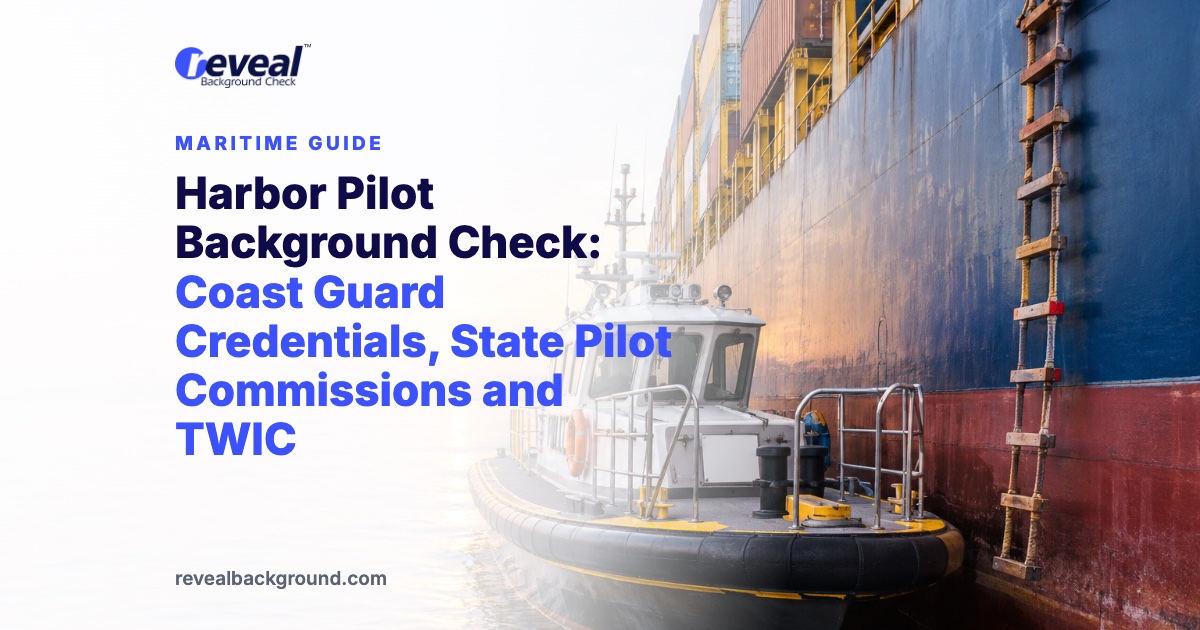
A harbor pilot boards inbound and outbound ships to guide them through channels, under bridges and alongside berths in some of the busiest and most hazardous stretches of water in the country. Because a single misjudgment can ground a tanker or close a shipping channel, nobody gets to do this job on the strength of a resume alone. A person who wants to pilot ships commercially has to clear several separate screening layers, run by different agencies, that overlap but are not identical. This post walks through what each layer actually checks, who runs it and where the public record stops.
The federal starting point: the merchant mariner credential
Every pilot begins as a credentialed merchant mariner. The United States Coast Guard issues the Merchant Mariner Credential (MMC) under 46 CFR Part 10, which sets the general eligibility rules that apply to every mariner, not just pilots. An applicant has to establish identity and citizenship or lawful status, pass a medical and physical evaluation under the standards in Subpart C of Part 10, and disclose criminal convictions and drug or alcohol related offenses on the application. The Coast Guard’s National Maritime Center reviews that disclosure against its own suitability standards and can deny, suspend or revoke a credential for convictions it considers incompatible with the safety duties of the job, separate from anything a state licensing board later decides.
The MMC itself does not make someone a pilot. It is the baseline qualification, built on sea service and testing, that a mariner needs before pursuing the specialized endorsement that actually authorizes piloting.
The First Class Pilot endorsement
Piloting authority on a federal credential comes from the First Class Pilot endorsement, governed by 46 CFR Part 11, Subpart G, Professional Requirements for Pilots. These endorsements are issued for specific designated pilotage waters, not for piloting in general, and the Officer in Charge, Marine Inspection for that zone sets the exact sea service, examination and local knowledge requirements for the waters involved. An applicant typically has to show a defined number of trips or round trips through the specific waters, pass a Coast Guard examination on local conditions, and continue to meet the medical and drug testing standards that apply to the underlying credential. Renewal carries its own documentation requirements under the same subpart, so a lapse in sea service or a new disqualifying event can affect an endorsement that was issued years earlier.
Where state pilot commissions fit in
Many of the country’s busiest ports layer a state licensing requirement on top of the federal credential, and a mariner who already holds a First Class Pilot endorsement still has to satisfy that state’s board before piloting in its waters. Florida is a useful example because its statute is public and specific. Florida Statutes Chapter 310 creates a Board of Pilot Commissioners inside the Department of Business and Professional Regulation, and section 310.071 requires a certified deputy pilot applicant to hold a United States Coast Guard license, document a set amount of sea service at a given rank, and pass an annual physical examination that includes a drug test with zero tolerance for unauthorized controlled substances. Florida’s board can also discipline a licensed pilot or deputy pilot for misconduct or incompetence under section 310.101, including action taken against the person’s license in another state or by the federal government.
Other pilotage states, including several on the Gulf Coast and the Great Lakes, run their own boards with their own statutes, and the licensing steps, fees and local training requirements are not uniform from port to port. If you are researching a specific state’s pilot commission, the accurate approach is to read that state’s own pilotage statute or board rule rather than assume Florida’s steps apply elsewhere.
TWIC and port access
Separate from licensing, a pilot who needs unescorted access to secure areas of a port facility or vessel has to hold a Transportation Worker Identification Credential (TWIC), issued under 49 CFR Part 1572. The Transportation Security Administration runs a security threat assessment on every applicant that includes an FBI fingerprint based criminal history records check, a check against terrorism related databases and a review of immigration status. The TSA’s TWIC program page describes the enrollment and background check process for mariners and port workers.
The disqualifying offense list in 49 CFR 1572.103 splits into two tiers. A small set of offenses, including treason, sedition, espionage and terrorism related crimes, is permanently disqualifying no matter how long ago the conviction occurred. A longer list of felonies, such as unlawful possession or use of an explosive or weapon, extortion, dishonesty or fraud, bribery, smuggling, distribution of a controlled substance, arson, kidnapping and robbery, is disqualifying on an interim basis, meaning it bars a TWIC if the conviction happened within the last seven years or the person was released from incarceration within the last five years. A conviction outside those windows does not automatically bar the card. Applicants who are denied can appeal or seek a waiver through the process TSA publishes, and a harbor pilot candidate who has a disqualifying record should expect the TWIC step, not the Coast Guard credential, to be where that record actually stops the application.
Drug and alcohol testing
Commercial mariners, including pilots, are subject to the Coast Guard’s chemical testing program under 46 CFR Part 16. The program requires pre-employment testing before a mariner starts safety sensitive duties, random testing throughout the year, testing after a serious marine incident and testing based on reasonable cause. A confirmed positive result or a refusal to test is reported and reviewed, and a medical review officer evaluates any claimed prescription use before a result is finalized. A positive result can affect both the underlying merchant mariner credential and, separately, a state pilot license or a port employer’s own fitness for duty standard.
The background check an employer or pilots’ association runs
A port authority, pilots’ association or terminal operator that hires or contracts with a pilot will typically also run its own consumer report through a background screening company, covering criminal history, employment and license verification. When that report comes from a consumer reporting agency rather than the hiring entity’s own files, the Fair Credit Reporting Act applies. The employer generally has to provide a standalone disclosure, get the applicant’s written authorization, and if it may take an adverse action based on the report, send a pre-adverse action notice with a copy of the report and a summary of rights before making a final decision, then a post adverse action notice if it proceeds. The Consumer Financial Protection Bureau’s Regulation V implements the FCRA’s consumer reporting rules and is the primary federal reference for those duties. Some employers also cross check a driving record database as part of a broader screening file, though this plays a smaller role for a maritime pilot than it would for a job centered on operating a road vehicle.
What a report actually returns still depends on state law. Many states limit how far back a nonconviction or sealed record can be reported, and the seven year reporting guideline that applies to many background checks is not a promise that any particular record will or will not appear. A pilot candidate’s full record, in other words, gets reviewed piece by piece across the federal credential, the state license and the employer’s own report, not in a single combined check.
Harbor pilot screening layers at a glance
| Layer | Who runs it | What it mainly checks | Governing rule |
|---|---|---|---|
| Merchant Mariner Credential | U.S. Coast Guard, National Maritime Center | Identity, medical fitness, criminal and substance disclosure | 46 CFR Part 10 |
| First Class Pilot endorsement | U.S. Coast Guard, local Marine Inspection Zone | Sea service, local waters examination, continued fitness | 46 CFR Part 11, Subpart G |
| State pilot license | State pilot commission or board | State specific licensing exam, physical exam, disciplinary history | Varies by state, for example Florida Statutes Chapter 310 |
| TWIC | Transportation Security Administration | Fingerprint based criminal history, terrorism and immigration checks | 49 CFR Part 1572 |
| Chemical testing | U.S. Coast Guard regulated program, employer administered | Pre-employment, random and post-incident drug and alcohol testing | 46 CFR Part 16 |
| Employer background check | Port employer, pilots’ association, consumer reporting agency | Criminal history, employment and license verification | Fair Credit Reporting Act, 12 CFR Part 1022 |
A consumer reporting agency that specializes in employment screening, such as Reveal Background, can help a port employer or pilots’ association coordinate the parts of this process that run through an FCRA compliant consumer report, while the Coast Guard, the relevant state board and TSA remain the agencies that decide credentialing, licensing and TWIC eligibility on their own separate tracks.
Frequently asked questions
Does every harbor pilot need a TWIC card?
A pilot who needs unescorted access to secure areas of a port facility or vessel generally needs a TWIC under 49 CFR Part 1572. Access rules can vary by facility, so a specific port or employer may have additional requirements.
What disqualifies someone from getting a TWIC card?
A short list of offenses such as treason, espionage and terrorism related crimes is permanently disqualifying. A longer list of felonies, including fraud, distribution of a controlled substance, robbery and arson, is disqualifying only if the conviction occurred within the last seven years or incarceration ended within the last five years, under 49 CFR 1572.103.
Is a harbor pilot background check the same in every state?
No. The federal layers, the Coast Guard credential, the pilot endorsement, TWIC and chemical testing, apply nationwide, but each pilotage state runs its own licensing board with its own statute, so the state level requirements and any state specific disciplinary history differ by port.
Does a Coast Guard pilot endorsement replace a state pilot license?
No. The First Class Pilot endorsement authorizes piloting on a federal credential for specific designated waters, but many states still require a separate state license or certification before a person can pilot commercially in that state’s ports.
How does drug testing work for harbor pilots?
Pilots are subject to the Coast Guard’s chemical testing program under 46 CFR Part 16, which includes pre-employment, random, post-incident and reasonable cause testing, with a medical review officer evaluating any claimed prescription use before a result is finalized.
Can a port employer run its own background check in addition to the federal and state checks?
Yes. A port employer or pilots’ association can run its own consumer report covering criminal history and credential verification. When that report comes from a consumer reporting agency, the Fair Credit Reporting Act’s disclosure, authorization and adverse action rules apply to the employer.
For related background on the credential that underlies this process, see our post on the merchant mariner credential background check. For more on the port access card discussed above, see TWIC card disqualifying offenses and the appeal process.
This article is general information, not legal advice. Employers and license applicants should consult the applicable state pilotage statute, the Coast Guard and TSA directly, or qualified counsel for guidance on a specific situation.