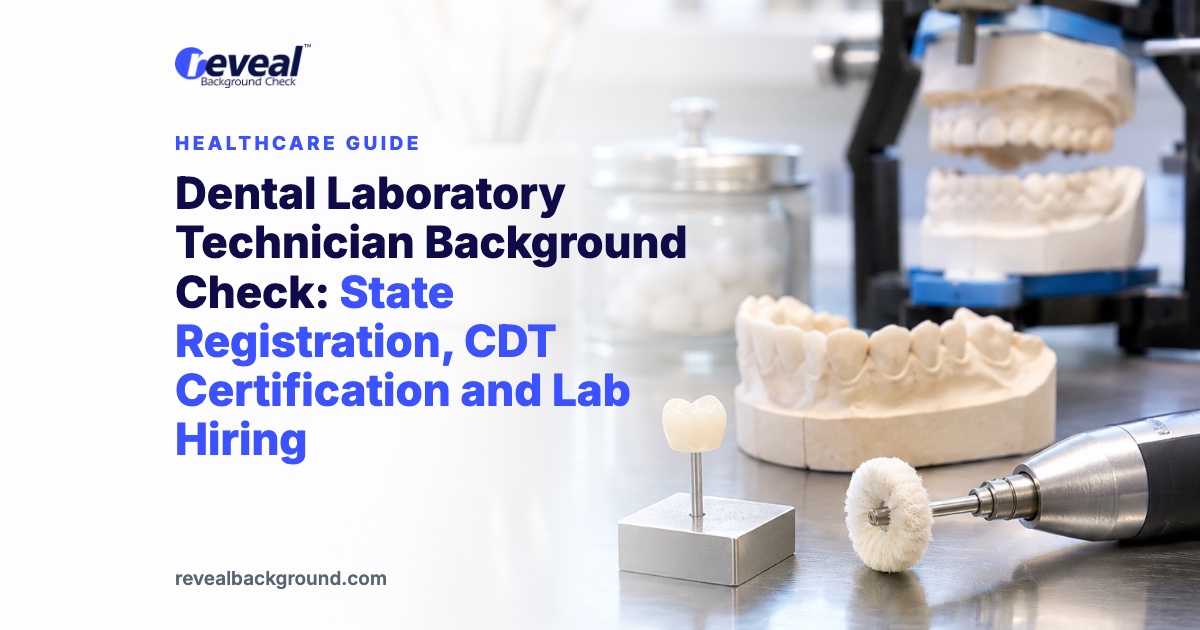
Dental laboratory technicians build the crowns, bridges, dentures, clear aligners and other dental appliances that dentists fit into a patient’s mouth. Most technicians never meet a patient directly, which leads some employers to assume the role needs little screening. That assumption misses two things: the laboratory itself is often a registered or inspected facility under state law, and the appliances the lab produces are regulated medical devices. A hiring background check for this role should reflect both of those facts, plus the ordinary employer duties under the Fair Credit Reporting Act.
What a Dental Laboratory Technician Does
Technicians work from a dentist’s prescription and an impression or digital scan to fabricate crowns, bridges, veneers, dentures, orthodontic retainers and other removable or fixed dental appliances. Some technicians specialize in a single product line, such as removable dentures or digital CAD/CAM crown milling, while others work across several product categories in a general lab. The job is production and craft work performed in a lab setting, not direct patient care, which is a key reason the licensing landscape looks different from other dental occupations such as dentists or dental hygienists.
Is a Dental Laboratory Technician a Licensed Profession?
No state currently issues an individual professional license to dental laboratory technicians the way it licenses dentists or dental hygienists. Where state law regulates this space at all, it typically regulates the dental laboratory as a business or facility, not the individual technician working inside it. That distinction matters for a background check, because there is usually no licensing board record to pull on a specific worker, and employers need to verify registration status at the facility level instead.
State Registration Rules for Dental Laboratories
A small number of states require the laboratory itself to register with a state agency, usually as part of the state’s dental practice act. Florida requires every dental laboratory operating in the state to hold a registration certificate issued by the Department of Health, and the laboratory must meet recordkeeping and facility standards to keep that registration current, under Florida Statutes Chapter 466. Texas similarly addresses dental laboratories as a regulated category of business under its dental practice statute, found in Texas Occupations Code Chapter 262. Other states have no comparable registration requirement for dental laboratories or their technicians at all. An employer hiring in a state that does regulate labs should confirm the facility’s registration is active with the appropriate state dental board or health department rather than assuming a technician carries any personal credential.
| State approach | Who must register | What is typically required | Individual technician license required |
|---|---|---|---|
| Florida | The dental laboratory as a business | Registration certificate from the Department of Health, recordkeeping and facility standards | No |
| Texas | The dental laboratory as a business | Registration under the state dental practice statute | No |
| Most other states | No state registration scheme for labs or technicians | Not applicable | No |
Because this varies by state and can change, an employer should verify current rules with the dental board or health department in the state where the laboratory operates rather than relying on a general summary.
Certification Is Common but Voluntary
Many technicians pursue a voluntary certification that demonstrates skill in a specific product category, such as crown and bridge work, ceramics, removable prosthetics or orthodontics. This type of credential is awarded by a private certifying body, not a government agency, so it functions as a hiring reference point rather than a legal requirement to work in the field. A background check cannot treat a voluntary certification the same way it treats a government license. Employers who want to confirm a certification claim should contact the certifying organization directly rather than accepting a candidate’s self report, the same standard applied to any other professional credential during employment verification.
FDA Oversight of the Devices, Not the Technician
Many of the products a dental laboratory produces, including crowns, bridges, dentures and orthodontic appliances, are classified as medical devices under federal law and fall within the dental device classification regulations at 21 CFR Part 872. That classification governs how the device itself must be manufactured and labeled. It does not create a federal licensing or background check requirement for the individual technician who fabricates the device. Employers sometimes conflate device regulation with personnel regulation, and the two are separate. A lab’s quality system obligations are a facility and manufacturing compliance matter, while screening the people who work in that facility is an employer hiring decision governed by ordinary employment law.
What Employers Typically Screen For
With no personal license to verify in most states, employers generally build a screening package around the parts of the role that actually carry risk. That usually includes identity verification, a criminal history check appropriate to the jurisdiction, employment history verification for prior lab experience, and confirmation of any claimed certification. Labs that supply hospital systems, orthodontic networks or large dental service organizations may also run facility access checks, since lab staff may need credentials to enter client clinical sites for intraoral scanning support or fitting adjustments. Drug testing policies vary by employer and should be applied consistently and in writing rather than improvised per candidate.
The FCRA Process Still Applies
When a dental laboratory uses a third party consumer reporting agency to run a background check, it is acting as a user of consumer reports under the Fair Credit Reporting Act, and the same federal process applies regardless of whether the role carries a state license. The employer must provide a clear, standalone written disclosure to the applicant and get written authorization before ordering the report. The Consumer Financial Protection Bureau’s Regulation V sets out these consumer reporting requirements, and the Equal Employment Opportunity Commission’s guidance on background checks explains the pre-adverse action notice, the opportunity to respond, and the final adverse action notice an employer must send before and after deciding not to hire based on report content. Employers should apply the same criminal history policy to every applicant for the role and be able to show the policy is job related, since inconsistent screening can create discrimination exposure separate from any FCRA violation.
Building a Reasonable Screening Policy
A dental laboratory does not need to invent a license verification step that does not exist. A reasonable policy instead documents what the lab actually checks: identity, criminal history consistent with state and local law, verified employment history, and certification claims confirmed with the issuing body when a candidate lists one. For laboratories operating in a state with a registration requirement, the policy should also include a step to confirm the facility’s own registration is current, since that is a compliance obligation on the business rather than the hire. Written policies applied consistently reduce both legal risk and hiring delay, because staff are not deciding case by case what to check.
Frequently asked questions
Do dental laboratory technicians need a state license?
No state currently licenses dental laboratory technicians as individuals. A small number of states regulate the dental laboratory as a business through a registration requirement, but that registration applies to the facility, not the person working in it.
Which states require dental laboratories to register?
Florida and Texas both address dental laboratories in their dental practice statutes and require the laboratory to register with the applicable state agency. Other states vary, and some have no comparable requirement, so an employer should confirm current rules with the state dental board or health department where the lab operates.
Is CDT or a similar certification a government requirement?
No. Certification programs for dental laboratory technicians are offered by private certifying organizations and are voluntary. They are a useful hiring reference point, but they are not a substitute for a government issued license because no such license exists for this role in most states.
Does FDA device regulation apply to the technician or the product?
FDA device classification rules apply to the dental appliance itself, such as a crown or denture, not to the person who fabricates it. There is no federal personnel licensing requirement tied to this classification.
What should a background check for this role include?
Most employers include identity verification, a criminal history check appropriate to the jurisdiction, employment history verification, and confirmation of any claimed certification with the issuing organization. The specific mix should match the lab’s actual risk, not a license that does not exist for the role.
Does the FCRA apply even though there is no license to verify?
Yes. Any time an employer orders a background check through a third party consumer reporting agency, the FCRA disclosure, authorization, and adverse action process applies, regardless of whether the position is licensed.
This article is general information, not legal advice. Employers should consult qualified counsel about screening policies and state specific registration requirements before making hiring decisions.
For a compliant screening package built around what a role actually requires, including identity, criminal history and employment verification, visit Reveal Background. Related reading: Dental Office Background Checks and Professional License Verification Background Checks.