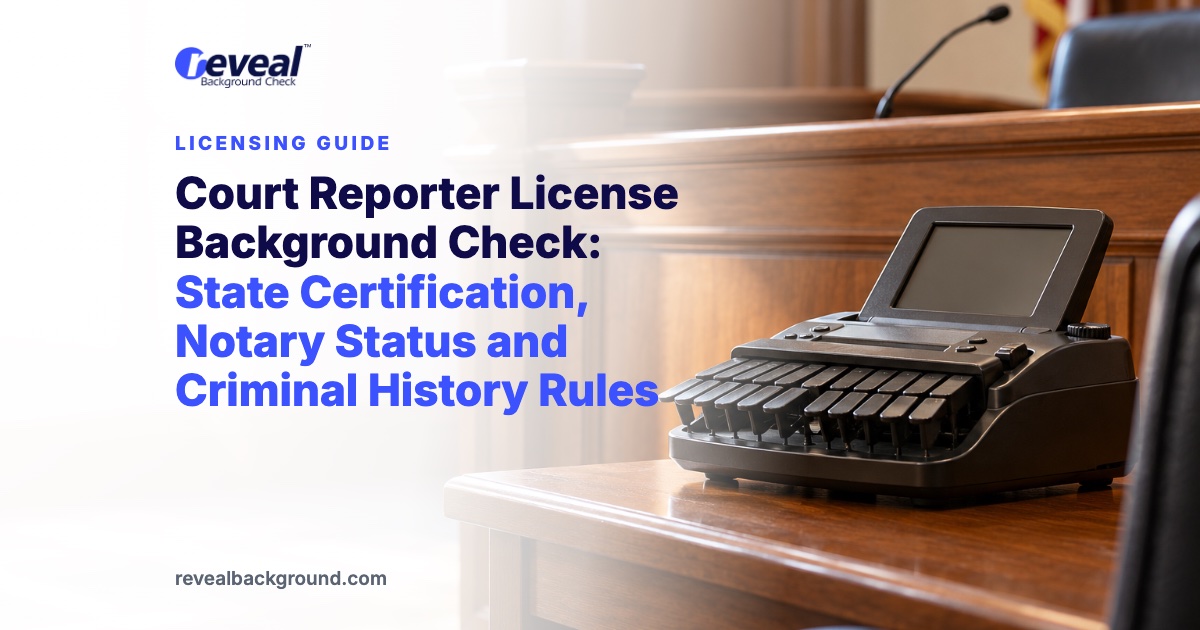
Court reporters capture the official record of depositions, hearings and trials, so courts, bar associations and litigants rely on the record being accurate and the reporter being trustworthy. Roughly half the states run a formal licensing or certification program for court reporters, and most of those programs include some form of criminal history review. The other states leave reporter credentialing to private certifying organizations, which means the background screening happens at the agency or firm level instead of a state board. This guide walks through how state boards treat criminal history, where notary or oath authority fits in, and what an employer or reporting agency typically checks before placing a reporter on an assignment.
Not every state licenses court reporters
There is no single national license. Some states, including California, run a state board that certifies reporters and reviews criminal history as part of that process. The Court Reporters Board of California licenses Certified Shorthand Reporters (CSRs) and requires applicants to disclose any criminal convictions or disciplinary actions as part of eligibility. Other states, such as Texas, route certification through a judicial branch agency rather than a traditional licensing board, and that agency builds a criminal history check directly into the application process through the Judicial Branch Certification Commission.
States without a licensing requirement generally rely on voluntary national credentials from reporting associations, with the actual hiring screen performed by the court system, law firm or reporting agency that engages the reporter. In those states, there is no state background check rule to point to, and it would be inaccurate to say one exists. If your state is not one of the examples above, check that state’s judicial administration or secretary of state site directly rather than assuming a uniform national standard.
Criminal history and fingerprinting: two real examples
California’s eligibility rules require a CSR applicant to show they have not committed acts or crimes that would be grounds for denial of licensure, and the board publishes a separate disclosure form for any prior conviction or disciplinary action. Details on documenting experience, education and the disclosure requirement are on the board’s applicant eligibility page.
Texas takes a more procedural approach. The Judicial Branch Certification Commission requires fingerprint based criminal history searches through both the Texas Department of Public Safety and the FBI for anyone seeking certification, registration or licensure under its programs, including court reporters. Applicants with a prior record can request a criminal history evaluation before formally applying, and anyone who believes their FBI record is inaccurate can pursue a correction under federal regulation. The commission explains both the fingerprint process and the record dispute path on its criminal history FAQ page.
Neither page lists a single master list of disqualifying offenses that applies nationwide, and it would be inaccurate to suggest one exists. Each board generally evaluates convictions in relation to the duties of the license, which is a common pattern in occupational licensing but is decided case by case rather than through a fixed list.
Notary commission and oath authority: this varies by state
A deposition reporter has to be able to administer the oath to witnesses before testimony begins. In some states, certification itself carries that authority, so a separately commissioned notary is not required. In other states, the person swearing in witnesses at a deposition needs independent notary or oath authority, which is a separate credential from the reporter’s professional certification. Because this detail is set state by state and the sources above do not state a uniform rule, treat it as something to confirm with your own state’s court reporter board or secretary of state rather than assuming either answer applies everywhere. Many working reporters hold a notary commission in addition to their certification simply because it keeps their authority to swear witnesses from depending on which jurisdiction they are working in that day.
Freelance reporters versus official or judicial reporters
Hiring screening tends to differ by setting. An official or judicial reporter is typically a court employee, so the hiring court conducts its own employment background check in addition to whatever the state certification process already required, often including fingerprinting tied to courthouse access. A freelance reporter usually works through a court reporting firm or agency that sends reporters out to depositions and hearings for law firms. The firm, not the court, is typically the one running the background check and deciding whether to place that reporter with a client, and the firm may repeat that screening periodically rather than relying solely on the state’s initial licensing check.
| Factor | California (CSR, state board) | Texas (JBCC) |
|---|---|---|
| Licensing authority | Court Reporters Board of California | Judicial Branch Certification Commission |
| Criminal history review | Disclosure of convictions and disciplinary acts as part of eligibility | Fingerprint based state and FBI criminal history search |
| Fingerprinting required | Required as part of the application process | Required, processed through a state vendor to DPS and the FBI |
| Pre-application record review | Not described as a standalone step on the board’s site | Applicants may request a criminal history evaluation before applying |
| Dispute process for inaccurate FBI record | Not addressed on the eligibility page | Described, following federal regulation for correcting FBI records |
What agencies and employers generally check
Beyond the state certification step, a court reporting firm, law firm or corporate legal department hiring a reporter directly as an employee may run its own consumer report through a background screening company. When that happens, the employer has specific duties under the Fair Credit Reporting Act: providing a standalone disclosure, getting written authorization, and if the employer decides not to move forward based on the report, sending a pre-adverse action notice with a copy of the report and a summary of rights before taking final adverse action. These are federal requirements that apply regardless of state licensing status, and they are set out in the Fair Credit Reporting Act provisions governing permissible purposes for consumer reports. A background check does not automatically reveal every past record in every state; what shows up depends on the state’s reporting limits, the sources searched and how old the record is, so avoid assuming uniform results across jurisdictions.
What can affect eligibility
Because each board decides convictions on a case by case basis, there is no single answer to what disqualifies someone. In general, boards look at whether the conduct relates to honesty, trustworthiness or the duties of the license, which matters for a profession built on producing an accurate, unaltered record. An applicant with a record should go directly to the board’s own disclosure or pre-application evaluation process, where one exists, rather than guessing how a past conviction will be treated.
Frequently asked questions
Do all states require a license to work as a court reporter?
No. Some states run a state licensing or certification board, while others rely on voluntary national credentials and leave screening to the hiring court, firm or agency.
Is fingerprinting always required for court reporter certification?
It depends on the state. Texas requires a fingerprint based criminal history search through state and federal databases as part of certification. Other states handle disclosure differently, so check the specific board’s own requirements.
Does a court reporter need to be a notary public?
It depends on the state and the type of assignment. In some states, certification itself carries authority to administer oaths, while in others a separate notary commission is needed for deposition work. Confirm the rule with your state’s board rather than assuming either answer.
Will a past conviction automatically disqualify a court reporter applicant?
Not automatically. Most boards evaluate convictions individually in relation to the duties of the license rather than applying one fixed disqualifying list, and some boards let applicants request a review before formally applying.
Who runs the background check, the state board or the hiring firm?
Often both, for different purposes. The state board’s check is tied to licensing eligibility. A reporting firm, law firm or court that hires the reporter directly may run its own separate employment background check, which is subject to the Fair Credit Reporting Act if a consumer reporting agency is used.
What rights does an applicant or employee have if a background check is used against them?
Under the Fair Credit Reporting Act, an employer must give notice before taking adverse action, provide a copy of the report and a summary of rights, and allow an opportunity to respond before the decision is final.
Court reporting intersects with other legal support roles that go through similar screening questions. See our coverage of paralegal background check requirements and notary public background check requirements for related hiring and licensing context.
Reveal Background helps employers and agencies run FCRA compliant background checks for legal support roles, including the disclosure, authorization and adverse action steps described above. Learn more at Reveal Background.
This article is general information, not legal advice. Licensing and background check requirements vary by state and change over time; confirm current rules with the relevant state board before relying on them.