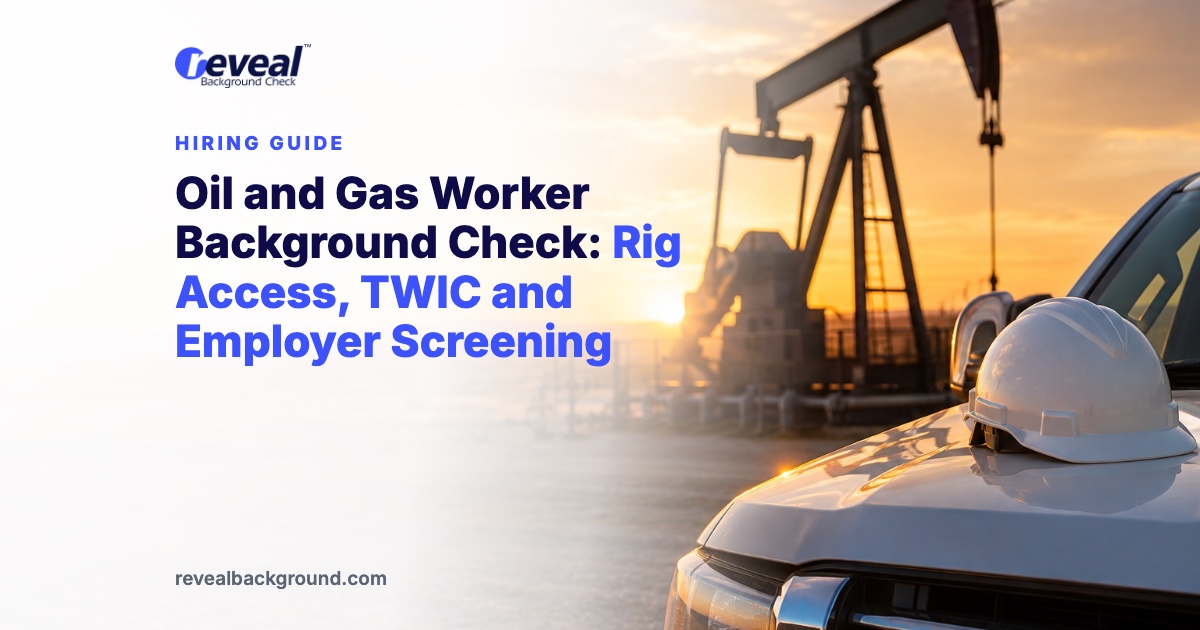
Oil and gas employers hire across a wide range of roles in a single operation: rig hands and roustabouts on a drilling location, pipeline technicians performing covered tasks, offshore and marine terminal workers, and commercial drivers hauling water, sand, crude or equipment to a well site. Each of these roles can carry a different screening requirement, and no single background check covers all of them. Understanding which federal rule applies to which job is the first step to building a compliant hiring process.
This guide walks through the main screening layers that apply across the industry: standard employment background checks under the Fair Credit Reporting Act, the Transportation Worker Identification Credential for secure facility access, pipeline operator drug and alcohol testing under PHMSA, and commercial driver screening under FMCSA. It also covers how these layers typically combine for different oilfield roles.
FCRA basics that apply to every oilfield hire
Regardless of role, any employer, staffing agency or contractor that obtains a background check report from a consumer reporting agency for employment purposes has to follow the Fair Credit Reporting Act. That means giving the applicant a standalone disclosure, getting written authorization before the report is pulled, and, if the report factors into a decision not to hire or to withdraw an offer, sending a pre adverse action notice with a copy of the report and the Summary of Rights, followed by an adverse action notice once the applicant has had a chance to respond. Staffing agencies that place contract rig, pipeline or terminal workers carry this same duty even when the worksite operator is a separate company.
What a background check actually surfaces depends on the type of search, the jurisdiction and state reporting limits. Criminal history results vary by state, and a report should never be assumed to show every arrest or every record in a worker’s history. Employers in safety sensitive oil and gas roles often layer several checks together rather than relying on one national database search.
TWIC cards for port and offshore facility access
Workers who need unescorted access to secure areas of a port facility or certain offshore installations regulated under the Maritime Transportation Security Act generally need a Transportation Worker Identification Credential, commonly called a TWIC card. The Transportation Security Administration manages the TWIC program and runs a security threat assessment on every applicant that includes a criminal history records check, immigration status verification and a terrorism related check. The disqualifying criminal offenses and appeal procedures for that assessment are set out in federal regulation under 49 CFR Part 1572. A related Coast Guard rule, 33 CFR Part 105, sets facility security plan requirements for many marine terminals that handle petroleum products, which is part of why TWIC access controls apply there.
Not every oil and gas job needs a TWIC card. Many onshore rig and pipeline roles never touch a regulated port or marine facility. Employers should confirm with the specific terminal, dock or offshore operator whether unescorted access to a secure area is actually required before assuming a worker needs one. For a closer look at what disqualifies an applicant and how an appeal works, see our separate post on TWIC card disqualifying offenses and the appeal process.
PHMSA pipeline operator qualification and drug testing
Workers who perform covered tasks on a regulated gas or hazardous liquid pipeline fall under separate federal rules administered by the Pipeline and Hazardous Materials Safety Administration. Pipeline operators must have an operator qualification program confirming that an individual performing a covered task has the training and ability to do it safely, and they must run drug and alcohol testing on covered employees under 49 CFR Part 199. That testing regime includes pre employment, random, post accident, reasonable suspicion, return to duty and follow up testing, a structure that closely mirrors the DOT model used for commercial drivers.
Because operator qualification and drug testing duties attach to the task rather than to a job title, a worker who occasionally performs a covered function, even temporarily or as a contractor, can trigger these requirements. Employers and staffing agencies that place pipeline labor should confirm which specific tasks a role involves before deciding which screening tier applies.
FMCSA rules for drivers hauling to well sites
Oil and gas operations depend heavily on trucking: hauling water, sand, chemicals, crude and heavy equipment in and out of a site. Any driver operating a commercial motor vehicle that meets the federal weight or hazardous material thresholds falls under Federal Motor Carrier Safety Administration rules. That includes mandatory controlled substances and alcohol testing under 49 CFR Part 382, which covers pre employment, random, post accident, reasonable suspicion and return to duty testing for safety sensitive driving functions.
Before putting a commercial driver on the road, employers also have to query the FMCSA Drug and Alcohol Clearinghouse for both a full query on new hires and an annual limited query on current drivers, to check for unresolved drug or alcohol violations recorded by other employers. A motor vehicle record check and, where available, a review of a driver’s Pre Employment Screening Program record round out a typical pre hire file for a CDL hauler. We cover how hiring teams use that driving history report in more detail in our post on the FMCSA PSP report for driver hiring.
Motor vehicle record checks are not limited to drivers whose main job is driving. Many rig hands, field technicians and maintenance staff operate a company truck or heavy equipment on location even though driving is not their primary function. Employers that assign any driving duty to a role often add an MVR check as a standard part of that role’s screening, separate from whether the FMCSA commercial thresholds apply.
Comparing screening by role type
| Role or setting | Primary access or credential | Drug and alcohol testing authority | Other typical screening |
|---|---|---|---|
| Rig hand or roustabout, onshore drilling site | Site specific contractor badge, no TWIC required for most onshore locations | Not federally mandated unless the role also involves a covered pipeline task or a commercial vehicle; many operators still apply company policy testing | Criminal history, employment verification, MVR if a vehicle is assigned |
| Pipeline operator or technician performing a covered task | Operator qualification under PHMSA pipeline safety rules | Mandatory under 49 CFR Part 199: pre employment, random, post accident, reasonable suspicion, return to duty | Criminal history, employment and training verification |
| Offshore platform or marine terminal worker | TWIC card for unescorted access to a secure area | Varies by employer; facility security obligations apply separately under Coast Guard rules | TSA security threat assessment covering criminal history, immigration status and terrorism related checks |
| CDL driver hauling water, sand, crude or equipment | Commercial driver license | Mandatory under 49 CFR Part 382; FMCSA Clearinghouse query required before and during employment | MVR, PSP record review where used, criminal history |
| Safety, maintenance or office support staff | Varies by site access level | DOT testing generally applies only if the role meets FMCSA driving or safety sensitive definitions | Criminal history, employment verification, education verification |
Why safety context still matters, even outside the screening file
Oil and gas extraction remains one of the more hazardous industries tracked by federal workplace safety agencies, and the Occupational Safety and Health Administration’s oil and gas extraction program page outlines the hazards it focuses enforcement on, from falls and struck by incidents to combustible gas exposure. A background check does not replace safety training, but employers filling safety sensitive rig and pipeline roles often pair screening with verification that required safety certifications are current, since both pieces feed into the same hiring decision.
State variation and what a background check will not guarantee
Criminal record reporting rules, look back limits and ban the box style restrictions vary significantly by state, and some states limit how far back a nonconviction record can be reported or restrict when an employer may ask about certain offenses. None of the federal programs described above override those state rules; they sit on top of them for the specific access or safety function involved. Employers operating across multiple states should not assume one state’s practice applies everywhere, and should build their screening policy around the strictest applicable rule rather than the most permissive one.
Employers and staffing agencies coordinating TWIC, PHMSA, FMCSA and standard FCRA screening across a multi state oilfield workforce often find it easier to work with a background screening partner that can route the right check to the right role rather than running one generic search for every hire.
Frequently asked questions
Does every oil and gas job require a TWIC card?
No. TWIC is only required for workers who need unescorted access to secure areas of a port or maritime facility regulated under the Maritime Transportation Security Act, such as certain offshore platforms and terminals that handle petroleum products. Many onshore rig and pipeline positions never need one. Confirm with the specific facility operator before assuming a TWIC is required.
Who has to be tested under the PHMSA drug and alcohol testing rule?
Operators of gas, hazardous liquid and other regulated pipeline facilities must test covered employees who perform covered tasks, meaning functions that affect pipeline integrity or safety, under 49 CFR Part 199. The rule includes pre employment, random, post accident, reasonable suspicion, return to duty and follow up testing.
Can an oil and gas employer refuse to hire someone over a past conviction?
Employers may generally be able to consider criminal history that is job related, but state law, local ordinances and the nature of the offense all factor into that decision. An employer may be able to deny access to a safety sensitive or secure area based on a disqualifying offense list, but should still apply the FCRA adverse action process and consult qualified counsel before finalizing the decision.
Do background checks on oil and gas workers show every past arrest?
Not necessarily. What appears depends on the type of check, where the records come from and state reporting rules. Reports typically include convictions and, depending on the state, may include certain nonconviction records within look back limits that vary by jurisdiction. A background check should not be treated as a record that shows everything in every state.
Does a motor vehicle record check matter for oilfield jobs that are not driving jobs?
It can. Many oilfield roles, including rig hands and field technicians, operate a company vehicle or heavy equipment on location even when driving is not the primary job duty. Employers that assign any driving responsibility often add an MVR check and, where the role meets the commercial driving threshold, FMCSA Clearinghouse and Part 382 testing requirements.
Does the FCRA apply to contractors and temporary oilfield staffing agencies?
Yes. Any entity that obtains a consumer report for employment purposes, including a staffing agency placing contract rig or pipeline workers, must follow FCRA procedures: standalone disclosure, written authorization, and pre adverse and adverse action notices when a report factors into a hiring decision.
This article is general information, not legal or medical advice. Employers should consult qualified counsel for guidance specific to their workforce and jurisdiction.