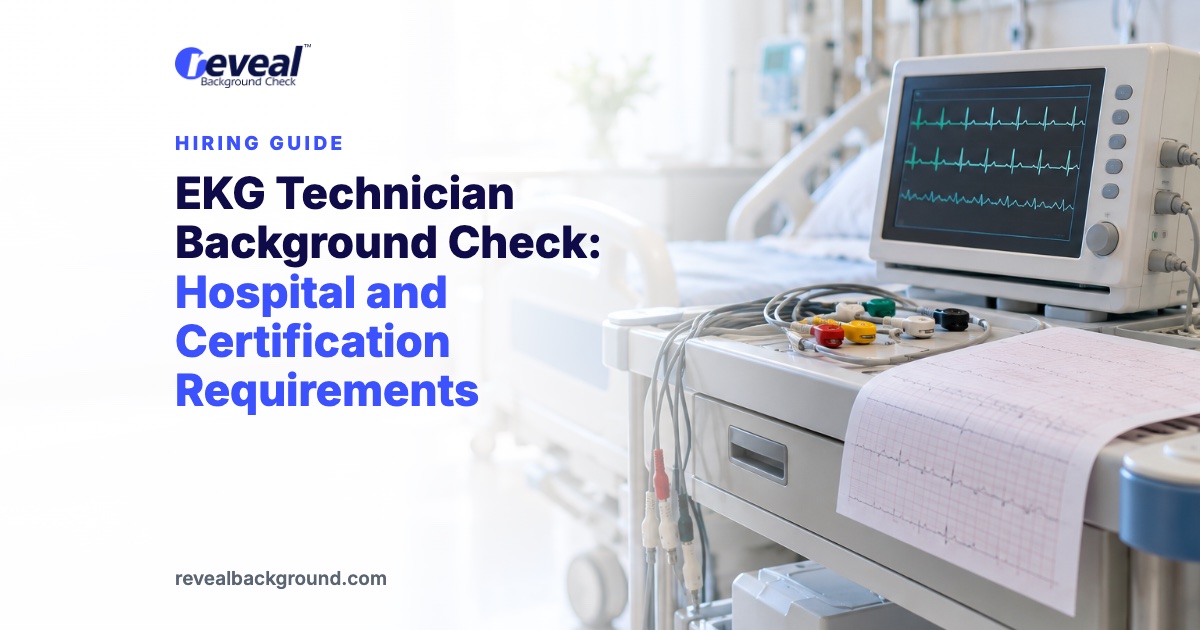
EKG technicians, also called cardiographic or electrocardiograph technicians, record and help monitor the heart’s electrical activity for patients in hospitals, cardiology practices, and urgent care settings. Most states do not issue a professional license for this role. Certification is generally voluntary and issued by private certifying organizations rather than a state board. That makes the background check an EKG technician goes through mostly a function of the hospital’s own hiring policy and the state’s general health facility licensing rules, not a dedicated EKG licensing statute.
This post covers what typically gets checked, how hospital policy and state facility rules interact, where federal exclusion screening fits in, and what the Fair Credit Reporting Act requires when an employer uses a background check company to screen a candidate.
Why there is no single national standard
Because EKG technician is not a licensed occupation in most states, there is no central licensing board that sets a uniform background check rule the way there is for nurses or physician assistants. Instead, the check an applicant experiences usually comes from two layers stacked on top of each other.
- The hospital’s or clinic’s own hiring policy, driven by its status as a state licensed health care facility and, for larger systems, by payer and accreditation requirements.
- The state’s health facility licensing rules, which in some states require background checks for broad categories of health facility employees and in other states are narrower and focused on specific direct care roles.
Because these layers vary by state and by employer, a technician applying to two different hospitals in two different states can go through noticeably different screening steps even though the job itself is similar.
State rules vary: two examples
State approaches to screening health care facility employees differ in scope. Two examples illustrate the range, and neither should be read as applying identically to every state.
Illinois has a dedicated statute, the Health Care Worker Background Check Act, administered through the Illinois Department of Public Health’s Health Care Worker Registry. It requires a fingerprint based criminal history check for unlicensed workers who provide direct care, and its registry is built primarily around certified nursing assistants and other direct care staff in long term care and home health settings. Whether a hospital’s EKG technician falls under this specific act depends on the facility type and the technician’s role, since the statute is written around direct resident or patient care contact in the settings it names.
Wisconsin takes a broader, contact based approach rather than naming specific job titles. Its Caregiver Background Check Program requires regulated health care entities to run a background check on employees and contractors who have regular and direct contact with patients, clients, or residents. Whether that reaches a hospital’s EKG technicians depends on how much direct patient contact the role involves and how the employing entity is regulated under the law, not on a fixed list of job titles.
Where a state has no dedicated health care worker background check statute, the hospital’s own policy, built around its general facility licensing obligations and its own risk tolerance, generally fills that gap. Employers and candidates should check the specific rule in their state rather than assume either the Illinois or Wisconsin model applies.
What a hospital background check for this role typically includes
| Screening layer | Who requires it | What it typically covers |
|---|---|---|
| Hospital or employer policy | The hiring facility’s human resources and compliance functions | Criminal history search, employment and education verification, reference checks, and often drug screening, set by internal policy |
| State health facility or health worker statute | State health department or licensing agency, where such a statute exists | Fingerprint based criminal history check, and in some states an abuse or neglect registry check, generally tied to facility type or direct care contact |
| Federal exclusion screening | The employer’s compliance program, following guidance from the HHS Office of Inspector General | Confirms the applicant is not on the List of Excluded Individuals/Entities or the federal System for Award Management exclusion list |
| FCRA consumer report process | The employer, under federal law, whenever a third party background check company is used | Disclosure, written authorization, pre adverse action notice, adverse action notice, a copy of the report, and the Summary of Rights |
Criminal history and abuse or neglect registries
A criminal history check for a hospital based role generally looks at county, state, and sometimes federal records, and may include a fingerprint based state and FBI check where state law or hospital policy calls for one. What specifically disqualifies a candidate varies by state and by the hospital’s own policy, and state law and the seven year reporting rule vary, so no background check can be assumed to surface every past record in every state.
Some states also maintain abuse, neglect, or patient exploitation registries separate from the general criminal history check. These registries are most consistently tied to long term care and vulnerable adult or child protection settings. Whether a hospital is required to check one for an EKG technician role depends on the state and whether the position involves the kind of direct patient contact the registry statute addresses. Where a state has no such rule reaching this role, it is more accurate to say so than to imply a check exists that does not.
OIG and SAM exclusion screening
Hospitals that bill Medicare, Medicaid, or other federal health programs generally screen new hires, including clinical support staff, against the HHS Office of Inspector General’s List of Excluded Individuals/Entities (LEIE) and the federal System for Award Management exclusion list. Exclusion means a person cannot be paid, directly or indirectly, for any item or service billed to a federal health program. Because that liability can attach to the employer even for an excluded employee’s indirect role in patient care, many compliance programs check this list for a wide range of clinical staff, not only billing providers, and recheck it periodically rather than only at hiring.
Drug screening
EKG technicians are not generally subject to a specific federal drug testing mandate the way safety sensitive transportation workers are. Pre employment and, at some hospitals, random drug testing is more often a condition of employment set by the facility’s own policy. Candidates should expect that policy, and any related documentation process for prescribed medication, to be explained by the specific employer rather than assume a uniform federal rule applies to this role.
FCRA requirements when a background check company is used
When a hospital uses a consumer reporting agency to run a background check, the Fair Credit Reporting Act sets the process the employer has to follow. That generally includes giving the applicant a standalone written disclosure that a report may be obtained, getting the applicant’s written authorization, and, if the employer may act on something in the report, sending a pre adverse action notice with a copy of the report and a copy of the Summary of Rights before taking any adverse action, followed by an adverse action notice if the employer proceeds. The Consumer Financial Protection Bureau’s Regulation V implements these FCRA notice and disclosure duties in more detail. These are employer duties under federal law, and they apply regardless of what the report does or does not contain.
Frequently asked questions
Does an EKG technician need a state license to work?
In most states, no. Certification for this role is generally voluntary and issued by private certifying organizations rather than a state licensing board, so there is no state license tied to a background check requirement in the way there is for a nurse or physician assistant.
Will a background check show every arrest or conviction in an applicant’s past?
Not necessarily. What a background check reports depends on state law, the sources searched, and the seven year reporting rule, which vary by state. No employer or screening company can promise that a report will surface every past record.
Do hospitals have to check the OIG exclusion list before hiring an EKG technician?
Hospitals that bill federal health programs generally run exclusion checks on a wide range of staff, including clinical support roles, because employing an excluded individual can create liability for the facility. The specific scope of who gets checked is set by the hospital’s own compliance program.
Are EKG technicians covered by state health care worker background check laws?
It depends on the state. Some states have statutes focused on direct care workers in long term care or home health settings, which may or may not reach a hospital based EKG technician. Other states apply a broader facility level screening rule that can reach more hospital employees. Where a state has no such rule, hospital policy generally fills the gap.
Can a hospital require a drug test before an EKG technician starts work?
Many hospitals require pre employment drug screening as a condition of employment under their own policy. This is generally not driven by a specific federal mandate for this role, so the details vary by employer.
What must an employer do under the FCRA before rejecting an EKG technician applicant because of a background check?
The employer generally has to send a pre adverse action notice with a copy of the report and the Summary of Rights, give the applicant a chance to respond, and then send an adverse action notice if it proceeds with the decision.
Related reading
For how exclusion screening works across healthcare hiring more broadly, see Healthcare Exclusion Screening: OIG LEIE and SAM Checks. For a comparison role in clinical support hiring, see Medical Assistant Background Check Requirements: What Clinics and Practices Screen. Employers building or reviewing a screening policy for clinical support roles can start at Reveal Background.
This article is general information, not legal or medical advice. Employers should consult qualified counsel about their specific screening obligations.