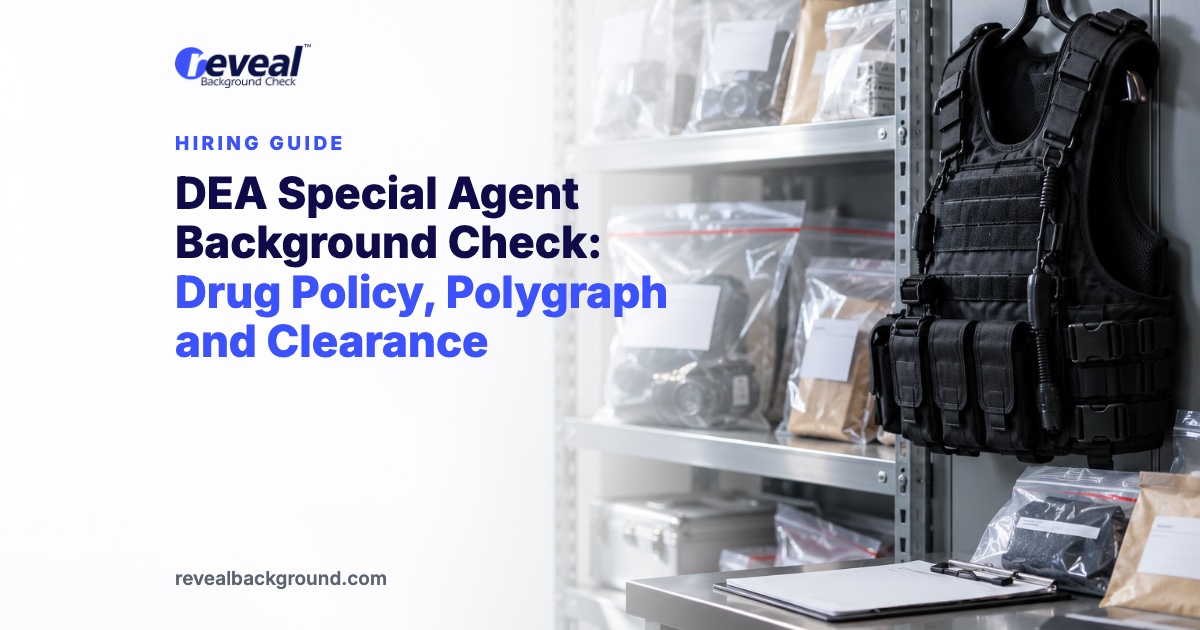
A Drug Enforcement Administration special agent carries a badge, a firearm and routine access to classified information. Because of that combination, the screening an applicant goes through is not a single background check. It is a layered federal process that includes a suitability review, a medical and psychological evaluation, often a polygraph examination, and a national security background investigation that supports a Top Secret clearance. Below is how that process generally works under federal rule, where the drug use policy comes from, and what tends to disqualify applicants.
What Makes This Screening Different From an Employment Background Check
Most employment background checks are governed by the Fair Credit Reporting Act and look backward at criminal records, employment history and education. A DEA special agent applicant goes through that kind of review too, but it sits inside a much larger federal suitability and security clearance framework. Suitability determinations for federal jobs are made under standards the Office of Personnel Management sets and oversees, and OPM also serves as the government’s suitability authority that supports agencies through adjudication and training, as described on OPM’s Suitability Executive Agent page. Because the position requires access to classified law enforcement and national security information, applicants are also investigated against the standards in 32 CFR 147.19, which sets out the three federal investigation standards tied to each clearance level, including the standard required for Top Secret access.
The General Shape of the Hiring and Investigation Process
The exact sequence and names of each step can change as the agency updates its hiring process, so applicants should always confirm the current steps and eligibility rules directly from the agency’s own job announcement rather than relying on secondhand summaries. In broad terms, federal law enforcement hiring of this kind typically includes a written or structured interview phase, a conditional offer, a medical examination, a psychological evaluation, and for many federal law enforcement and intelligence positions, a polygraph examination. Polygraph use is set by agency policy rather than a single government wide regulation, so its scope and the questions covered can vary by agency.
Running alongside those steps is the background investigation itself. For Top Secret and Sensitive Compartmented Information access, the applicable federal standard is the Single Scope Background Investigation, commonly called an SSBI, which is the investigation standard referenced in 32 CFR Part 147’s attachments for that clearance level. A periodic reinvestigation follows on a recurring basis to keep the clearance current, under the same part of the regulation.
| Investigation standard | Access level it supports | When it is used |
|---|---|---|
| National Agency Check with Local Agency Checks and Credit Check | Confidential and Secret, and “L” access authorization | Lower sensitivity clearance levels |
| Single Scope Background Investigation | Top Secret, Sensitive Compartmented Information, and “Q” access authorization | Initial investigation for a DEA special agent’s clearance level |
| Single Scope Background Investigation, Periodic Reinvestigation | Continued Top Secret and SCI access | Recurring reinvestigation after the clearance is granted |
This structure comes directly from the three standards described in 32 CFR 147.19.
The Drug Use Policy Applicants Are Screened Against
Federal drug policy for applicants starts with Executive Order 12564, the Drug Free Federal Workplace order, which states plainly that federal employees are required to refrain from the use of illegal drugs and specifically authorizes agencies to test any applicant for illegal drug use. That order, and the agency programs built from it, are summarized by the National Archives at the codified text of Executive Order 12564.
On top of that government wide authority, illegal drug use is also one of the specific factors OPM and agencies apply when deciding whether someone is suitable for federal employment. Under 5 CFR 731.202, the “illegal use of narcotics, drugs, or other controlled substances, without evidence of rehabilitation” is listed as a factor that can support an unfavorable suitability determination, alongside excessive alcohol use, criminal conduct and dishonest conduct. For a position that itself carries drug enforcement duties, an applicant’s drug history tends to receive close attention, and the agency sets its own specific thresholds for how recent or how extensive any past use can be. Because those thresholds are set and periodically updated by the hiring agency rather than fixed in a general statute, this is exactly the kind of detail an applicant should pull from the current official job posting rather than assume stays the same over time.
Separately from the suitability determination, the security clearance adjudication looks at drug involvement again under its own framework. Guideline H of the federal adjudicative guidelines, codified at 32 CFR 147.11, explains the government’s concern this way: improper or illegal involvement with drugs raises questions about a person’s willingness or ability to protect classified information, because drug abuse or dependence can impair judgment and increase the risk of unauthorized disclosure. This article does not describe, and will not describe, any method for concealing drug use from a test or an investigator. The purpose of covering this policy is to explain what the government reviews and why, not to help anyone get around it.
Common Disqualifiers Beyond Drug History
The same suitability factors in 5 CFR 731.202 apply to every federal applicant, not just drug history. They include misconduct or negligence in prior employment, criminal conduct, intentional false statements made during the application or examination process, dishonest conduct, failure to meet financial obligations such as filing tax returns, and violent conduct. For a clearance decision specifically, the adjudicative guidelines in 32 CFR Part 147 add additional categories, including financial considerations, criminal conduct, emotional and mental health concerns, and security violations. None of these factors alone automatically disqualifies someone. The regulation directs adjudicators to weigh the nature, recency and circumstances of the conduct and any evidence of rehabilitation, which is often called the whole person approach.
The Clearance Itself
Once the investigation is complete, an adjudicator decides whether to grant eligibility for access to classified information at the Top Secret level, and in some assignments, Sensitive Compartmented Information. That decision is separate from, but built on top of, the suitability determination OPM or the agency makes about overall employment suitability. Readers who want to understand how these two determinations relate, and how a security clearance differs from the kind of background check most employers run, can see our explainer on security clearance versus an employment background check. For a broader look at the standard forms used across federal hiring, including the forms behind many of these investigations, our guide to federal job background checks and the SF-85, SF-85P and SF-86 forms covers how those forms differ and when each is used.
Civilian employers screening for non federal roles do not have authority to run this kind of national security investigation, and most never need to. What they can run, under the Fair Credit Reporting Act, is a standard consumer report covering criminal history, employment and education verification, and related checks appropriate to the job. Reveal Background builds those FCRA compliant screening programs for civilian employers, which is a different process from the federal suitability and clearance investigation described above.
Frequently asked questions
What security clearance does a DEA special agent need to hold?
DEA special agents generally need to hold a Top Secret clearance, and some assignments require access to Sensitive Compartmented Information. That level of access is investigated using the Single Scope Background Investigation standard described in 32 CFR 147.19.
Does the DEA require a polygraph exam for special agent applicants?
Many federal law enforcement and intelligence agencies include a polygraph examination somewhere in their hiring process, but polygraph use is set by individual agency policy rather than a single uniform federal regulation. Applicants should confirm whether a polygraph is required, and what it covers, directly from the agency’s own current hiring materials.
What drug use disqualifies a DEA special agent applicant?
Illegal drug use is a recognized suitability factor under 5 CFR 731.202 and is also evaluated separately as part of security clearance adjudication under Guideline H in 32 CFR 147.11. The specific thresholds an agency applies, such as how recent any past use can be, are set and updated by that agency rather than fixed in a general statute, so the current official job announcement is the accurate source.
What is a Single Scope Background Investigation?
It is the federal investigation standard used to support eligibility for Top Secret access and Sensitive Compartmented Information, as set out in 32 CFR Part 147. It is more extensive than the National Agency Check with Local Agency Checks and Credit Check standard used for lower level clearances, and it is followed by periodic reinvestigation to keep the clearance current.
How is a security clearance investigation different from a regular employment background check?
An employment background check run under the Fair Credit Reporting Act looks at criminal history, employment and education for hiring purposes. A security clearance investigation is a separate federal national security process that evaluates a person’s eligibility to access classified information, using the suitability and adjudicative standards in 5 CFR Part 731 and 32 CFR Part 147.
Can an agency or OPM deny suitability for reasons unrelated to criminal history?
Yes. Under 5 CFR 731.202, suitability determinations can also consider misconduct in prior employment, dishonest conduct, false statements made during the hiring process, failure to meet financial obligations, and excessive alcohol use, in addition to criminal conduct and illegal drug use.
This article is general information about federal screening and security clearance standards, not legal advice, and it is not a substitute for the official, current requirements published by the hiring agency.