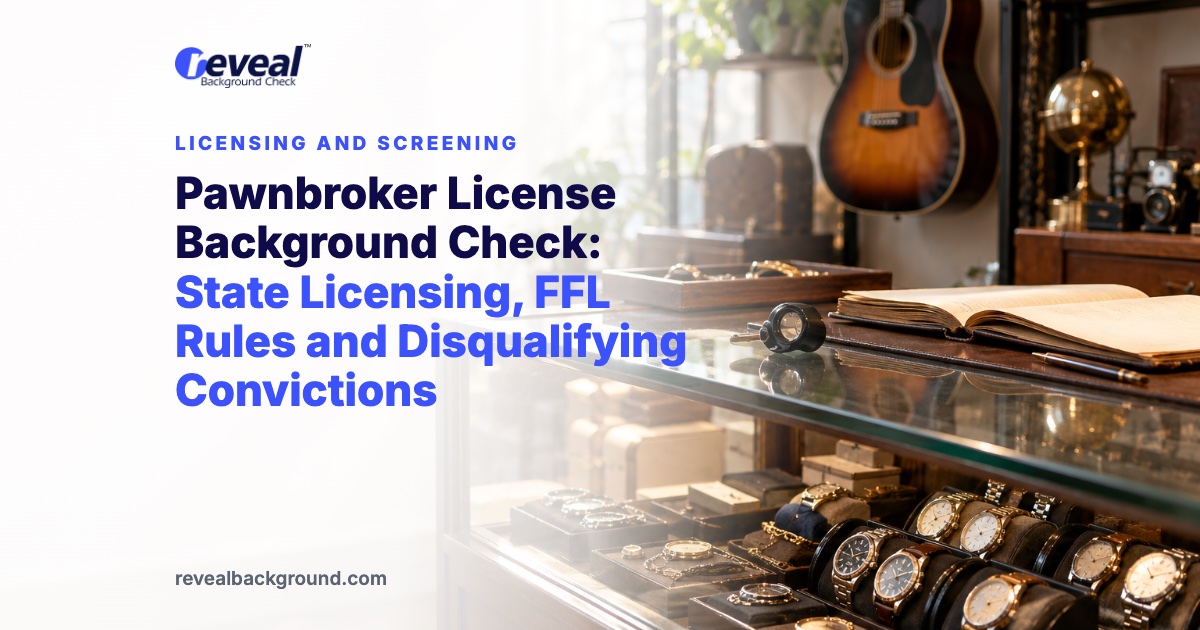
A pawnshop sits at an unusual intersection of retail, lending and secondhand goods, and state lawmakers have historically treated it as a business that needs close watching. Pawnbrokers handle cash, hold other people’s property as collateral, and buy and resell goods that sometimes turn out to be stolen. Because of that, most states license the pawnshop itself, many also license the individual employees who work the counter, and a pawnshop that accepts firearms in pawn or for resale needs a federal firearms license on top of whatever the state requires. This post walks through how a handful of states actually structure that licensing and criminal history review, where the federal firearms piece fits in, and what an employer should still screen for beyond the license itself.
Pawnbroker licensing is a state and sometimes local function
There is no federal pawnbroker license. States set the licensing framework, and the details vary a great deal, from which agency issues the license to whether employees need their own license separate from the shop’s. Some states run the kind of fingerprint based criminal history review typical of a financial services license. Others fold pawn activity into a broader secondhand dealer and property reporting law enforced mostly at the local level. Knowing which pattern a given state follows matters before an employer assumes a background check already happened somewhere in the licensing process.
Texas: a license for the pawnshop and a separate license for each employee
Texas regulates pawnshops through the Office of Consumer Credit Commissioner, under Chapter 371 of the Texas Finance Code and the agency’s own rules in Title 7, Chapter 85 of the Texas Administrative Code. Texas does not stop at licensing the business. Anyone who works as a pawnshop employee, meaning someone who conducts pawn transactions or supervises people who do, must also hold a pawnshop employee license issued through the same agency. The employee licensing process includes a review of the applicant’s criminal history as part of the application, and the agency maintains a public license search so a shop can confirm an employee’s license is active before putting them on the floor. A shop that lets an unlicensed person conduct pawn transactions is operating outside its own license, independent of anything a private background check would catch.
Florida: a state license with explicit lookback periods for owners and employees
Florida licenses pawnbrokers through the Department of Agriculture and Consumer Services under the Florida Pawnbroking Act. The statute sets out specific eligibility rules rather than leaving the criminal history standard to agency discretion. An applicant for a pawnbroker license cannot have been convicted of, found guilty of, or pled guilty or nolo contendere to a felony within the last ten years, regardless of adjudication, under section 539.001 of the Florida Statutes. The same statute requires the agency to collect fingerprints for each person subject to those eligibility requirements and submit them to the Florida Department of Law Enforcement, which forwards them to the FBI for a national criminal history check. The law goes further than the owner’s own license. A licensed pawnbroker may not knowingly hire anyone to work in the pawnshop who has a felony conviction, guilty plea or withheld adjudication within the last five years, or a conviction within the last five years for a crime involving theft, larceny, dealing in stolen property, receiving stolen property, burglary, embezzlement or obtaining property by false pretenses. Operating as a pawnbroker without first securing the license is itself a third degree felony under the same section.
California: pawn activity regulated as part of the secondhand dealer and stolen property law
California does not run a single statewide pawnbroker license board. Instead, the legislature built a statewide secondhand dealer and coin dealer framework specifically to curtail the sale of stolen property, and that framework explicitly covers anyone whose business includes taking property in pawn, under Business and Professions Code section 21625. The practical screening and compliance work happens through local permitting by city or county law enforcement rather than a single state licensing office, and the state law layers a daily reporting duty on top of that local permit. A secondhand dealer or coin dealer, a category that reaches pawn transactions, must report transactions to local law enforcement no later than the next business day, under section 21628. That reporting duty is the mechanism California relies on to catch stolen property moving through a pawnshop, rather than a single statewide criminal history check tied to one license.
State comparison at a glance
| State | Who licenses it | Employee level screening | Key disqualifier or mechanism |
|---|---|---|---|
| Texas | Office of Consumer Credit Commissioner | Separate pawnshop employee license with its own criminal history review | Set by agency review of the application, confirmed through the license search |
| Florida | Department of Agriculture and Consumer Services | Statute bars knowingly hiring someone with a disqualifying record | Felony within 10 years bars an owner, felony or theft related crime within 5 years bars an employee |
| California | Local law enforcement permit, under a statewide secondhand dealer law | Daily transaction reporting to police, not a separate employee license | No statewide employee criminal history standard, enforcement is through reporting and local permits |
Where a firearms license fits in
A pawnshop that takes firearms in pawn, or that buys and resells firearms, is dealing in firearms for purposes of federal law regardless of what the state pawnbroker license covers. That activity requires a federal firearms license from the Bureau of Alcohol, Tobacco, Firearms and Explosives, commonly referred to by license type, with the pawnbroker category generally issued as a Type 02 license. Federal rules on who can hold a firearms license and how a license is issued sit in 27 CFR part 478, subpart C, which covers license eligibility, the application itself and the categories of license ATF issues. A business applying for a federal firearms license identifies its responsible persons, the individuals with the power to direct the business’s firearms related affairs, and each responsible person goes through a background check as part of that application. A felony conviction or certain other disqualifying records under federal law can bar an individual from being a responsible person on a federal firearms license even if that same person would otherwise qualify for the state pawnbroker license.
What employers should screen beyond the license itself
A pawnshop employee handles cash, controls access to a vault or safe, and has routine contact with items that may later turn out to be stolen property. Even where a state does not require a separate employee license, an employer has its own practical reasons to run a background check before handing someone that kind of access. A reasonable screening approach for pawnshop roles generally includes a criminal history search covering theft, fraud and property crimes, confirmation of any required state license or registration, a check of any sex offender or exclusion registries relevant to the role, and a drug test where the employer’s policy calls for one. Roles that involve driving between locations or picking up inventory add a motor vehicle record check to that list. None of this means that every past record will surface. What a background check turns up depends on where someone lived, how far back state law allows a report to go, and what records a given jurisdiction actually makes available, and that varies by state.
FCRA duties when the background check comes from a consumer reporting agency
When a pawnshop orders a background check from a consumer reporting agency rather than relying only on the state licensing process, the Fair Credit Reporting Act duties for employers apply the same way they would for any other hire. The employer must give the applicant a standalone disclosure and get written authorization before ordering the report, provide a copy of the report and a summary of rights before taking adverse action based on it, and follow the pre-adverse and adverse action notice sequence if it decides not to hire someone because of what the report shows. The Federal Trade Commission’s guidance on using consumer reports lays out that sequence step by step. Skipping the pre-adverse notice, or making the decision before the applicant has a chance to respond, is one of the more common compliance mistakes an employer may be able to avoid by building the notice sequence into its hiring workflow from the start.
Frequently asked questions
Do all pawnshop employees need their own license?
It depends on the state. Texas requires a separate pawnshop employee license with its own criminal history review, on top of the shop’s own license. Florida does not license individual employees but bars a licensed pawnbroker from knowingly hiring someone with certain disqualifying convictions. California relies on local permits and a daily police reporting duty rather than a separate statewide employee license.
What is the most common disqualifying offense for a pawnbroker license?
A felony conviction is the most common disqualifier in states that set an explicit standard. Florida bars a pawnbroker applicant with a felony within the last ten years and bars employment of someone with a felony or certain theft related conviction within the last five years. Other states may use different lookback periods or leave the determination to agency discretion, so it is worth confirming the current rule in the relevant state.
Does a pawnshop need a federal firearms license?
Only if it takes firearms in pawn or buys and resells firearms. That activity requires a federal firearms license from the ATF, generally the pawnbroker category of license, separate from and in addition to the state pawnbroker license.
Can a background check show every past conviction a pawnshop applicant has?
Not necessarily. What a report shows depends on where the search is run, how far back state law allows reporting to go, and what records a given jurisdiction makes available. State law on this varies.
Does every state require fingerprinting for a pawnbroker license?
No. Florida requires fingerprint submission to state and federal authorities as part of its licensing eligibility review. Other states, including California, do not run a single statewide fingerprint based license for pawnbrokers and instead rely on local permits and transaction reporting.
Does the FCRA apply if a pawnshop background check is separate from the state license application?
Yes. If the pawnshop orders a report from a consumer reporting agency to help decide whether to hire someone, the standard FCRA steps apply, including disclosure, authorization, and the pre-adverse and adverse action notice sequence, regardless of what the state licensing process separately requires.
For related screening questions, see our posts on liquor license background checks and which background checks are right for retail businesses. Learn more about building a compliant screening program at Reveal Background.
This article is general information, not legal advice. Licensing and screening rules vary by state and change over time, so confirm current requirements with the relevant state agency, the ATF, or legal counsel before making a hiring decision.