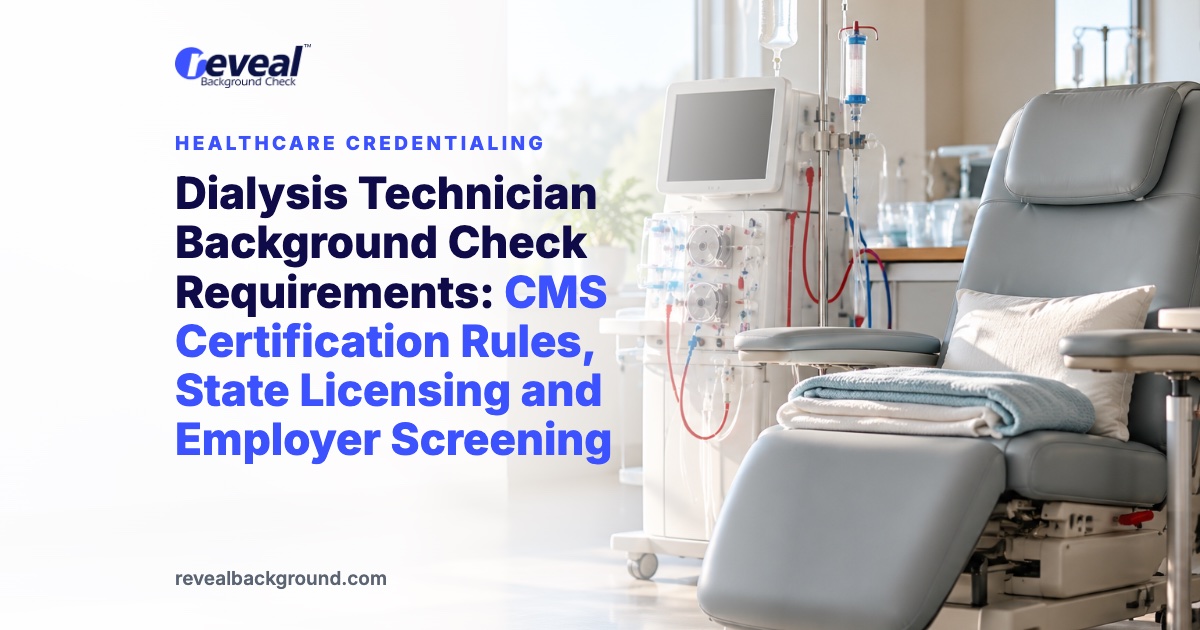
Dialysis patient care technicians work directly on a patient’s vascular access, operate equipment that sits between a patient’s blood and a machine, and often do it with less direct physician oversight than other clinical roles. Because of that, dialysis facilities build hiring around two layers: a federal personnel rule that every Medicare certified dialysis facility must follow, and whatever additional screening or state licensing applies on top of it. This guide walks through both, plus the employer’s own legal duties when a background check is part of the process.
The federal rule every certified dialysis facility must follow
Dialysis facilities that want to bill Medicare must be certified under the Medicare Conditions for Coverage for End Stage Renal Disease (ESRD) facilities. Those conditions set personnel qualifications for everyone on staff, including patient care technicians, in 42 CFR 494.140. Paragraph (e) of that section is specific to dialysis patient care technicians. It requires a technician to meet all applicable state requirements for education, training, credentialing, competency, standards of practice, certification, and licensure in the state where the person is employed; hold a high school diploma or its equivalent; complete a facility training program approved by the medical director that covers subjects such as principles of dialysis, cannulation technique, complications, water treatment, and infection control; and become certified under a state certification program or a national commercially available certification program within eighteen months of being hired into the role.
That last point matters for screening purposes: the federal rule itself does not create a single national license. It requires certification, but lets the technician meet that bar through either a state program, where one exists, or a national certification exam, and it gives a facility an eighteen month runway to get a new hire certified rather than requiring certification before the first day. A background screening or credentialing process that only checks for “a dialysis certification” without asking which pathway and what date is missing part of the federal requirement.
Comparing the layers that apply to a dialysis technician hire
| Requirement | Who sets it | What it covers | Applies everywhere? |
|---|---|---|---|
| Facility training program | Medical director and governing body, under 42 CFR 494.140(e)(3) | Dialysis principles, cannulation, complications, water treatment, infection control, safety | Yes, in every Medicare certified facility |
| State or national certification | State certification program where one exists, or a national certification body, per 42 CFR 494.140(e)(4) | Competency as a dialysis patient care technician, due within eighteen months of hire | Yes, but the pathway and timing vary |
| State professional license or registration | Individual state law and the state’s own licensing or health agency | Varies; some states layer a separate state credential on top of the federal certification requirement | No, varies by state; confirm with the specific state agency |
| OIG exclusion check | Facility policy, tied to Medicare and Medicaid program integrity rules | Whether a candidate is barred from being paid through federal healthcare programs | Applies to any facility billing federal healthcare programs |
| Criminal history and registry checks | Facility policy and, in some states, statute | Criminal record, and in many states, abuse or neglect registry status | Common practice, not a single federal mandate |
Does every state add its own license for dialysis technicians?
No, and the federal rule itself acknowledges that directly by telling technicians to follow whatever their own state requires, which is not the same everywhere. Some states administer or require a state specific certification or registration for dialysis technicians on top of the facility training and national or state certification path described above, while other states have no separate state credential and rely entirely on the facility’s own compliance with 42 CFR 494.140. Rather than listing specific states here without a verified citation for each one, the accurate guidance is this: before finalizing a job posting, an offer, or a credentialing file, check the current rule directly on the licensing or health agency page for the state where the technician will actually work. A rule that existed a few years ago may have changed, and a neighboring state’s rule does not carry over.
What employers typically screen before a dialysis technician starts
Beyond the certification and training pieces required by the Conditions for Coverage, most dialysis providers build a hiring screen around several additional layers. What exactly is checked and how results are weighed is a matter of employer policy and, in some cases, state law, not a single uniform standard.
- OIG exclusion check. The Department of Health and Human Services Office of Inspector General maintains the List of Excluded Individuals and Entities. A provider that bills Medicare or Medicaid and employs an excluded person, even in a non billing support role, can face civil monetary penalty exposure. Most dialysis providers check new hires against the list and then re-check on a recurring basis, using the OIG exclusions database instructions as the starting point.
- Criminal history check. Because the role involves direct, often unsupervised patient contact and access to needles and other sharps, a criminal history review is standard practice for patient care technician hiring. What disqualifies a candidate is set by employer policy and, in some states, by statute tied to healthcare licensure or Medicaid provider eligibility, rather than one nationwide list of disqualifying offenses.
- Abuse and neglect registry checks. Many states maintain adult or child abuse and neglect registries that healthcare employers check for roles involving direct patient contact. Coverage, the registry’s name, and whether a check is mandatory all vary by state, so confirm the current rule with the specific state’s health or social services agency.
- Drug screening. Pre employment drug testing, and in some facilities random testing, is common for clinical roles with access to medications and controlled substances, even though a patient care technician typically does not handle controlled substances directly the way a nurse or pharmacist might.
- Motor vehicle record check, where driving is part of the job. Technicians who support home hemodialysis patients or travel between clinic locations may be subject to an MVR check if driving a personal or company vehicle is part of the role.
- Health and immunization clearance. Because the role involves blood exposure, facilities commonly require proof of certain immunizations or a documented declination before the start date. This is a facility credentialing step, separate from a consumer background check in the legal sense.
Where FCRA duties come in
When a dialysis facility uses a third party consumer reporting agency to run a criminal history check, registry check, or other consumer report on a technician candidate, the Fair Credit Reporting Act governs the process. The employer must give the candidate a standalone disclosure, get written authorization before ordering the report, and, if the employer intends to take an adverse action based in whole or in part on what the report shows, send a pre adverse action notice along with a copy of the report and the Summary of Rights, allow a reasonable waiting period, and then send the adverse action notice if the decision stands. The Federal Trade Commission’s guidance on using consumer reports for employment purposes lays out these duties in plain terms for employers. A background check does not automatically show every record in every state; what is reportable depends on the type of record and state specific reporting rules, and a report should never be treated as a complete record of someone’s history just because nothing turned up.
When criminal history is part of the review, employers should also be aware of the Equal Employment Opportunity Commission’s enforcement guidance on the use of arrest and conviction records in employment decisions, which addresses how blanket exclusion policies can raise discrimination concerns under Title VII. An employer may be able to consider the nature of an offense, how long ago it occurred, and its relationship to the dialysis technician role, generally on a case by case basis, rather than applying an automatic disqualification. This is general background, not legal advice, and employers building or revising a screening policy should talk to counsel familiar with the applicable state and federal rules.
Frequently asked questions
Does federal law require dialysis technicians to be certified?
Yes, for any Medicare certified dialysis facility. Under 42 CFR 494.140(e), a patient care dialysis technician must complete an approved facility training program and become certified under a state certification program or a national certification program within eighteen months of being hired.
Do all states have their own license for dialysis technicians?
No. The federal rule itself defers to whatever each state requires, and that is not the same everywhere. Some states add a state specific certification or registration on top of the federal requirement, and others do not have a separate state credential. Confirm the current rule with the licensing or health agency in the state where the technician will work.
What is the OIG LEIE and why does it matter for dialysis technician hiring?
The List of Excluded Individuals and Entities is the exclusion list maintained by the HHS Office of Inspector General. Providers that bill Medicare or Medicaid generally check new hires and current staff against it, because employing an excluded individual can expose the provider to civil monetary penalties.
Can a background check show every criminal record from every state?
Not necessarily. What is reportable depends on the type of record and the specific state’s reporting rules, and no report should be assumed to capture every record in every jurisdiction just because the search came back clean.
Who is responsible for FCRA notices when hiring a dialysis technician?
The employer is responsible for FCRA compliance when it uses a consumer reporting agency, including providing a standalone disclosure, obtaining written authorization, and sending pre adverse action and adverse action notices with the required Summary of Rights if the employer intends to act on the report.
Does the federal certification rule apply to every dialysis worker, including water treatment staff?
No, not in the same way. 42 CFR 494.140(e) covers patient care dialysis technicians specifically. Water treatment system technicians are addressed separately under the same section and must complete a training program approved by the medical director and governing body, without the same certification timeline.
For related hiring context, see our guides on CNA background check requirements and healthcare exclusion screening for OIG LEIE and SAM checks. To talk through a screening program for dialysis facility hiring, visit Reveal Background.
This article is general information, not legal or medical advice. Certification, licensing, and screening requirements vary by state and by employer policy; consult qualified counsel for guidance specific to your organization.