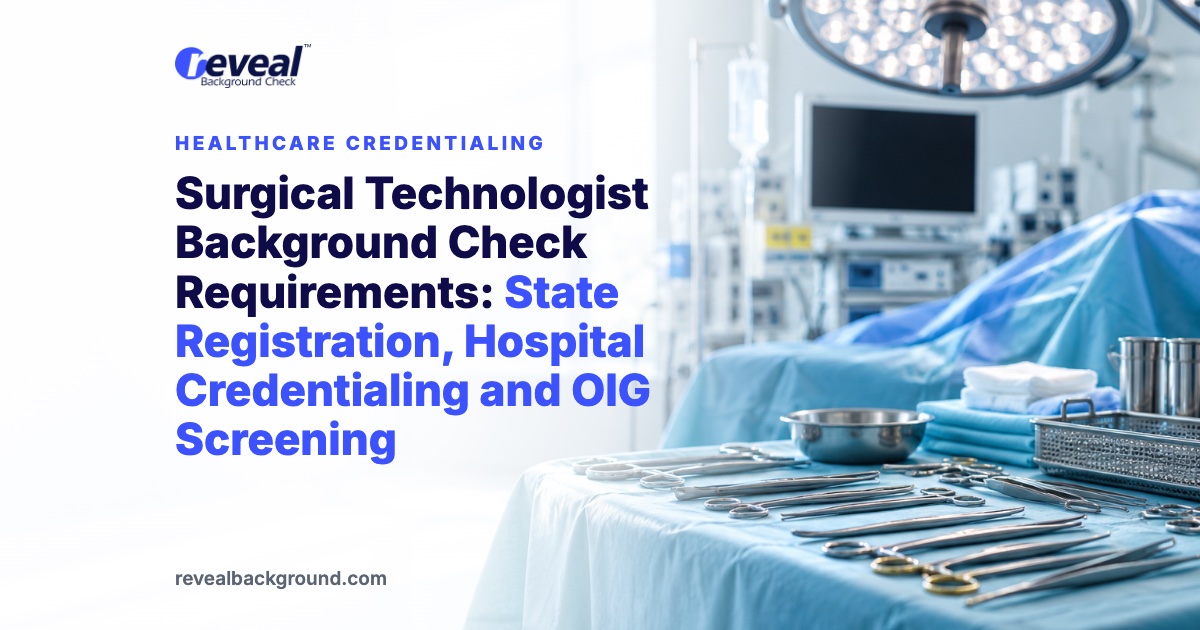
Surgical technologists work inside the sterile field, handling instruments, counting supplies, and supporting the surgical team during procedures. Because the role puts someone in direct contact with patients while they are unconscious and most vulnerable, employers treat screening seriously, even though state licensing law for this job is thin compared to nursing or medicine. Two separate systems usually decide what gets checked: a small group of state boards that register or license surgical technologists, and the hospital or surgery center that actually hires, which layers on its own credentialing, exclusion screening, and health requirements under federal hospital rules.
This guide breaks down what each layer typically covers, where states differ, and what the Fair Credit Reporting Act requires when a third party compiles the report.
Do states license or register surgical technologists?
Most states do not regulate the surgical technologist title at all. There is no federal licensing scheme for this occupation, so unless a state legislature has passed a specific registration or licensure law, the decision to screen, train, or require certification sits entirely with the hospital or surgical facility. Where a state has no rule, that is the honest answer, not a gap to fill in with assumptions about what “probably” applies.
A handful of states are the exception. Washington requires state registration before a person may practice as a surgical technologist, under its Uniform Disciplinary Act framework. The Washington State Department of Health registration requirements page lays out the application steps, and the department’s own application instructions state plainly that criminal history checks are conducted on all applicants, with fingerprint based checks through the Washington State Patrol and the FBI required for applicants who have lived in another state or who have a criminal record in Washington.
Illinois also regulates the profession, but through a different mechanism. The Illinois Department of Financial and Professional Regulation surgical technologist page explains that the title “Surgical Technologist, Licensed” is protected, and that licensure requires graduation from an accredited surgical technology program (or an approved military program) plus current certification through the National Board of Surgical Technology and Surgical Assisting.
Other jurisdictions have looked at the question and chosen not to regulate. The District of Columbia Department of Employment Services page on the surgical technician occupation states directly that DC does not require registration for this role, even though national certification remains available on a voluntary basis. Employers and applicants in states without a licensing law should not assume a hidden requirement exists. The correct move is to check the relevant state’s health licensing agency directly rather than guess.
| State | Regulatory status | Governing agency | What the rule covers |
|---|---|---|---|
| Washington | Registration required to practice | Washington State Department of Health | Criminal history check on all applicants, fingerprint check for out of state or Washington criminal history |
| Illinois | License required to use the protected title | Illinois Department of Financial and Professional Regulation | Accredited education and current NBSTSA certification |
| District of Columbia | No state registration required | Not applicable | Certification is voluntary, not a legal requirement |
| Most other states | No specific state regulation of the title | Not applicable | Screening and credentialing decisions are left to the employer |
What hospitals actually screen before you work in the OR
Even in states without a licensing law, the hospital or ambulatory surgery center almost always runs its own pre-employment screening program, because the facility, not the state, is accountable for who it allows near patients and who it bills federal health programs through.
Criminal history
Criminal background checks for roles with direct patient contact are standard practice across hospital systems. Because a surgical technologist has access to patients, controlled substances in the OR, and medical equipment, employers generally run county, state, and sometimes federal criminal record searches as part of onboarding. What disqualifies a candidate varies by employer and by state law. Background checks compiled by a third party screening company are governed by the FCRA, discussed further below.
OIG exclusion screening
Hospitals that participate in Medicare or Medicaid have a strong incentive to check every new hire, not just licensed clinicians, against the List of Excluded Individuals and Entities maintained by the Department of Health and Human Services Office of Inspector General. The OIG’s background page on the exclusions program explains that anyone who employs or contracts with an excluded individual to provide items or services paid for with federal funds can face civil monetary penalties, which is why exclusion screening typically happens before hire and then on a recurring basis for the life of employment. The LEIE database and downloadable files are publicly available for employers to check names directly. For a deeper look at how LEIE screening works alongside the separate SAM exclusion list, see Reveal Background’s guide to healthcare exclusion screening.
State abuse and neglect registries
Many hospitals also check state administered abuse, neglect, or vulnerable adult registries as part of their own hiring policy for patient facing staff, even when a specific federal rule for surgical technologists does not mandate it the way it does for some long term care roles. Policies on which registries get checked, and how often, vary by employer and by state.
Drug screening
Pre-employment drug testing is common for operating room staff given their proximity to controlled substances and the safety sensitive nature of surgical support work. Testing programs and panels vary by employer.
Immunization and health records
Hospitals typically require proof of immunizations, a TB screening, and sometimes a physical capable of performing OR duties before clearing a new surgical technologist to start, consistent with standard infection control practices in a sterile environment.
CMS conditions of participation and staffing
Hospitals that accept Medicare and Medicaid payment must meet the Conditions of Participation set out by the Centers for Medicare and Medicaid Services. The CMS hospital Conditions of Participation page and the underlying regulation at 42 CFR 482.23 on nursing services require hospitals to maintain adequate numbers of qualified personnel and to meet applicable state and local law for hospital staff. This is the federal backbone that pushes hospitals toward documented, consistent credentialing files even in states that do not separately license surgical technologists. To understand how credentialing and background screening work together and where each one stops, see Reveal Background’s comparison of credentialing versus background checks in healthcare.
The FCRA rules employers must follow
When a hospital uses a third party consumer reporting agency to run a surgical technologist’s background check, the Fair Credit Reporting Act applies. The Federal Trade Commission’s guidance on employer background checks and applicant rights explains that before obtaining a report, an employer must give the applicant a clear, standalone written disclosure and get written authorization. Before taking any adverse action, such as withdrawing an offer because of something found in the report, the employer must give the applicant a pre-adverse action notice that includes a copy of the report and a copy of the Summary of Your Rights Under the Fair Credit Reporting Act, and give the person a reasonable opportunity to respond before the decision is final. The FTC’s guidance for employers on background checks covers the same disclosure, authorization, and adverse action sequence from the employer’s side. A background check will not necessarily show every past record in every state. What reports and how long it stays reportable depends on state law and the type of record, so employers should not assume a record is automatically visible or automatically hidden.
What this means for applicants and employers
For applicants, the practical takeaway is to check the licensing agency in the state where the job is located before assuming registration is or is not required, and to expect that even unregulated states will still run a criminal history check, drug screen, and OIG exclusion check through the hospital’s own hiring process. For employers, the mix of state rules, hospital credentialing policy, and CMS conditions of participation means a consistent, documented screening program matters more than relying on state licensure alone, since most states do not license this role at all. A consumer reporting agency that understands healthcare screening, like Reveal Background, can help build a process that holds up across states with very different rules.
Frequently asked questions
Does every state require a license to work as a surgical technologist?
No. Only a small number of states, including Washington and Illinois, regulate the title through registration or licensure. Most states leave the decision to screen and credential surgical technologists to the employer.
What does a surgical technologist background check usually include?
Typical hospital screening includes a criminal history check, an OIG exclusion list check, drug screening, and verification of immunization and health records. State registration, where it exists, may add its own criminal history or fingerprint requirement.
Why do hospitals check the OIG exclusion list for surgical technologists even if the role is not licensed?
Hospitals that bill Medicare or Medicaid can face civil monetary penalties for employing anyone on the federal exclusion list, regardless of whether that person’s occupation is separately licensed by the state.
Can a past criminal conviction automatically disqualify a surgical technologist applicant?
It generally depends on the employer’s policy and state law, and the FCRA gives applicants the right to see the report and respond before an employer finalizes an adverse decision. Employers should consult counsel on how to apply conviction history consistently and lawfully.
Does the Fair Credit Reporting Act apply to surgical technologist background checks?
Yes, when a third party consumer reporting agency compiles the report. The employer must provide a standalone disclosure, obtain written authorization, and follow the pre-adverse and adverse action notice process before relying on the report to make a hiring decision.
This article is general information, not legal advice. Employers should consult qualified counsel about screening policies, and applicants with specific questions should contact the relevant state licensing agency or an attorney.