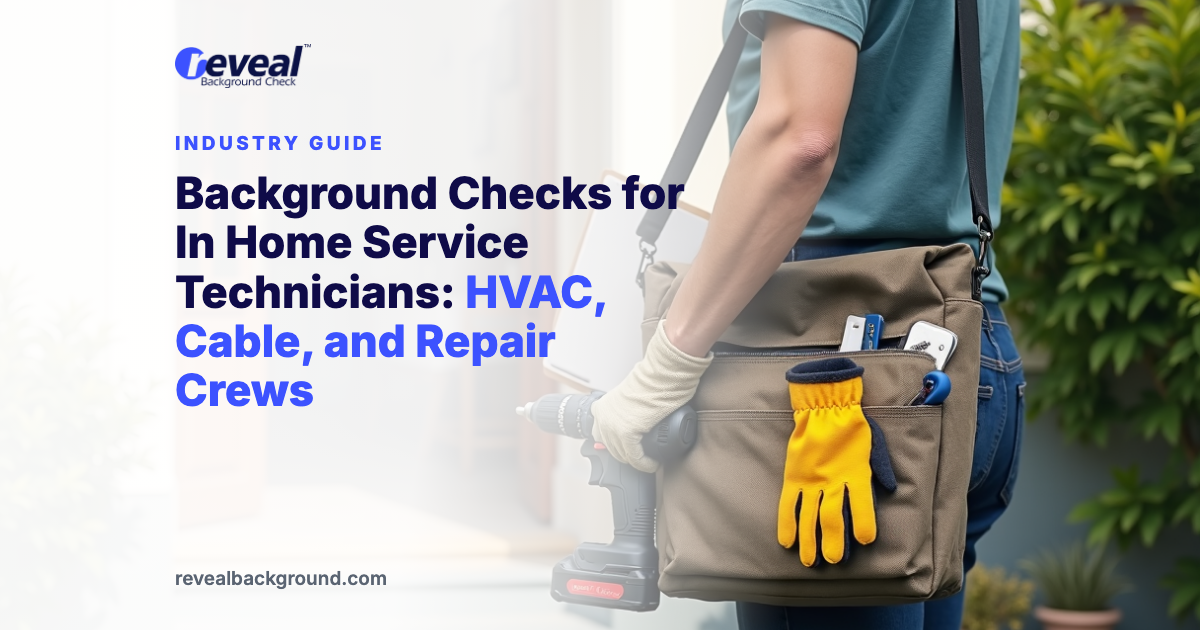
A technician who fixes a furnace, runs a cable line, or repairs an appliance is often alone in a stranger’s house, sometimes with a key, a garage code, or a homeowner who steps out to run an errand. That level of access is different from almost any other frontline job, and it is exactly the kind of fact pattern that shows up in negligent hiring lawsuits when something goes wrong. If a company sent someone into a home without a reasonable screening process and that person harmed a resident, stole property, or caused an incident, the company’s hiring file becomes evidence.
This is not a theoretical risk category. Home services companies, HVAC contractors, cable and satellite installers, appliance repair outfits, and pest control operators are named in negligent hiring claims with some regularity, and the legal standard courts apply is whether the employer exercised reasonable care in hiring and kept exercising it over time. Our overview of negligent hiring exposure covers the legal theory in more depth. Here, the focus is what an in-home screening program should actually contain.
Why in-home access raises the bar
Most jobs involve interacting with the public in a public space. In-home service work is different because the customer invites a stranger past their own front door, often based on nothing more than a company name and a scheduled appointment window. The homeowner has no way to independently vet the person standing on their porch. That responsibility sits entirely with the employer, and courts have generally held employers to a higher standard of care when the nature of the job puts vulnerable people, including children and elderly residents, in direct and unsupervised contact with an employee.
The Equal Employment Opportunity Commission’s guidance on using arrest and conviction records in hiring decisions is still the reference point for how to weigh criminal history without running afoul of discrimination law. It calls for an individualized assessment that considers the nature of the offense, the time that has passed, and the nature of the job, rather than a blanket exclusion policy. For a role that involves entering private homes, the job-relatedness of a criminal history search is easy to document, but the assessment still has to be done fairly and consistently. The EEOC’s enforcement guidance on arrest and conviction records lays out the framework.
What a sensible package looks like
There is no single mandated checklist for home service screening outside of a handful of state licensing rules, but a defensible package for this category of work generally covers four areas: criminal history, sex offender registry status, driving record for anyone operating a vehicle for the job, and identity verification to confirm the person is who they claim to be before they are issued a uniform, badge, or company vehicle key.
Criminal history searches should go beyond a single county. Technicians often live in one county and have worked or been convicted in another, so a search scoped only to the county of current residence misses records. A national criminal database search paired with primary source verification at the county or state level catches more than either search alone. Sex offender registry checks matter specifically for this role because the harm being screened for, unsupervised contact with residents in their own home, is exactly the pattern registry checks are built to flag. The U.S. Department of Justice’s National Sex Offender Public Website is the authoritative aggregator for state and territory registries and is worth understanding even if your screening provider queries it as part of a bundled package. You can review how it works at the National Sex Offender Public Website.
Motor vehicle records matter for any technician who drives a company vehicle between appointments, not just for companies that classify drivers as a separate job category. A clean criminal record does not tell you anything about how someone drives, and a technician with a pattern of reckless driving or license suspensions is a liability risk both on the road and in the eyes of a jury weighing whether the company knew or should have known. Our guide to MVR screening covers how to read a driving record and what violation patterns should trigger a second look. States that operate employer notification programs, like California’s Employer Pull Notice program through the DMV, let employers get ongoing alerts when a driver’s record changes rather than relying on a single point-in-time pull. Details on that structure are on the DMV’s Employer Pull Notice program page.
Comparing the screening scope by role
| Screening component | Indoor-only technician | Driving field technician | Subcontracted crew member |
|---|---|---|---|
| National criminal database search | Recommended | Recommended | Recommended, often skipped in practice |
| County or statewide primary source check | Recommended | Recommended | Recommended, frequently absent |
| Sex offender registry search | Recommended | Recommended | Recommended, high-risk gap |
| Motor vehicle record | Not applicable | Required | Required if the crew drives to the site |
| Identity verification | Recommended | Recommended | Recommended, easy to overlook when hiring flows through a third party |
| State license verification | Required where licensed trade | Required where licensed trade | Required, and the crew’s license is not the same as the individual worker’s status |
The last row is where a lot of companies get tripped up. A subcontracted HVAC or cable crew may work under a licensed business entity, but that license covers the business, not necessarily the background of every technician the business sends to a job site.
State contractor licensing rules already require some of this
Several states have built background screening directly into contractor licensing, which means a portion of this work is already mandated rather than optional. California’s Contractors State License Board requires fingerprint-based background checks for licensees as part of its criminal background check program, a requirement it phased in specifically because of concerns about who was entering customers’ homes under a licensed contractor’s name. The CSLB’s own announcement on the fingerprinting requirement is available on its fingerprinting requirement notice.
The gap most companies miss is that a licensing board background check covers the license holder, typically the business owner or a designated qualifying individual, not necessarily every technician who shows up at a customer’s door under that license. A company can be fully compliant with its state licensing board and still have employees and subcontracted crew members who were never independently screened. If your state’s licensing rules only reach the license holder, your own hiring process has to cover everyone else who enters a home under your brand.
Because any background check run through a screening company is a consumer report under the Fair Credit Reporting Act, the process still has to follow federal disclosure and authorization requirements regardless of what a state licensing board separately mandates. The Federal Trade Commission’s guidance for employers walks through the notice, authorization, and adverse action steps required before a report can be used in a hiring decision, available at the FTC’s background checks guidance for employers. The Consumer Financial Protection Bureau, which now shares FCRA rulemaking authority, publishes the implementing regulation known as Regulation V, which spells out the technical compliance requirements for anyone furnishing or using consumer reports. That regulation is posted at the CFPB’s Regulation V page.
The subcontractor screening gap
This is the weak point in most home services screening programs. A company screens its own W-2 technicians carefully, then dispatches a subcontracted crew, a franchise partner’s staff, or a third party install team to the same customer’s home with no independent verification at all. The homeowner does not know or care about the org chart. From their perspective, everyone wearing the company logo was sent by the company, and that is also how a court is likely to view it if a subcontractor causes harm.
Closing this gap does not require screening every subcontractor employee to the same depth as a direct hire, but it does require a minimum standard written into subcontractor agreements: proof that the subcontracting company runs its own criminal, sex offender registry, and identity checks, on a cadence you can verify, with documentation you can request. Verbal assurance that “we background check everyone” is not documentation. If a subcontractor cannot produce evidence of its screening process, that is worth treating as a red flag rather than a formality to skip past.
Rescreening and staying current
A background check is a snapshot of a person’s record on the day it was pulled. Someone can pass a pre-hire screen cleanly and then have an incident a year into the job. Many home services companies address this with periodic rescreening, commonly built around license renewal cycles or an annual review, plus continuous monitoring options that flag new criminal filings or license actions as they happen rather than waiting for the next scheduled check. For roles that involve unsupervised home access, continuous monitoring closes a real gap that a once-a-year check leaves open for months at a time.
Setting up a program that covers criminal history, registry checks, MVR pulls for drivers, and rescreening does not require building it from scratch. Reveal’s background check pricing page outlines package options built for exactly this kind of role-based screening, so you can match the depth of the check to what the job actually requires instead of running one generic package across every position.
Frequently asked questions
Do all in-home service technicians need a background check before entering a customer’s home?
There is no single federal law that mandates it for every trade, but state contractor licensing rules increasingly require it at the license holder level, and the negligent hiring standard that courts apply makes a documented screening process the practical baseline for any company sending technicians into private homes.
What does a sex offender registry check add beyond a standard criminal record search?
Registry checks flag registrants regardless of whether their underlying conviction shows up cleanly in a general criminal database search, and they specifically address the risk pattern this role creates: unsupervised access to a residence. It is a targeted check for a targeted risk, not a substitute for a broader criminal history search.
How often should technicians be rescreened after they are hired?
Many home services companies rescreen annually or align rescreening with license renewal cycles, and pair that with continuous monitoring so new criminal filings or license actions surface as they happen rather than sitting undetected until the next scheduled check.
Are subcontractors held to the same screening standard as direct employees?
Legally, a homeowner and a court generally do not distinguish between a company’s direct employee and a subcontracted crew wearing the same uniform. Practically, many companies screen direct hires but not subcontractors, which is the most common gap in home services screening programs and the one worth closing first.
Does a motor vehicle record check matter if the technician does not drive far between jobs?
Distance is not the relevant factor. If a technician operates a company vehicle at all, a driving record check establishes whether that person has a pattern of unsafe driving, which is a liability question independent of how many miles they log in a day.
Related Reading
This article is general information, not legal advice. Background screening requirements vary by state and by trade, and negligent hiring standards are set by state law, so employers should confirm current requirements with qualified counsel and a background check provider familiar with the applicable jurisdictions before building or changing a screening program.