Public Defender Background Check: Bar Admission, Character and Fitness and Office Hiring
← Back to Resources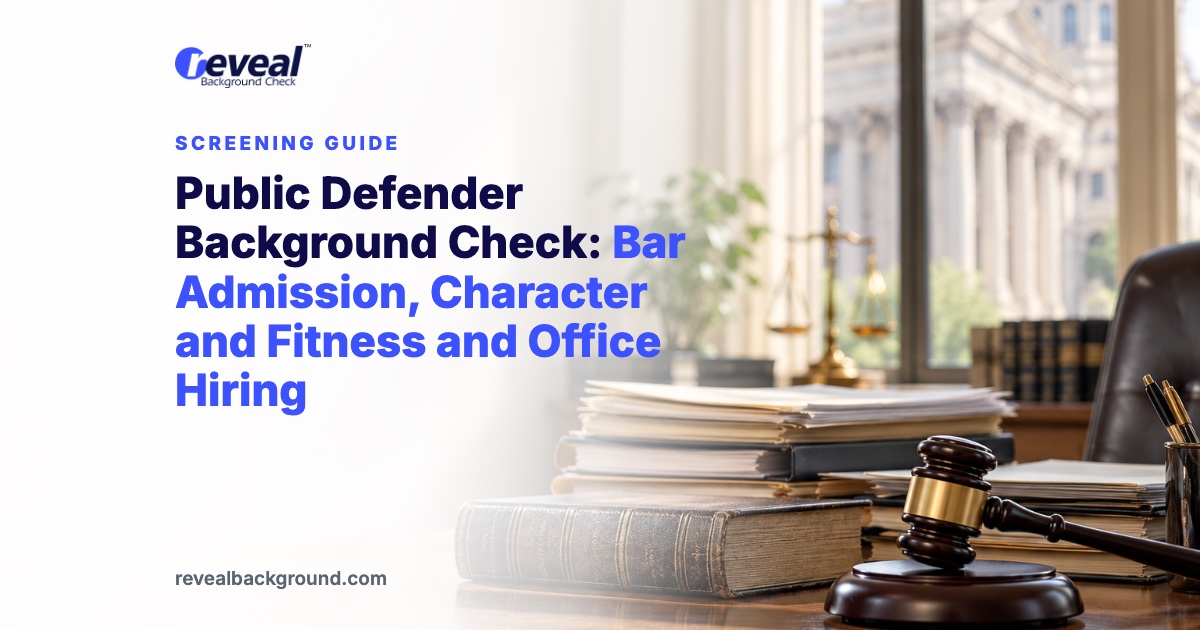
View pricing
A public defender is screened twice before taking a single case. The first review happens years earlier, when the person applies to practice law at all. The state bar's character and fitness process looks at honesty, financial responsibility and any criminal history before granting a license. The second review happens when a specific public defender office, whether a county agency, a state defender commission or a federal defender organization, decides whether to hire that licensed attorney. Each layer asks a different question, and understanding both helps explain why a conviction on someone's record does not automatically end a legal career, and why it does not automatically clear them for a government defense job either.
Two separate gatekeepers, two separate questions
Bar admission authorities decide whether a person may practice law in a state at all. Hiring authorities, including public defender offices, decide whether a licensed attorney is the right fit for a specific government role. A person can pass one review and fail the other. Someone can be a licensed, bar admitted attorney in good standing and still be turned down by a defender office over a conflict of interest, a weak reference, or information that surfaces during the office's own hiring screening. The reverse is also true. A bar applicant who clears character and fitness review after disclosing an old record may still face a defender office that has its own internal policy about certain offense types, separate from anything the bar required.
Bar admission: the character and fitness review
Every state requires a positive moral character or character and fitness determination before issuing a law license, and every applicant to a bar examination completes an extensive application that asks about prior arrests, convictions, discipline in another profession, financial history and candor on prior applications. The California State Bar's moral character determination page describes the standard as including honesty, fairness, candor, trustworthiness, observance of fiduciary responsibility, respect for and obedience to the law, and respect for the rights of others, and it warns applicants that the review can take several months. Texas runs a parallel process through the Board of Law Examiners, whose character and fitness page points applicants to the Rules Governing Admission to the Bar of Texas and to a separate set of guidelines the board uses to evaluate character issues and to oversee attorneys admitted on a probationary license.
These reviews are not criminal background checks in the employment sense. They rely heavily on the applicant's own disclosures, supporting records the applicant is required to produce, and in many states a fingerprint based criminal history check run through the state's law enforcement or court system. Lying on the application, or failing to update it when new information arises, is treated by most boards as more serious than the underlying conduct itself. The California Bar's own guidance stresses that candor is a significant factor in the committee's decision, separate from whatever the applicant is disclosing.
What a conviction means for bar admission
There is no single federal rule that bars someone from becoming a lawyer because of a criminal record, and state rules vary enough that no general statement covers every jurisdiction. Most character and fitness committees look at the nature of the offense, how long ago it occurred, what the applicant has done since, and whether the applicant was forthcoming about it, rather than applying an automatic disqualification list. A conviction can slow the process, trigger a formal hearing, or require character references and evidence of rehabilitation, but it does not end the application outright in most states. Anyone with a record who is applying to the bar should read their own state's admission rules directly rather than assume a result, because committees differ on how they weigh older offenses, expunged or sealed records, and conduct that occurred before law school.
Hiring into a public defender office
Passing the bar and being sworn in as an attorney does not promise a defender job. Most state and county public defender offices are government agencies, and they hire attorneys the way other government legal employers do: an application, interviews, reference checks, verification of the law license and bar standing, and often a conflicts check to confirm the applicant has no prior relationship with the prosecution's office, a victim, or a co-defendant in a pending case. Many offices also run or request a criminal history check as part of standard public sector hiring, separate from whatever the bar already reviewed years earlier, because the office is evaluating current fitness for a specific government role rather than general admission to the profession.
Federal defender organizations work differently from most county offices because their attorneys and staff are not independent contractors or nonprofit employees. As the federal judiciary's defender services overview explains, federal public defender organizations are federal entities and their staffs are federal employees, distinct from community defender organizations, which are nonprofit defense counsel organizations that receive federal funding but are incorporated under state law, and from panel attorneys, who are private practitioners appointed case by case. There are more than eighty authorized federal defender organizations employing thousands of lawyers, investigators, paralegals and support staff nationwide.
Public defender screening at a glance
| Hiring path | Who screens | What is reviewed | Legal basis |
|---|---|---|---|
| Bar admission (any state) | State bar admission authority or board of law examiners | Moral character, candor, prior discipline, criminal history disclosure | State supreme court admission rules |
| County or state public defender office | The hiring office or county human resources | License standing, conflicts of interest, references, often a criminal history check | State or county civil service and agency policy |
| Federal defender organization | The defender organization and the federal judiciary | Federal employment suitability review, fingerprint based background investigation | 18 U.S.C. 3006A and federal judiciary personnel policy |
Federal public defenders go through a judiciary background investigation
Because federal public defender staff are federal employees of the judiciary rather than state licensees doing a government job, they go through the same employment suitability process as other judiciary hires. The judiciary's own employment eligibility page states that all judiciary employees, including interns, volunteers and contractors, are fingerprinted as part of the background check process and must be found suitable before onboarding, and that law enforcement officers, executives and candidates for moderate risk, high risk or select high risk positions must undergo a fuller background investigation. The federal defender organization itself exists under 18 U.S.C. 3006A, the Criminal Justice Act provision that authorizes federal courts to establish defender organizations and appoint a chief federal public defender to a term set by the circuit's court of appeals.
That means a federal public defender has typically cleared three separate checkpoints before starting work: law school and bar admission with its own character and fitness review, the federal defender organization's hiring and reference process, and the judiciary's own suitability and fingerprint based background check tied to the position's sensitivity level.
Conflicts checks matter as much as criminal history
For a public defender specifically, a conflicts of interest check is often the screening step that gets the most attention internally, because an undisclosed conflict can get a case thrown out or an attorney disqualified mid representation. Offices generally ask applicants and current staff to disclose prior employment at a prosecutor's office, any family relationship to current judges or prosecutors in the jurisdiction, and prior representation of a party on the opposing side of an active or recent case. This is separate from a criminal history or credit check and is usually handled through office policy and an internal conflicts database rather than a consumer reporting agency.
When an outside background check company is involved
Some government hiring offices, including public defender agencies, use a third party consumer reporting agency to run all or part of the pre employment background check, rather than handling fingerprinting and records review entirely in house. When that happens, the agency hiring the attorney or support staff member is an employer under the Fair Credit Reporting Act and must provide a standalone disclosure, get the applicant's written authorization, and follow the pre adverse and adverse action notice process, including giving the applicant a copy of the report and a summary of their rights, before deciding not to hire based on what the report shows. What shows up on that report and how far back it goes still depends on state law and the type of search ordered, so no office should assume a report will surface every record in every state.
Public defender offices considering outside screening, and attorneys curious about what a background check for a government legal role typically covers, can review how Reveal Background structures FCRA compliant screening for public sector and legal employers.
Related reading
For the broader bar admission process that applies to every licensed attorney, not just public defenders, see our guide to attorney character and fitness background checks. For the comparable screening path on the other side of the courtroom, see our prosecutor background check guide.
Frequently asked questions
Does a criminal record automatically disqualify someone from becoming a public defender?
No single rule disqualifies every applicant with a record. Bar character and fitness committees weigh the offense, how long ago it happened, and the applicant's candor and conduct since, rather than applying an automatic bar in most states. A separate hiring decision by a defender office follows its own policies on top of bar admission.
Do public defender offices run their own background check, or rely on the state bar's review?
Most offices do both. The bar's character and fitness review covers admission to practice law generally, while the hiring office typically verifies license standing, checks for conflicts of interest, contacts references and often runs or requests a separate criminal history check tied to the specific government job.
Are federal public defenders considered government employees?
Yes. Federal public defender organizations are federal entities and their staff are federal employees of the judiciary, which is different from community defender organizations that are nonprofit entities receiving federal funding, and different from panel attorneys who are privately practicing lawyers appointed case by case.
What background investigation do federal defender office employees go through?
As judiciary employees, they are fingerprinted as part of the standard background check process and must be found suitable before onboarding. The depth of the investigation depends on the position's sensitivity level, with higher sensitivity roles requiring a fuller background investigation.
Does the Fair Credit Reporting Act apply when a public defender office checks a candidate's background?
It applies whenever the office uses an outside consumer reporting agency to run the check. In that situation the office must provide a standalone disclosure, obtain written authorization, and follow the pre adverse and adverse action notice steps before deciding not to hire based on the report.
Can a licensed attorney with a prior conviction still be hired by a public defender office?
It depends on the state's bar admission outcome, the specific offense, and the individual office's hiring policy. A record that did not prevent bar admission will not automatically prevent hiring, but each defender office makes its own fitness determination for the role it is filling.
This article is general information about public defender screening and licensing, not legal advice. Bar admission and hiring rules vary by state and by agency, and anyone with questions about a specific application or job should consult the relevant bar authority or hiring office directly.
Compare background check packages
Find screening options for the people and roles you hire for.