Anesthesiologist Assistant License Background Check: State Licensure, NCCAA and Hospital Screening
← Back to Resources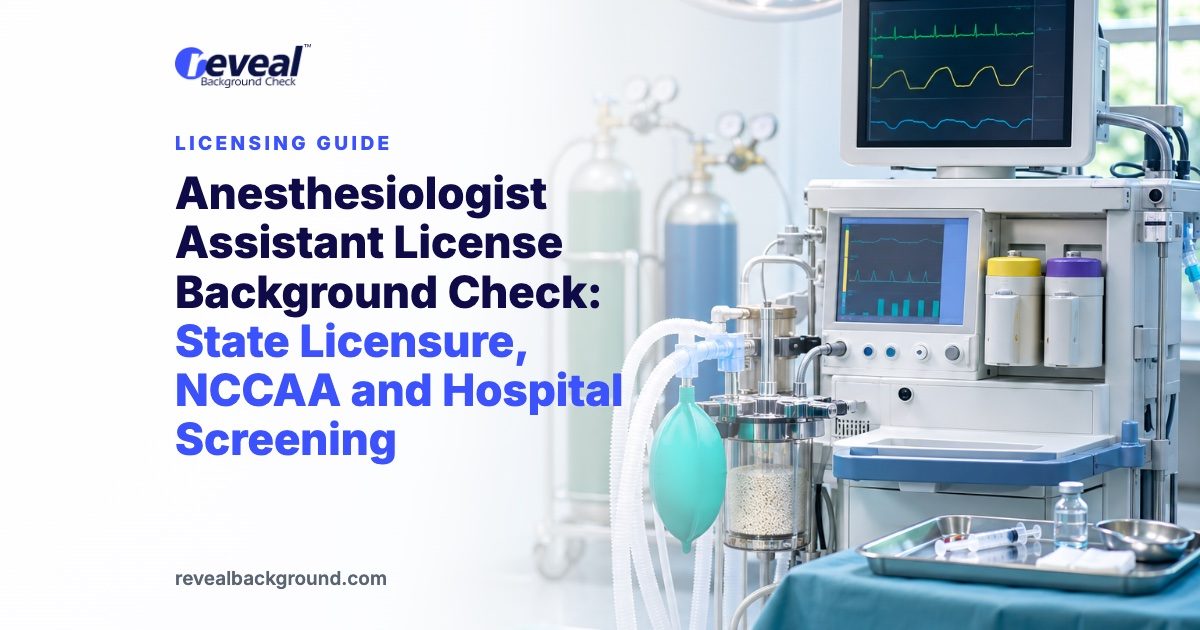
View pricing
A certified anesthesiologist assistant, often written as CAA or AA, delivers anesthesia care as part of an anesthesia care team under the direction of a licensed anesthesiologist. The role only exists as a licensed profession in roughly twenty states plus the District of Columbia, which makes background screening for this job different from most clinical positions. An employer, hospital credentialing office, or staffing agency hiring an anesthesiologist assistant has to confirm an active state license, verify national certification, and run the same federal checks used across anesthesia care teams, including exclusion and sanction screening and a National Practitioner Data Bank query.
This guide walks through how state licensure works for anesthesiologist assistants, what national certification adds, why controlled substance access makes diversion related screening relevant, and how the National Practitioner Data Bank, the Office of Inspector General exclusion list, and the Fair Credit Reporting Act fit into the hiring process.
Where anesthesiologist assistants are a licensed profession
Unlike physicians, registered nurses, or physician assistants, anesthesiologist assistants are not licensed nationwide. State medical boards that have adopted an anesthesiologist assistant practice act typically regulate the profession alongside physician assistants, since both are dependent practice roles supervised by a physician. Ohio is a representative example. The State Medical Board of Ohio maintains a dedicated practitioner resources page for anesthesiologist assistants describing scope of practice and supervision requirements, separate from its physician assistant program.
Georgia licenses the role through the same body that licenses physicians. The Georgia Composite Medical Board lists Anesthesiologist Assistant as its own license category alongside physician assistants. South Carolina's Board of Medical Examiners likewise recognizes anesthesiologist assistants as licensees under its medical practice statute. Missouri's Board of Registration for the Healing Arts runs a separate Anesthesiologist Assistant licensing committee with its own application forms and disciplinary records search, distinct from the physician assistant and physician boards it also houses.
Because the list of states that license the role changes as legislatures act, an employer or a background screening company should confirm current status directly with the state medical or healing arts board in the state where the person will practice rather than relying on a fixed count. Where a state has not adopted an anesthesiologist assistant practice act, there is no state license to verify for that title, and the applicant cannot practice under that scope in that state regardless of certification held elsewhere.
Criminal history as part of initial licensure
State medical boards generally require a fingerprint based criminal history check before issuing any license they regulate, and anesthesiologist assistant applicants go through the same process as physicians and physician assistants in that state. Ohio's medical board publishes this requirement on its criminal records check page, which explains that applicants must submit fingerprints for a check through the Ohio Bureau of Criminal Identification and Investigation and the FBI as part of the licensing process administered by the board.
This state level fingerprint check is separate from, and does not replace, an employer's own pre-employment background check. A hospital or anesthesia group still needs its own FCRA compliant report because the state board's review answers only one question, whether the person qualifies for a license, not whether the person meets a specific employer's hiring criteria or whether anything has changed since the license was issued.
| State example | Licensing body | Does it license anesthesiologist assistants as a distinct category | Public source |
|---|---|---|---|
| Ohio | State Medical Board of Ohio | Yes, with its own practitioner resources page and fingerprint based criminal records check requirement for licensure | med.ohio.gov |
| Georgia | Georgia Composite Medical Board | Yes, listed as its own license category with physician assistants | medicalboard.georgia.gov |
| South Carolina | Board of Medical Examiners | Yes, anesthesiologist assistants are recognized licensees | llr.sc.gov |
| Missouri | Board of Registration for the Healing Arts | Yes, a separate Anesthesiologist Assistant licensing committee | pr.mo.gov |
For any state not listed here, an employer should check that state's medical board or healing arts board directly rather than assume the rule matches a neighboring state, since scope of practice statutes, supervision ratios, and whether the title exists at all vary by legislature.
NCCAA certification and why it matters to an employer
Most states that license anesthesiologist assistants require current certification by the National Commission for Certification of Anesthesiologist Assistants as a condition of licensure, along with graduation from an accredited anesthesiologist assistant program. Certification has to be maintained on a continuing basis, and a lapse can affect licensure status. Primary source verification of this certification, done through the certifying body's own verification channel rather than by trusting a resume or diploma copy, is a standard part of credentialing for this role, the same way hospitals verify board certification for physicians.
License and certification verification answers whether someone is currently authorized to practice. It does not substitute for a separate criminal background check, since a license can be active even where the state's review window or reporting rules did not capture a more recent arrest, and an employer's own screening serves a different purpose than the state's gatekeeping function.
Controlled substance access and diversion related screening
Anesthesia care involves routine handling of controlled substances, and diversion, meaning the theft or improper use of those drugs by a member of the care team, is a recognized risk that hospitals and anesthesia groups screen for during both hiring and ongoing employment. Anesthesiologist assistants typically administer controlled substances under the order and supervision of the anesthesiologist rather than under their own individual Drug Enforcement Administration registration, which is different from how some other advanced practice roles are authorized. The federal definition of a mid level practitioner who may hold independent DEA registration authority is set out in the Code of Federal Regulations at 21 CFR 1300.01, and employers should confirm with counsel and the state board how that framework applies to anesthesiologist assistants in a given state rather than assume parity with nurse practitioners or physician assistants.
Because diversion risk is tied to drug access rather than title alone, hospital anesthesia departments commonly pair licensure verification with the same drug screening, criminal history review, and ongoing monitoring protocols used for anesthesiologists and nurse anesthetists on the same care team.
National Practitioner Data Bank and exclusion screening
Hospitals and group practices that grant clinical privileges are required to query the National Practitioner Data Bank as part of credentialing, which reports medical malpractice payments, licensure actions, and certain clinical privilege actions tied to a practitioner. The reporting and querying framework for the data bank is set out in federal regulation at 45 CFR Part 60. A clean state license does not promise a clean data bank history, since an adverse action in one state, or a malpractice payment, can exist in the data bank independent of current license status elsewhere.
Separately, any healthcare employer, including an anesthesia practice, should check whether an applicant appears on the Department of Health and Human Services Office of Inspector General's List of Excluded Individuals and Entities. An excluded individual generally cannot be paid for services billed to federal health programs, and hiring or continuing to employ an excluded person can expose the employer to civil monetary penalties regardless of whether the person holds a current state license.
FCRA duties when the background check is run by a third party
When a hospital, anesthesia group, or staffing agency uses a consumer reporting agency rather than conducting the check entirely in house, the Fair Credit Reporting Act applies. The employer must provide a standalone disclosure and get the applicant's written authorization before ordering the report, and if the employer plans to take action based on something in the report, it must send a pre-adverse action notice with a copy of the report and the Summary of Rights, give the applicant a reasonable opportunity to respond, and only then send an adverse action notice if it proceeds. A background check does not automatically report every record in every state the way some employers assume, and state law and record retrieval practices vary, so an employer should not represent to applicants that a report will or will not surface a specific item.
Frequently asked questions
Is an anesthesiologist assistant license the same as a physician assistant license?
No. Even though several state boards group the two professions together administratively, anesthesiologist assistant licensure has its own scope of practice tied to anesthesia care under an anesthesiologist's supervision, and the two credentials are verified separately.
Do all states license anesthesiologist assistants?
No. The profession is licensed in a limited group of states, generally cited as around twenty states plus the District of Columbia, and the exact list changes as state legislatures act. An employer should verify current status with the specific state medical or healing arts board rather than assume the role is recognized everywhere.
Does an active anesthesiologist assistant license mean the person passed a criminal background check?
In states that require fingerprint based criminal history review as part of licensure, such as Ohio, an active license generally means that check occurred at the time of application or renewal. It does not substitute for an employer's own current background check, which can capture more recent activity.
Why would a hospital run an OIG exclusion check if the state license is current?
A state license and federal program exclusion are tracked separately. A person can hold an active state license while appearing on the OIG exclusion list, and billing federal health programs for an excluded person's services can expose the employer to penalties.
Do anesthesiologist assistants hold their own DEA registration?
Generally they administer controlled substances under the supervising anesthesiologist's order rather than an independent registration, though the specifics depend on state law and institutional protocol. Employers should confirm the applicable framework rather than assume it mirrors nurse practitioner or physician assistant authority.
Related reading
For a comparison of how a related dependent practice role is licensed and screened, see our guide to the physician assistant license background check process. For more on the federal exclusion database referenced above, see healthcare exclusion screening with OIG, LEIE and SAM.
Employers building a compliant hiring process for anesthesia care team roles can start with a current background check from Reveal Background.
This article is general information for employers and is not legal advice. Licensing, credentialing, and screening requirements vary by state and institution, and employers should confirm current rules with the applicable state board and legal counsel.
Compare background check packages
Find screening options for the people and roles you hire for.